Imaginary dialogue between Merlin and King Arthur
by Charactorium · King Arthur · Mythology · 5 min read
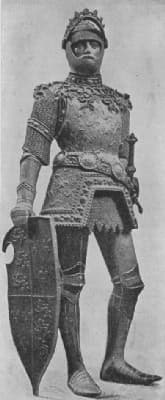
It is in the great hall of Camelot, at nightfall, that Merlin finds the king he has guided since his birth at Tintagel. The torches dance their light on the bare wood of the Round Table, still warm from the knights' meal. The old counselor knows Arthur better than anyone — he held the child before he held the sword. Tonight, he comes to make him speak not of the king who is acclaimed, but of the man behind the legend.
—Arthur, I was there when you had this table made without head or foot. Why did you want it round?
You remember, Merlin, the quarrels that tore my court apart: every baron demanded the seat of honor, the first after mine, and blood was shed for a chair. I understood that a table with a top and bottom bred pride even before the first course. So I wanted it round, so that none could say they sit above another. The bravest and the newest arrival eat at the same height, and are measured only by their deeds. That day I forged not a piece of furniture, but a brotherhood. My knights no longer serve a throne: they serve a common oath.
That day I forged not a piece of furniture, but a brotherhood.
—You who led me to the lake's shore, tell me: what did you feel when that hand rising from the water handed you Excalibur?
Awe more than joy, my old master. When the Lady of the Lake raised the blade above the dark waters, I knew that this gift was not mine, but a trust. An ordinary sword kills; this one makes a king, and a king can make a whole people live or perish. You had warned me that iron does not give the right to rule, that it only seals it in the eyes of men. I took it trembling, and every time I draw it, I feel its weight: it does not belong to me, I belong to it. The day I prove unworthy, the water will take it back.
An ordinary sword kills; this one makes a king.
—Many still whisper that your father was not king and that your blood did not designate you. Did you ever feel the crown legitimate?
Blood alone would never have sufficed, and I know that better than anyone. Others had more illustrious ancestors and larger armies. What made me king was the sword pulled from the stone before all, and the blade given by the waters — signs that men could neither buy nor fake. The crown weighs on my brow, but it is the marvelous that holds it in place. Yet I do not rely on wonders alone: a sign is quickly disproven if the king proves unjust. I earn my legitimacy every morning, in court as in battle. The wonder opened the door; it is up to me to deserve to stay.
The wonder opened the door; it is up to me to deserve to stay.
—Before the crown, I saw you as a battle leader against the Saxons. How did you hold on at Badon, when all seemed lost?
At Badon, I was not yet the king they sing of: I was the one leading the charge, the leader of the British wars. The kings of our island were too jealous to fight together, and the Saxon invader advanced on their quarrels. I gathered them under one banner, not by my title, but because they finally feared the Saxons more than each other. That day, I bore on my shoulders the sign of Our Lord, and the Britons won. I did not win by genius: I won because I knew how to turn a handful of rival lords into a single fist. War taught me unity before peace taught it to me at the Table.
—Between us, Arthur: do you feel more like the king of stories or the simple war leader I knew in the mud of the camps?
You touch where the skin is thin, Merlin. The bards already make me greater than I am; they forget the sleepless nights, the festering wounds, the men I saw die without being able to save them. Deep down, I remain that dux bellorum, that battle leader you picked up exhausted after the fight. The king is the garment; the war leader is the man. But I have understood one thing: a people need the legend as much as the sword. If they must magnify me so that the Britons keep hope, let them do it — as long as I never forget where I come from.
The king is the garment; the war leader is the man.
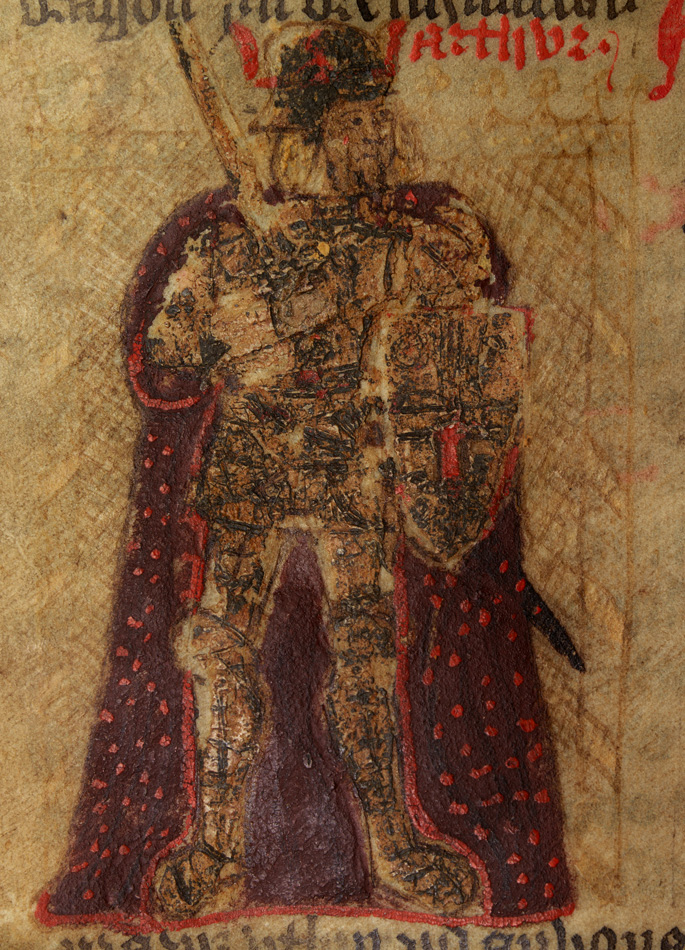
—You sent your best knights on the roads to seek the Grail. Isn't that emptying your court of its bravest?
I feared it, yes, and some reproached me for sending my pillars after a cup that no one has ever seen. But a court that lives only on feasts and tournaments eventually rots from its own splendor. The quest for the Grail is not a war to be won: it is a trial that reveals what a man carries within. The sword proves the courage of the arm; the Grail tests the purity of the heart. I wanted my knights to seek higher than themselves, to serve something other than their glory. Few will return, I know. But those who return will be worth a thousand ordinary fighters, for they will have learned humility — the only virtue my throne cannot give.
The sword proves the courage of the arm; the Grail tests the purity of the heart.
—You demand of your knights honor, loyalty, protection of the weak. Isn't that an impossible burden you place on their shoulders?
Impossible, perhaps, and that is why it must be demanded. If I asked only for the possible, my men would be merely well-paid soldiers, quick to switch sides at the first richer lord. By imposing an ideal that none fully attains, I give them something to pursue all their lives. The weak one protects will never pay in gold; the oath kept in the shadows, no one will see. That is where the true knight is measured: in what he does when nothing compels him. I prefer a court of men who fail to be perfect than a troop satisfied with mediocrity.
—I fear for you, my king. Mordred grows in the shadow of your throne. What would you do if your own rose against you?
That fear, Merlin, I carry too, even if I speak of it to no one but you tonight. The Saxons I know how to face: they come from outside, sword in hand, and I see them coming. But betrayal is born within, at my own table, among those who share my bread. That is my greatest fear: that this kingdom I united will be torn apart by my own, not by the enemy. If one of my own raises the sword against me, then all we have built, you and I, will topple like the table on a quarrelsome night. A king can defeat an army; he rarely survives his own.
A king can defeat an army; he rarely survives his own.
—And if that fateful day came — the wound too many — where would you want to be carried, you who do not fear death?
To the waters, from where everything came. If I fall, let me not be shut under cold stone like an ordinary king. Let me be taken to the island beyond the mists, Avalon, where the wise women might still heal my wounds — or soothe them, if none can. I do not know if I will die there or sleep there, waiting for my people to need me again. You taught me, Merlin, that nothing truly ends in our world, that everything returns as the wheel turns. So I want to believe that my end will be but a sleep, and that Excalibur, returned to the waters, will wait for another worthy hand.
—One last thing, Arthur. Of all you have built, what would you like to be remembered when neither you nor I are here?
Not my battles, nor even Excalibur, Merlin. Swords rust and victories are forgotten. What I would like to be kept is the idea of this table where no one is greater than another, where power serves instead of crushing. I have seen too many kings who reigned only for themselves; I wanted to reign for what transcends us — justice, harmony among men who were opposed in everything. If one day something must be said of Arthur, let it not be that he was strong, but that he tried to be just. The rest, the marvelous and the glory, I leave to the storytellers. For me, it is enough to have kept the oath.
Let it not be said that Arthur was strong, but that he tried to be just.
Read further
This imaginary interview was generated by artificial intelligence from sources documented in King Arthur's profile. It dramatises what the figure might have said based on what we know about them, but does not constitute attested historical testimony. For primary sources and factual documentation, refer to the full profile.