Imaginary interview with King Arthur
by Charactorium · King Arthur · Mythology · 6 min read
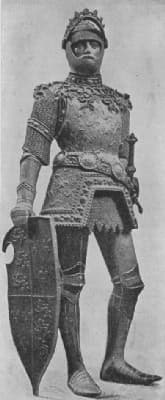
Camelot, at the hour when the torches in the great hall cast their last glimmers upon the deserted Round Table. The king has remained alone, his heavy sword laid across his knees, his gaze turned toward the door through which his knights will return — or will not return. He agrees to speak, in a low voice, as one confides an oath.
—They call you king, but others simply name you war leader. Who are you really?
Before the crown, there was the fray. When Rome's legions had withdrawn from the island, it lay bare, offered to the Saxons who landed in whole bands. I was then only the one called to lead the British kings when the battle grew too heavy for one alone. At Badon, I bore the sign of our Lord on my shoulders and the invaders receded like a tide. Today they call me dux bellorum, the leader in battles, and that is truer than any crown. Kingship I received afterwards, almost as an afterthought, because a frightened people wants a face to follow. But in my memory, I remain first that mud-covered man who held the line when all else fled.
Before the crown, there was the fray.
—Tell us about your sword. How did you obtain it?
Excalibur was not forged by human hand. One misty morning, I saw rise from the middle of the lake an arm clothed in white silk, holding the blade straight toward the sky — the Lady of the Lake was offering it to me from the fairy realm, that world neighboring ours to which the isle of Avalon also leads. I understood that day that I bore not an ordinary weapon but a pledge. A sword given to you thus is not yours: it designates you. As long as it shines at my side, none can say that I rule by force or by spilled blood — I rule because the deep waters willed it. And the day I must return it, I already know to whom: it will be cast back where it was born.
A sword given to you thus is not yours: it designates you.
—What does this blade represent for those who follow you?
A king without a visible sign is but a man who shouts louder than others. When I raise Excalibur in council, my barons do not see the metal; they see the promise made to me at the water's edge. Tradition says this blade cannot be broken and that he who bears it cannot shed blood for an unjust cause — that is why I never draw it lightly. It hangs at my belt when I dispense justice in the great hall of Camelot, near the Round Table, and its mere presence silences quarrels. The marvelous, you see, is not an ornament: it is that part of the world which reminds the powerful that they hold their power only from a hand higher than their own.
—Why did you want a round table, rather than a throne that sets you apart?
Because a long table kills more surely than a sword. At every feast, the lords tore each other apart to see who would sit near the head and who would rot at the far end — and from these precedence disputes were born grudges, then wars. I had a table carved without head or foot, where the first is equal to the last and the last to the first. The clerk Wace wrote it for posterity, in his Roman de Brut, around 1155: none can boast of being better placed than his neighbor. I was told this idea was bold, almost dangerous, in a world where everyone knows their rank from birth. Perhaps. But I wanted brothers in arms, not a court of courtiers watching for my favor. The circle is my only written law.
A long table kills more surely than a sword.
—Do your knights obey you out of fear or something else?
Neither out of fear nor calculation — by oath. He who takes his place at my circle swears to protect the weak, keep his word, and never flee a just cause. These are not words thrown to the wind: it is chivalry, and it weighs heavier than any chains. I do not ask a man to love me; I ask him to keep his oath even when I do not see him, even deep in a forest where no one will know if he faltered. That is why I send them on quests, alone, down paths I know not: a knight's worth is not measured before my eyes at Camelot, but where he believes he has only God as witness. A king followed out of fear is already half overthrown.
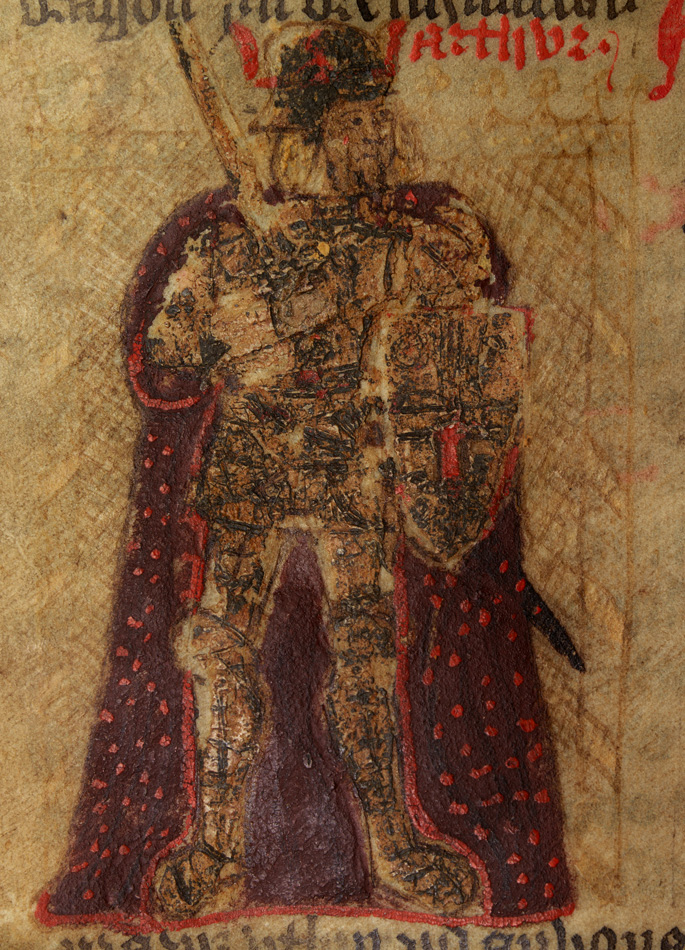
—You sent your best men in search of the Grail. What did you truly hope to find?
The Grail is not a treasure to be brought back in a chest. It is the sacred cup, and to seek it is to seek oneself before heaven. I saw my knights, my bravest, leave one by one for that adventure which is not of the sort won by the sword. Some will never return, and I knew that when I let them go. Why then send them? Because a kingdom that feeds only on battles rots from within. The quest raises my men above plunder and glory; it teaches them that there exists an honor that no hand can seize. If Camelot is to leave a trace in the memory of men, I want it to be this: a court that dared to seek higher than itself.
To seek the Grail is to seek oneself before heaven.
—This quest divided your Round Table as much as it ennobled it. Do you regret it?
One does not regret having shown the sky to men, even if some lost themselves there. Yes, the quest for the Grail emptied my great hall: seats remained cold, friendships unraveled on the roads. But I prefer a half-empty table of men gone toward the sacred than a full table of satisfied bellies. Chivalry without aspiration is but well-dressed butchery. I wanted my companions to know that courage is not only holding a line against the Saxons, but facing that part of themselves that recoils from purity. Some returned transformed, their faces lit by a light I do not possess myself. For that single look brought back, I would have emptied Camelot ten times.
—Let us come to the darkest day. What happened at Camlann?
Camlann was the wound of a whole world, not just mine. Evil did not come from outside, from the invaders I had held at bay all my life — it rose from my own blood. Mordred raised against me the banners I myself had gathered, and we clashed on a plain I still see, strewn with those who had sworn loyalty to the same circle. In the end, there were no longer Britons or traitors, only dead lying side by side. I struck down Mordred and he struck me as he fell. That day, it was not a king who perished: it was a dream of equality that men had carried too high for their own strength. Every great kingdom, I learned in the mud of Camlann, carries within it the seed of its fall.
Evil did not come from outside: it rose from my own blood.
—And after the battle? They say you did not die like other kings.
My wounds were deep, yet I was not laid in a stone tomb. I was carried to Avalon, the isle of fairies beyond the waters, the very place from which Excalibur had come — for what comes from the depths returns there. There, tradition says, my wounds are to be healed far from the sight of the living. So I did not die as men die: I rest, waiting. Whether men believe I sleep or keep watch matters little — the essential is that they never quite bury the hope I embodied. Later, monks will claim to have found my bones and a cross bearing my name; let them talk. One does not nail a legend into a lead coffin. As long as a people needs a king who will return, that king does not die.
One does not nail a legend into a lead coffin.
—If people still spoke of you in a thousand years, what would you want them to remember?
I do not know what the centuries will make of my name — perhaps a storyteller, in a hundred years, will embroider adventures I never lived, and so much the better if they inspire brave hearts. Let them imagine me born at Tintagel on its windswept cliff, let them credit me with a thousand battles, I see no offense. But if only one thing is to be kept, let it be the circle. Not the sword, not the crown, not even the quest for the Grail: the headless table where different men sat as brothers. Kingdoms fall, Camlann taught me that well. Kings fade. But the idea that one can govern by shared honor rather than fear — if that survives in a single memory, then I will not have reigned in vain.
If only one thing is to be kept, let it be the circle.
Read further
This imaginary interview was generated by artificial intelligence from sources documented in King Arthur's profile. It dramatises what the figure might have said based on what we know about them, but does not constitute attested historical testimony. For primary sources and factual documentation, refer to the full profile.