Kids interview Léopold Sédar Senghor
by Charactorium · Léopold Sédar Senghor (1906 — 2001) · Literature · Politics · 5 min read
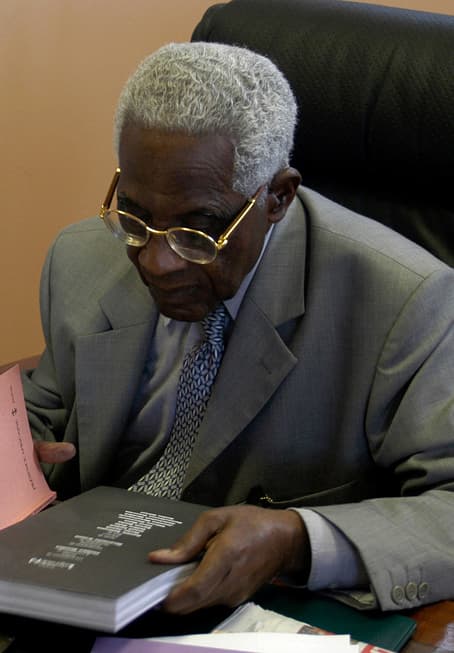
That morning, two young visitors on a school trip pushed open the door of an elegant old gentleman. He had laid down his fountain pen on a notebook covered in verses. He smiled, touched that anyone still took an interest in him, and invited them to sit down.
—How old were you when you passed that super hard exam?
I was 29, it was in 1935. The exam was called the agrégation in grammar — imagine the toughest test in all of France to become a teacher. When they told me I had passed, I was the very first African to do so. You know, my child, I was born in Joal, a small fishing port in Senegal. And there I was, years later, teaching in high schools in Paris. It was like opening a door that no one before me had dared to push. That day I carried a heavy pride: behind me, there were all the children of Africa who were told 'you won't make it'.
I pushed open a door that no one before me had dared to push.
—Is it true you were a prisoner during the war?
Yes, and I was scared, I won't lie to you. In 1940, German soldiers captured me. They locked me in a camp called a stalag, a kind of big prison of planks and barbed wire. One day, they wanted to release me before my African comrades. I refused. Imagine: leaving alone, leaving behind bars those who had fought by my side. I couldn't. So I stayed, and in the evening, on little scraps of paper, I wrote poems to hold on. Later, I dedicated an entire book, Hosties noires, to those African soldiers, the Senegalese tirailleurs, who died for France and were too quickly forgotten.
I couldn't leave alone, leaving my comrades behind the barbed wire.
—What exactly is Négritude? It sounds like a weird word.
You're right, it's a word we invented on purpose! Around 1928, I arrived in Paris, in the Latin Quarter, full of cafés and libraries. There I met two friends, Aimé Césaire and Léon Damas. At the time, many people said that Black cultures were worthless. That made us angry. So we forged this word, Négritude: a way to say, proudly, 'being Black is a wealth, a beauty, a dignity.' Imagine three students, in the evening, deciding to turn an insult into a flag. It wasn't hatred of others. It was finally standing tall.
We took an insult and turned it into a flag.
—Did some people disagree with your ideas?
Of course! And that's good, ideas must clash. A writer from Nigeria, Wole Soyinka, made fun of us a bit. He jokingly said that a tiger doesn't proclaim its 'tigritude': it pounces, it acts, it doesn't make speeches about itself. That was his way of telling us: 'stop talking so much about your pride, live it.' It made me think, I admit. I replied that to act, you first need to know who you are. You know, my child, being contradicted by a brilliant mind is not a defeat. It's a gift: it forces you to think better.
Being contradicted by a brilliant mind is not a defeat, it's a gift.
—Is it true you wanted your poems to be read with music?
Absolutely! For me, a poem without music is like a bird without wings. I often wrote in my books which instrument should accompany my verses. Most often, it was the kora: imagine a large round gourd covered with skin, with twenty-one strings plucked with the fingers. Its song is soft, like warm rain. In my time, in Africa, poets didn't read in silence: they sang, carried by the strings. In my collection Éthiopiques, a poem even tells the story of Chaka, a great warrior chief. I dreamed that people would listen to it, not just read it with their eyes.
A poem without music is a bird without wings.

—What did you write about? About whom, sometimes?
About the Africa of my childhood, and about its beauty. My very first book was called Chants d'ombre, in 1945. In it, there is a poem that many know, 'Femme noire'. It begins: 'Naked woman, black woman, clothed in your color which is life, in your form which is beauty.' You see, I wanted to celebrate what others despised. I always wrote with a pen, slowly, in the morning, in peace. For me, tracing each letter by hand was already a way of thinking, almost praying. Words came like picking fruit: unhurriedly, one by one.
I wanted to celebrate what others despised.
—What was it like on the day your country became free?
Unforgettable. It was June 20, 1960. Senegal became independent: it no longer depended on France, it governed itself. I was elected first president. That day, I did something that was close to my heart: I spoke in French, but also in Wolof, the language of our home. Imagine the square full of people, thousands of faces, and suddenly two languages answering each other. I wanted to show that you could be proud of your African language without giving up French. The two could walk together, hand in hand. That was my deepest dream, and that day, it came true.
Two languages answering each other, proud, and walking hand in hand.
—Did you leave power all by yourself? No one forced you?
No one. And it's one of the decisions I'm most proud of. In 1980, I decided to leave the presidency on my own, calmly, making way for someone else, Abdou Diouf. You know, at that time, in Africa, many leaders clung to power until their last breath. I found that dangerous. Power is like a warm chair: you always want to stay in it. But a good leader must know how to get up and leave before being pushed. I had governed for twenty years, I had faced difficult crises. It was time to become, simply, a poet again.
A good leader must know how to get up and leave before being pushed.

—Why did you sometimes wear a big African robe and sometimes a suit?
Ah, you noticed! It was intentional, this little game of clothes. For big celebrations in Senegal, I wore the boubou, a long, loose, embroidered tunic that floats when you walk. But to enter the Académie française or meet diplomats, I wore a dark suit. You know, my child, I didn't choose between Africa and Europe. I belonged to both. I called it cultural blending: mixing two heritages without damaging either, like blending two colors to make a more beautiful one. My boubou and my suit told the same truth: you can have two homes in one heart.
You can have two homes in one heart.
—You entered the Académie française? What exactly is that?
The Académie française is a very old assembly, three centuries old, that brings together forty people chosen for their love of the language. They are sometimes called 'the Immortals'. In 1983, I became the first African to enter! I was given seat number 16. Imagine a little boy from Joal, born in a fishing port on the Atlantic, who one day finds himself among these great names of the French language. I almost trembled. For me, it wasn't a personal reward. It was an open door: proof that a child from Africa could sit there, as if at home.
A child from a fishing port could sit among the Immortals, as if at home.
—If we could spend a day at your house, what would it be like?
Come, I'll show you. I got up early, before the noise. The morning was sacred: a moment of reflection, then writing, with a pen, in silence. On my walls, you would have seen masks and African sculptures that I loved to collect. At the table, my favorite dish was thiéboudiène, a fragrant fish rice, the dish of Senegal. In the evening, often, there was music, sometimes the kora. You know, my child, I spent my old age between two places: Joal, my village of sun, and Verson, in Normandy, under the gentle rain. I died there in 2001, at 95, my heart still divided between two lands.
The morning was sacred: silence, the pen, and words that come.
This imaginary interview was generated by artificial intelligence from sources documented in Léopold Sédar Senghor's profile. It dramatises what the figure might have said based on what we know about them, but does not constitute attested historical testimony. For primary sources and factual documentation, refer to the full profile.