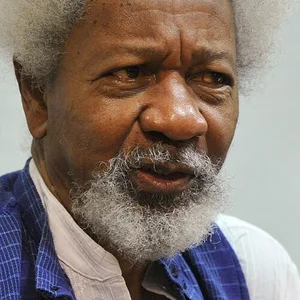

Wole Soyinka is a Nigerian writer, playwright, and poet born in 1934. The first African author to receive the Nobel Prize in Literature in 1986, he is a major figure in the defense of human rights and freedom in Africa.
Wole Soyinka(1934 — ?)
Wole Soyinka
Nigeria
5 min read
Frequently asked questions
Famous Quotes
« A tiger does not proclaim his tigritude, he pounces.»
Key Facts
- Born on July 13, 1934, in Abeokuta, Nigeria
- Imprisoned from 1967 to 1969 during the Biafran War for his outspoken stances
- First African writer to receive the Nobel Prize in Literature, in 1986
- Author of major plays such as A Dance of the Forests (1960) and Death and the King's Horseman (1975)
- Forced into exile in the 1990s under the dictatorship of Sani Abacha
Works & Achievements
Play created for Nigeria's independence, which refuses to idealize the past and warns the young nation.
Satirical comedy about the clash between village tradition and modernity, among his most frequently performed plays.
Prison notes written during his detention, a manifesto against silence in the face of tyranny.
Drama based on a true event and Yoruba cosmology, considered his theatrical masterpiece.
Acclaimed autobiographical account of his childhood, blending tenderness, humor, and a look at colonial society.
First Nobel literary prize awarded to an African writer, honoring his entire body of work.
Anecdotes
During the Biafran War, Wole Soyinka was imprisoned from 1967 to 1969, much of it in solitary confinement. Deprived of paper, he wrote poems between the lines of the few books he was allowed and on scraps of toilet paper. These texts would become the book *The Man Died* (1972).
In October 1965, Soyinka allegedly burst into a studio of the Western Nigerian regional radio station and, at gunpoint, had a politician's victory speech replaced with a message denouncing rigged elections. Tried for the act, he was ultimately acquitted.
In 1986, he became the very first African writer to receive the Nobel Prize in Literature. He dedicated his Nobel lecture to **Nelson Mandela**, then still imprisoned in South Africa under the apartheid regime.
A famous critic of the Négritude movement, Soyinka is said to have coined the line that became renowned: “A tiger does not proclaim its tigritude, it pounces on its prey.” A way of saying that identity is proven through actions rather than slogans.
Under the dictatorship of General **Sani Abacha**, threatened with death, Soyinka fled Nigeria in **1994**, slipping clandestinely across a border. In **1997**, the regime sentenced him to death in absentia; he would not return to the country until after Abacha's death in **1998**.
Primary Sources
“The man dies in all who keep silent in the face of tyranny.”
Soyinka dedicates his speech to Nelson Mandela and denounces the South African apartheid system as a disgrace to humanity.
An autobiographical account in which Soyinka recounts his childhood in Abeokuta, between the family's Christian home, school, and the world of Yoruba traditions.
In his preface, Soyinka warns that the play should not be reduced to a mere “clash of cultures,” but understood through the Yoruba worldview and the notion of duty.
Key Places
Town in western Nigeria where Soyinka was born in 1934 and where he spent the childhood recounted in 'Aké'.
Where he pursued his higher education in Nigeria, later an important intellectual and theatrical hub of his career.
Where Soyinka studied English literature in the late 1950s before returning to Nigeria.
London theatre where Soyinka worked as a play reader, a formative period in his career as a playwright.
Where he was held, often in solitary confinement, during the Biafran War between 1967 and 1969.
Typical Objects

The working tool of the 20th-century writer, on which Soyinka composes his plays, poems and essays. A symbol of the committed author's craft.

Scraps of paper and the margins of books on which Soyinka secretly wrote during his solitary confinement. A testament to resistance through writing.

A ritual mask inspired by Yoruba traditions, used in the theatre Soyinka directs. It connects live performance with African spiritual heritage.

An honour received in 1986, making him the first African laureate in literature. It symbolizes the worldwide recognition of African letters.

Printed volumes gathering his dramas, such as 'Death and the King's Horseman'. They spread his vision blending Yoruba culture with political critique.
School Curriculum
Vocabulary & Tags
Key Vocabulary
Daily Life
Morning
A writer and professor, Soyinka often begins his days early, reading and writing in quiet. The morning is devoted to creating plays, poems, or essays, sometimes interrupted by his university lectures.
Afternoon
The afternoon blends teaching, theatre troupe meetings, and rehearsals. A tireless activist, he also takes part in public debates and gatherings in support of human rights.
Evening
His evenings may be filled with theatrical performances, public readings, or writing. A sociable man, he also enjoys conversations among friends, artists, and intellectuals.
Food
His diet reflects West African and Yoruba cuisine: dishes made from yam, cassava, and rice, along with spicy stews and soups. During his imprisonment, by contrast, he experienced hunger and very meager rations.
Clothing
Soyinka wears both Western clothing and loose, colorful traditional African attire. With age, his famous white hair and beard became a true signature.
Housing
Over the course of his life, he lived in university housing in Nigeria, abroad during his exiles, and in a house near Abeokuta. Prison confined him to a narrow cell for nearly two years.
Historical Timeline
Period Vocabulary
Liens externes & ressources
Références
Œuvres
A Dance of the Forests (Une danse des forêts)
1960
The Lion and the Jewel (Le Lion et la Perle)
1963
The Man Died (L'Homme est mort)
1972
Death and the King's Horseman (La Mort et l'Écuyer du roi)
1975
Aké: The Years of Childhood (Aké, les années d'enfance)
1981
Prix Nobel de littérature
1986