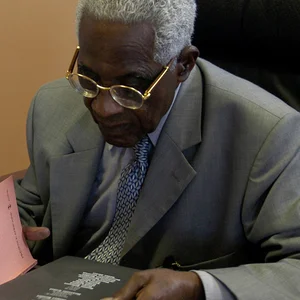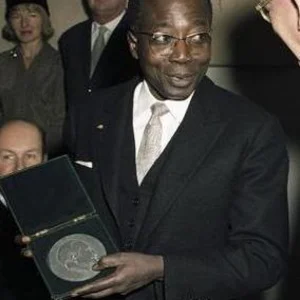

Senegalese poet, writer, and statesman (1906–2001), Senghor was the first president of independent Senegal. A leading theorist of the Négritude movement, he championed a humanist vision of African culture and left a lasting mark on twentieth-century Francophone literature.
Léopold Sédar Senghor(1906 — 2001)
Léopold Sédar Senghor
France, Sénégal
8 min read
Frequently asked questions
Famous Quotes
« I think, therefore I am. I feel, therefore I exist.»
« Négritude is the simple recognition of the fact of being Black, and the acceptance of that fact, of our destiny as Black people, of our history and our culture.»
« Africa is the cradle of humanity.»
Key Facts
- 1928–1956: Studies in France and involvement in the Négritude movement alongside Aimé Césaire
- 1945–1960: Member of the French National Assembly representing Senegal, participating in independence negotiations
- 1960: Became the first president of independent Senegal, governing until 1980
- 1978: Elected to the Académie française, the first African figure to receive this distinction
- 1984: Publication of his memoir 'Ce que je crois'
Works & Achievements
Senghor's first poetry collection, exploring exile, nostalgia for Africa, and the beauty of Serer culture. It establishes the aesthetic and thematic foundations of his entire poetic work.
A collection dedicated to African soldiers who died for France, blending funeral tribute with a denunciation of colonialism. It is one of the most moving works on the condition of the Senegalese tirailleurs.
A foundational anthology compiled by Senghor, prefaced by Jean-Paul Sartre under the title 'Black Orpheus'. It established Négritude as a literary and political movement recognized on a global scale.
A collection considered the pinnacle of Senghor's poetic art, combining African rhythms, biblical imagery, and surrealist inspiration. The poem 'Chaka' reinterprets the history of the Zulu chief.
The first volume of his political and cultural essays, which theorizes Négritude as Africa's contribution to universal civilization. A key reference work for understanding his philosophical thought.
The founding document of the Republic of Senegal, drafted under Senghor's direct impetus, which enshrined the principles of democracy, secularism, and national unity in the fundamental law.
Senghor's last major poetry collection, published just before his political retirement, marked by a testamentary tone and a meditation on death, memory, and the universal.
Anecdotes
In 1935, Senghor passed the agrégation in grammar, becoming the first African to obtain this qualification from a French university. This exceptional achievement opened the doors of teaching in mainland France, where he taught in Parisian secondary schools before the war.
During the Second World War, Senghor was taken prisoner by the Germans in 1940. Held in a prisoner-of-war camp, he continued to write poems and refused to be released before his African comrades, out of solidarity with them.
In 1960, upon the proclamation of Senegal's independence, Senghor delivered a speech in Wolof and in French, a powerful symbolic gesture that illustrated his conviction that African languages and the French language could coexist and enrich one another.
In 1983, Senghor was elected to the Académie française, the first African to join this institution three centuries old. He occupied seat number 16 and was received by Marguerite Yourcenar, another great figure of the Francophone world.
Senghor was a passionate amateur musician and insisted that his poems be read with African musical accompaniment, particularly the kora or the balafon. He himself specified the instruments to be used in his collections, considering that poetry could not be separated from music.
Primary Sources
Naked woman, black woman / Clothed in your colour that is life, in your form that is beauty / I grew up in your shadow; the softness of your hands bandaged my eyes.
Negritude is the sum of the cultural values of the Black world, as they are expressed in the life, institutions and works of Black people. It is not a racism; it is an awakening of consciousness, a solidarity.
Our vocation is to revive the values of Negritude, to integrate them into the current of human universalism. It is not a withdrawal into oneself; it is a contribution to the civilization of the Universal.
We had dreamed together, you and I, of a new poetry that would be our own: rooted in the black earth, open to the four winds of the spirit.
Senegal is free and independent. But independence is not an end in itself; it is the means to build together, in dignity and fraternity, a modern nation.
Key Places
Senghor's birthplace on the Senegalese Petite Côte, the site of his Serer childhood that he celebrated abundantly in his poetry. Joal remains today a place of remembrance and literary pilgrimage.
The site of Senghor's intellectual formation in the 1930s, where he attended the Sorbonne and met Aimé Césaire to found the Négritude movement. The cafés and libraries of the Latin Quarter were the cradle of his earliest ideas.
The seat of the Senegalese presidency, where Senghor governed from 1960 to 1980. It was from this palace that he led one of the most stable states in post-colonial Africa.
The Norman town where Senghor spent his final years and died on 20 December 2001. His residence in Normandy illustrated the European dimension of his life and multiple identity.
Founded during Senghor's presidency, this university was a cornerstone of his project for African intellectual development. It now bears the name of Cheikh Anta Diop University.
Typical Objects

Senghor composed all his poems and essays with a pen, attaching paramount importance to the physical act of writing as meditation. His fountain pen was his daily working instrument, used for both poetry and state speeches.

A traditional Mandingue musical instrument with 21 strings, the kora accompanied the recitation of Senghor's poems during public performances. He himself indicated in his collections that his poems should be read to the sound of the kora.

A loose, colourful traditional garment worn notably during African official ceremonies. Senghor alternated between Western dress for diplomatic meetings and the boubou to assert his African cultural identity.

France's supreme decoration, which Senghor received in recognition of his contributions to literature and politics. It symbolised the fertile ambivalence of his identity, caught between French heritage and African pride.

A work he compiled and published in 1948, which became an essential reference in Francophone African literature. This book had a place on his desk and in his personal library as a cornerstone of his cultural struggle.

Senghor collected masks and sculptures from West Africa, which he displayed in his offices in Dakar and in France. These works illustrated his conviction that African art was a civilisation in its own right.
School Curriculum
Vocabulary & Tags
Key Vocabulary
Daily Life
Morning
Senghor rose early and devoted the first hours of the morning to reading and poetic writing, before political obligations took over. He liked to write in quiet surroundings, often with a pen in handwritten notebooks. In Dakar, his day generally began with a prayer or a moment of contemplation, true to his Catholic faith.
Afternoon
Afternoons were dominated by official audiences, ministerial meetings, and diplomatic negotiations at the Palace of the Republic. Senghor also set aside time to revise his speeches, which he drafted himself with great stylistic care. He regularly received African and European intellectuals, writers, and artists.
Evening
Senghor's evenings were often cultural: he attended concerts, African dance or theater performances, or hosted dinners bringing together intellectuals and diplomats. He read extensively in the evenings — poetry, philosophy, linguistics — and sometimes composed verses late into the night. Music, particularly the kora, was frequently present during his personal evenings.
Food
Senghor appreciated traditional Senegalese cuisine, particularly thiéboudiène (fish and rice) and yassa chicken, emblematic national dishes. He also consumed local tropical fruits such as mango, papaya, and guava. During his stays in France, he alternated with French gastronomy, but remained attached to the African flavors of his childhood in Joal.
Clothing
In official African contexts or during national celebrations, Senghor wore the grand boubou in white or embroidered blue, a symbol of dignity and cultural identity. For European diplomatic receptions and sessions at the Académie française, he wore a dark three-piece suit accompanied by his official decorations. This dual attire embodied his vision of an African man who was fully universal.
Housing
In Senegal, Senghor resided at the Palace of the Republic in Dakar, surrounded by tropical gardens overlooking the Atlantic. After his political retirement in 1980, he divided his life between his family home in Joal and his residence in Normandy, in Verson, where he died in 2001. His interiors were decorated with African masks and sculptures, and bookshelves filled with thousands of volumes in French, Latin, and Greek.
Historical Timeline
Period Vocabulary
Visual Style
Un style visuel qui marie l'architecture coloniale de Dakar, les étoffes indigo des boubous sénégalais et la lumière dorée de l'Atlantique, évoquant la rencontre entre modernité et traditions africaines.
Sound Ambience
Une atmosphère sonore mêlant l'Atlantique, les rythmes africains de la kora et du djembe, et le bruissement administratif du Sénégal des premières années d'indépendance.
Liens externes & ressources
Références
Œuvres
Chants d'ombre
1945
Hosties noires
1948
Anthologie de la nouvelle poésie nègre et malgache de langue française
1948
Éthiopiques
1956
Liberté I – Négritude et Humanisme
1964
Constitution du Sénégal
1960
Élégies majeures
1979