Imaginary dialogue between Joseph Meister and Louis Pasteur
by Charactorium · Louis Pasteur (1822 — 1895) · Sciences · 5 min read
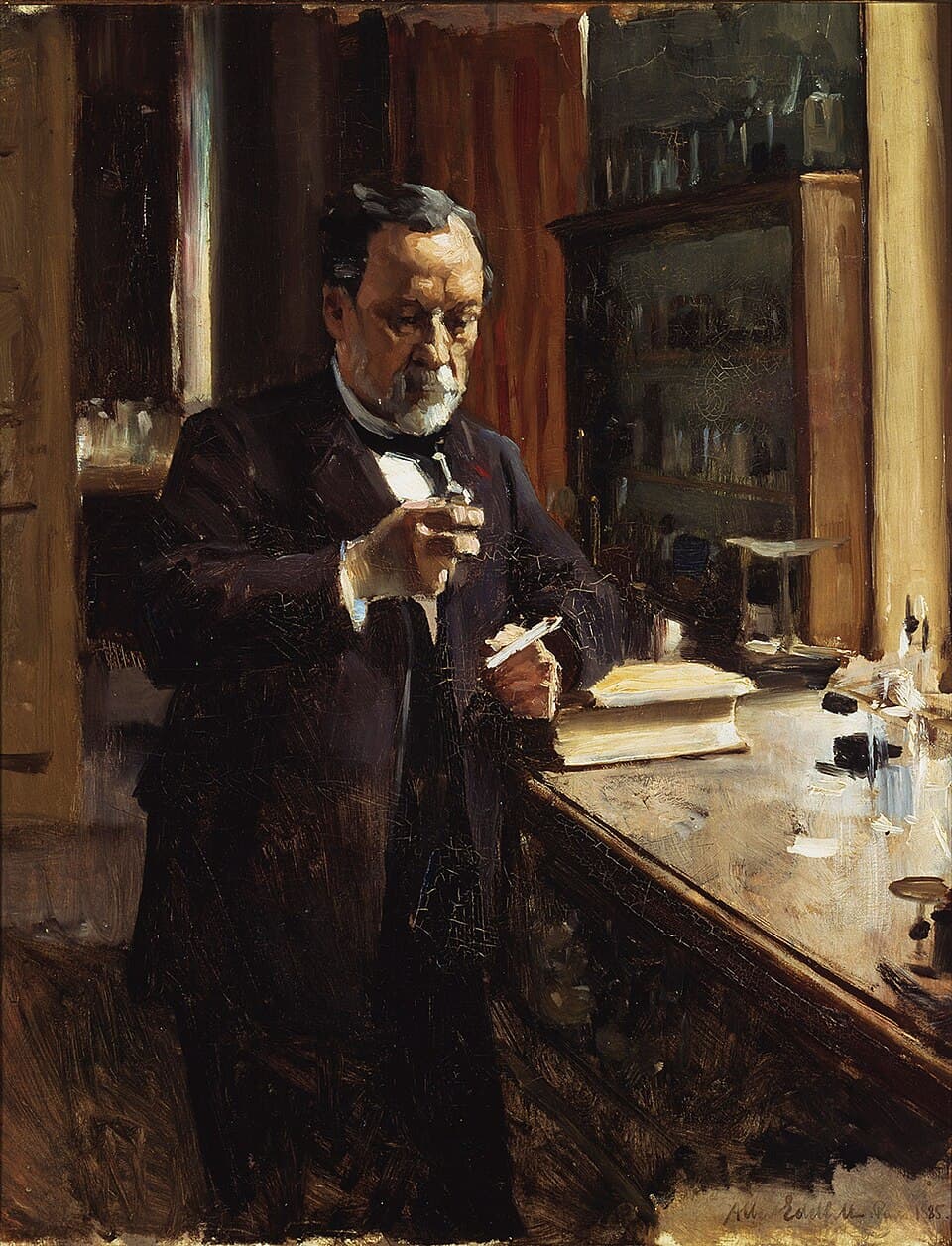
It is in the courtyard of the Institut Pasteur, in Paris, on a spring morning in 1893, that Joseph Meister finds the old master sitting near a window, his left hand resting on his cane. The light plays on the glass vats lined up in the neighboring laboratory, and in the distance one hears the barking of the kennel dogs. Eight years earlier, this scientist saved the nine-year-old boy bitten in fourteen places; today, Joseph works within these walls and watches over the one to whom he owes his life. He approaches, notebook in hand, to make the man behind the legend speak.
—Master, do you remember the day my mother brought me to you, in 1885? You were not a doctor. What did you feel before inoculating me?
How could I forget it, my child? You arrived from Alsace, your leg torn, and I was told you could barely walk. I had tested my method on fifty dogs, never on a human, and now a nine-year-old being was looking at me. I will not hide from you that I spent dreadful nights: with each inoculation stronger than the last, I trembled at bringing you death instead of taking it away. I consulted Vulpian and Grancher; I wanted doctors at my side so as not to bear such a responsibility alone. When, after fifteen days, you were running again in the courtyard, I understood that no joy had ever equaled my anguish.
I trembled at bringing you death instead of taking it away.
—Many have reproached you for trying on me what you had never tried on a human. Did that hurt you?
The reproaches, you see, I expected them. A scientist who touches a child's life exposes himself to all kinds of anger, and some colleagues muttered that I had acted recklessly. But what was I to do? Send you back to die of the most atrocious rabies, when I perhaps held your salvation in my hands? I weighed everything: your wound was sixty hours old, the disease was almost certain, my method had consistently worked on dogs. The duty of a man of science is not to protect himself, but to reach out when he can. Your recovery answered better than any speeches, and it was that which silenced the voices.
—Before saving me, you had fought another battle. Tell me about those swan-neck flasks they talk about in the lab.
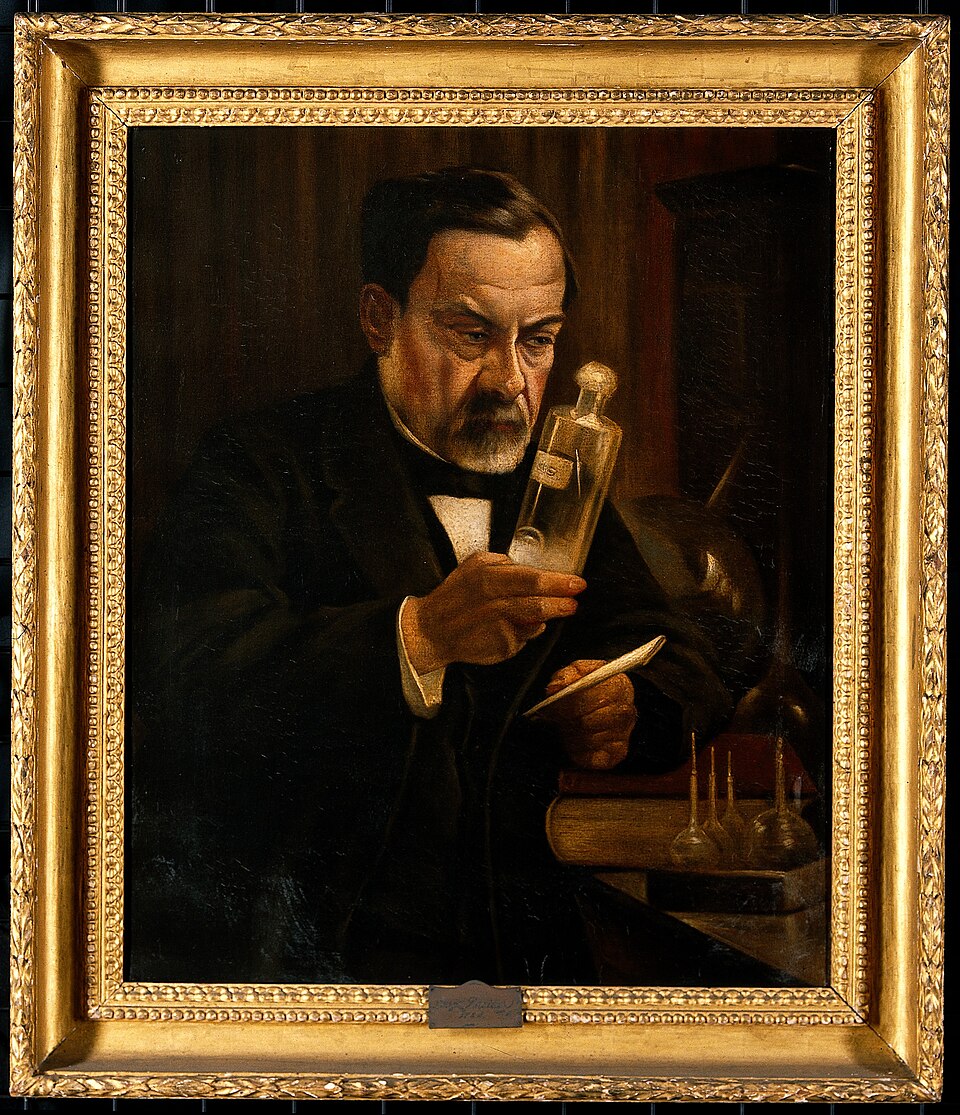
Ah, my dear flasks! That was a battle of my youth, long before your birth. People then taught that life could arise spontaneously from inert matter, that abandoned broth would spontaneously generate living beings. I wanted to put an end to that belief. I had flasks blown with a long swan-neck curve: air entered freely, but dust remained trapped in the curve. The broth stayed clear, without corruption, for months. If I broke the neck or tilted the flask to wet the dust, life would immediately teem. I demonstrated by experiments that I believe irrefutable that inert matter never gives rise to life. A few of those flasks still sleep here, sealed, intact.
Air entered freely, but dust remained trapped in the curve.
—Why did you fight so hard against such an old idea? What was so important about those invisible dust particles?
Because everything depended on it, my boy! If life arose spontaneously, then rot, fermentation, diseases themselves could spring from nothing, and one could neither understand nor prevent them. But by proving that every germ comes from a similar germ, carried by air and dust, I opened a huge door. Fermentations, putrefactions, contagions ceased to be mysteries: they were living beings, microscopic, that could be tracked, destroyed, warded off. Without those flasks, I would never have thought to attenuate a microbe, nor to cure you. Science advances like that: a laboratory truth, which seems a scholarly quarrel, one day becomes a child's salvation.
—In the lab, they still talk about the sheep experiment at Pouilly-le-Fort, in 1881. Were you afraid of public humiliation that day?
Afraid? Let's say I had staked my name before all of France. A skeptical veterinarian, Rossignol, had practically challenged me: I was lent a flock, and I publicly promised to protect the vaccinated animals against anthrax. Twenty-four sheep received my attenuated vaccine, twenty-four others remained controls. On the day of the test, I inoculated all with the most virulent microbe. The press, farmers, scientists flocked. When I was told that the vaccinated sheep were grazing peacefully while the controls lay dead or dying, I admit I savored that triumph. The whole difficulty had been in dosing the attenuation: a microbe weak enough not to kill, alive enough to protect.
A microbe weak enough not to kill, alive enough to protect.
—How did you discover that you could thus weaken a microbe without making it harmless forever?
By a happy accident, as often in science, but a prepared accident. I was studying chicken cholera. A culture of the microbe had been forgotten all summer, exposed to air. When I inoculated it to my chickens, they barely fell ill, then recovered. I was about to throw out these aged cultures when the idea came to test them: those same chickens, re-inoculated with a brand new virulent microbe, resisted admirably! Aging in air had blunted the virulence without abolishing the power to immunize. That was the principle Jenner had glimpsed for smallpox, but which I could now extend and produce at will. From that forgotten chicken was born, step by step, the method that saved you.
—They say the Emperor himself ordered you to study wine. How does a chemist come to look into our bottles?
Because at that time, you see, French wines were turning, souring, and these diseases were ruining our trade. Napoleon III charged me in 1863 to find the cause. Under the microscope, I discovered that each alteration of wine corresponded to a particular ferment, a living being that had come to corrupt it. The challenge was to destroy them without spoiling the drink. I found that by heating the wine between fifty-five and sixty degrees, one killed these ferments without altering its taste or bouquet. Winegrowers were suspicious: heating wine seemed like sacrilege to them! Yet the method prevailed, and today it is applied to beer, vinegar, and even milk. Studying wine fermentation led me straight to the germs of diseases.
—You speak of wine and disease in the same breath. Is there really a link between what spoils a bottle and what strikes a man?
The link is complete, my child, and that is my whole life. What turns wine, leavens dough, rots meat, and what gnaws at a sick person's flesh are microorganisms, invisible living beings. Understanding fermentation was already understanding contagion. The ferment that sours your wine and the microbe that infects a wound obey the same laws: they are born from a similar germ, multiply, and can be fought by heat, cleanliness, attenuation. That is why I constantly move from the brewer's vat to the patient's bedside. Sick wine taught me about sick man.
Sick wine taught me about sick man.
—Master, I who was born in Alsace, now German, know what the defeat of 1870 cost you. Why did you return your diploma to Bonn?
You who come from that wounded land understand me better than anyone. The University of Bonn had once made me an honorary doctor; after France's crushing defeat and the tearing away of Alsace-Lorraine, I could no longer bear that honor without shame. I returned it, refusing henceforth any distinction from Prussia. I was told that science knows no borders — and it is true, science has no homeland. But the scientist, on the other hand, has one, and he owes his country all the brilliance of his work. That this conflict took your native province from us was a wound that no discovery ever healed.
Science has no homeland, but the scientist does.
—Since your stroke in 1868, your left hand has refused all service. How could you continue despite this diminished body?
Ah, this hand... It has hung useless since that day in 1868 when I thought my career was over. I was barely forty-six, and already half my body had betrayed me. But the mind, you see, remained entirely whole. I learned to direct without manipulating myself: I dictate, I observe under the microscope, I command my assistants with a precision that illness has not dulled. Anthrax, chicken cholera, rabies, your vaccine — all of this I conceived after that stroke, infirm of hand but not of will. Paralysis taught me one thing: it is not arms that make science, it is obstinacy. And of obstinacy, heaven gave me enough for ten men.
It is not arms that make science, it is obstinacy.
This imaginary interview was generated by artificial intelligence from sources documented in Louis Pasteur's profile. It dramatises what the figure might have said based on what we know about them, but does not constitute attested historical testimony. For primary sources and factual documentation, refer to the full profile.