Imaginary interview with Louis Pasteur
by Charactorium · Louis Pasteur (1822 — 1895) · Sciences · 5 min read
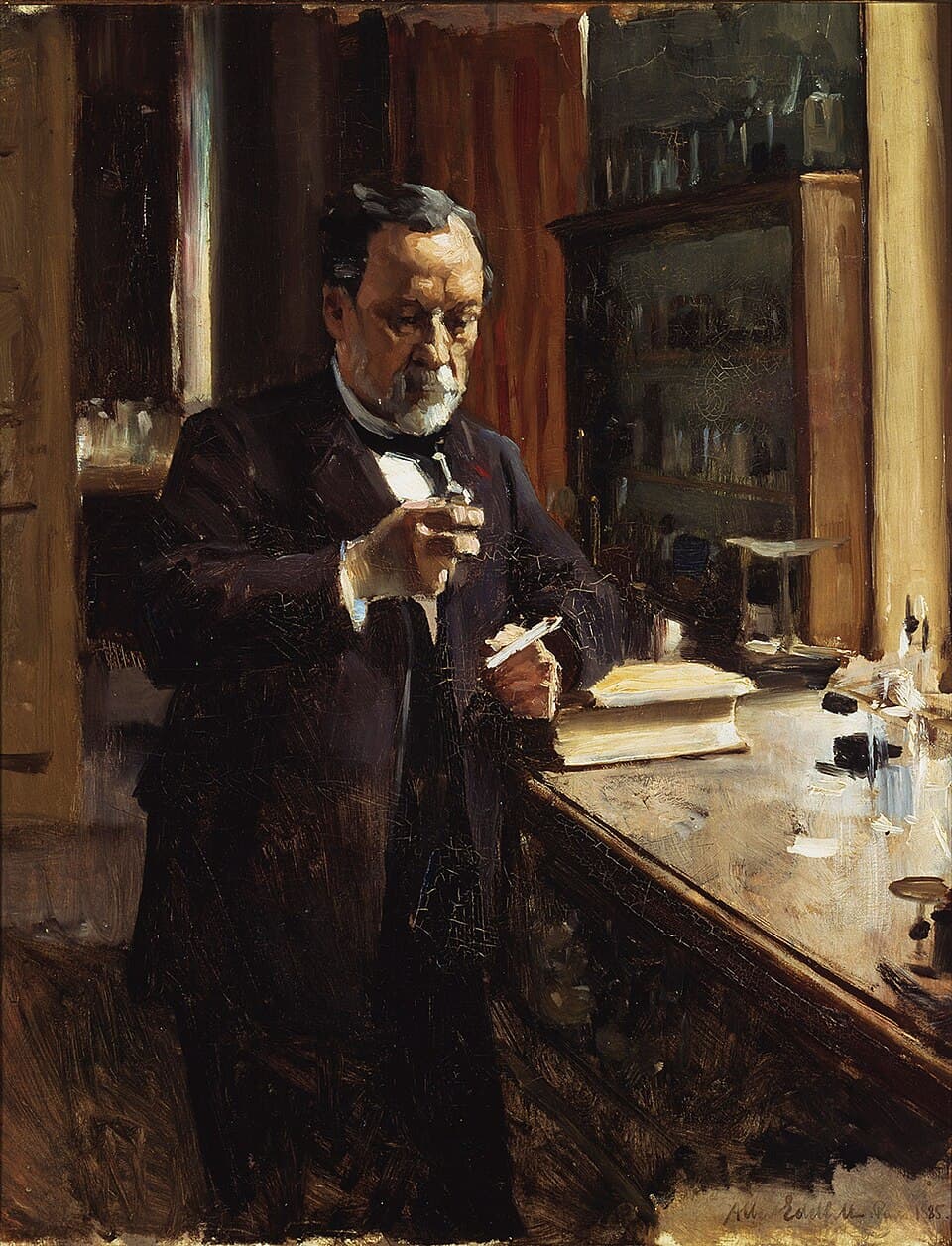
Paris, autumn 1892. In an apartment of the Pasteur Institute still smelling of culture broth, a half-paralyzed old man receives us, his right hand still refusing to shake ours. Behind him, on the shelf, flasks with curved necks stand guard like glass sentinels. He speaks softly, slowly, but his eyes have lost none of their fever.
—How did you come to tackle spontaneous generation, an idea that centuries had taken for granted?
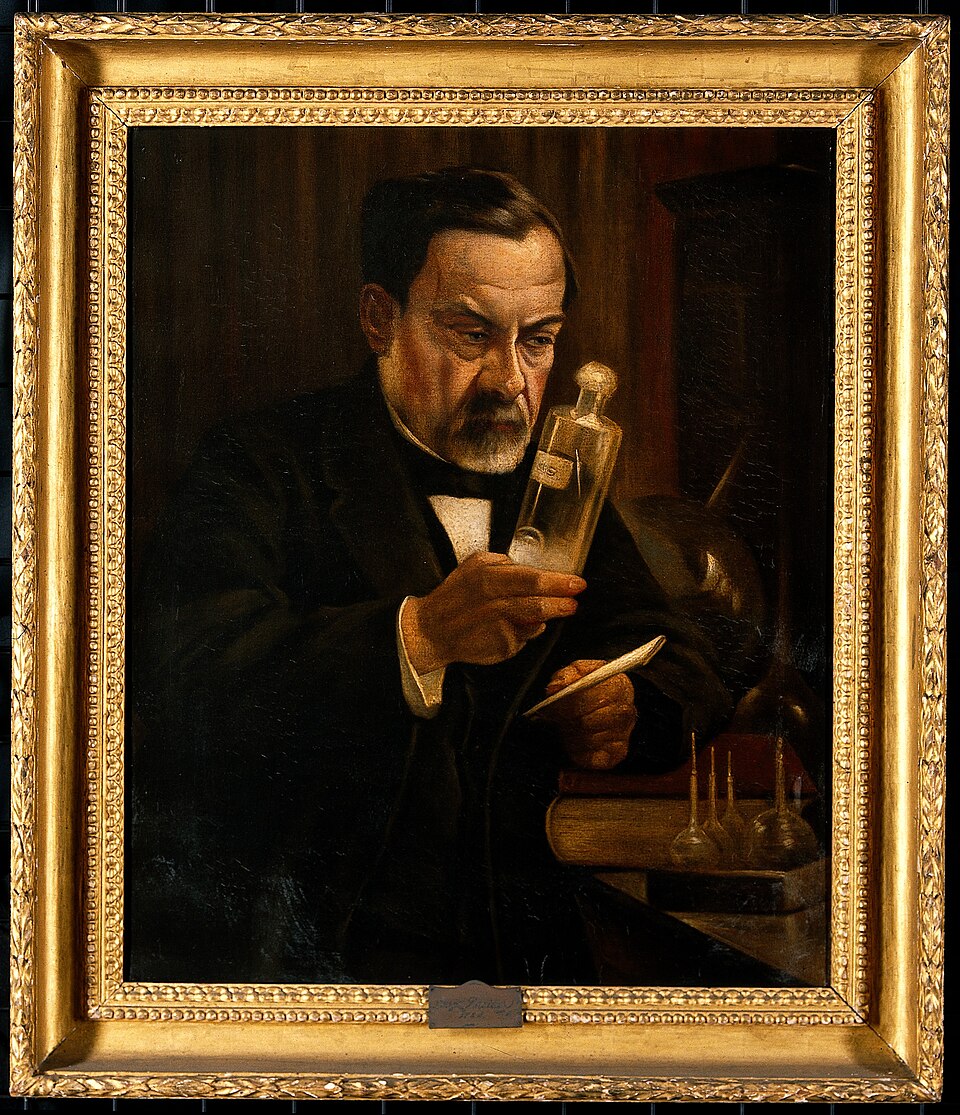
It all started from a tanner's stubbornness, I suppose, inherited from my father in Dole. I was told that a broth left in the air would teem with life on its own, as if inert matter gave birth to life on a whim. That seemed to me a laziness of the mind. So I had these balloons with long curved necks stretched over a flame, my swan-neck flasks: air entered, but its dust remained trapped in the glass bend. The broth remained clear, sterile, for months. Tip the flask, let the dust touch the liquid, and spoilage appears. In 1861, I wrote that I wanted to demonstrate, by irrefutable experiments, that there is no such thing as spontaneous generation. These flasks are still here, sealed, intact. They will outlive me.
Air entered, but its dust remained trapped in the glass bend.
—What did you say to those who saw your demonstration as an attack on ancient beliefs?
I was accused of wanting to kill a beautiful idea. But I kill nothing: I filter. Science does not pronounce by mood; it pronounces by repeated, contradicted, repeated experiment. My opponents swore that under certain conditions life arose from nothing; I simply asked them to show me the flask, the protocol, the reproducible result. None could. At the École Normale, where I had set up my laboratory, I spent my mornings dictating to my assistants what the microscope revealed to me: everywhere corpuscles, germs, never a spontaneous appearance. Spontaneous generation was a long, convenient daydream. I had the pride, perhaps, to prefer an inconvenient truth to a comforting fable.
—You are associated with wine and milk as much as with diseases. How does a chemist end up leaning over barrels?
By order of the Emperor, in truth. In 1863, Napoleon III was worried about French wines turning to vinegar and ruining our trade. I was entrusted with the investigation. I understood that fermentation was not a blind chemical reaction, but the work of tiny living beings: good ferments made wine, bad ones spoiled it. I wrote in my Studies on Wine that heating it between fifty-five and sixty degrees destroyed the spoilage ferments without damaging its taste. An oven, a thermometer, a little patience: that is what saves a harvest. They named it after me. I find it strange that a scientist is engraved on a bottle of milk — but after all, it is everyone's table that I wanted to preserve.
I find it strange that a scientist is engraved on a bottle of milk.
—Would you say that this science of wine changed your way of looking at disease?
It commanded everything. If an invisible being is enough to spoil a barrel of Burgundy, why would it not be the same with blood, a wound, or nursing milk? Fermentation was my school: it taught me that nothing spoils without a cause, and that the cause always has a body, even if imperceptible. From the brewer's vat, I moved on to the silkworms of the South, which were dying by the millions, then to the animals in the stables. The thread never broke. I refuse, moreover, to shake hands — people think I am obsessive — because I now know what a palm carries. Cleanliness is not a coquetry; it is a logical consequence of what I saw at the bottom of a flask of must.
—Tell us about Pouilly-le-Fort. Why did you accept a public challenge, before the press, when everything could have failed?
Out of pride, and out of necessity. I was called upon to prove that my vaccines were not a laboratory daydream. In the spring of 1881, on a farm in Seine-et-Marne, I agreed that a flock be split in two: some received my attenuated anthrax culture, the others nothing. Then all were inoculated with the virulent bacillus. I confess that the waiting days were dreadful; I held my reputation at the tip of a syringe. When the barn was opened, the twenty-four vaccinated animals were standing, and the controls lay dead or dying. Before a hundred witnesses, journalists and veterinarians from abroad, the demonstration was beyond dispute. I had gambled, and the experiment had answered for me.
I held my reputation at the tip of a syringe.
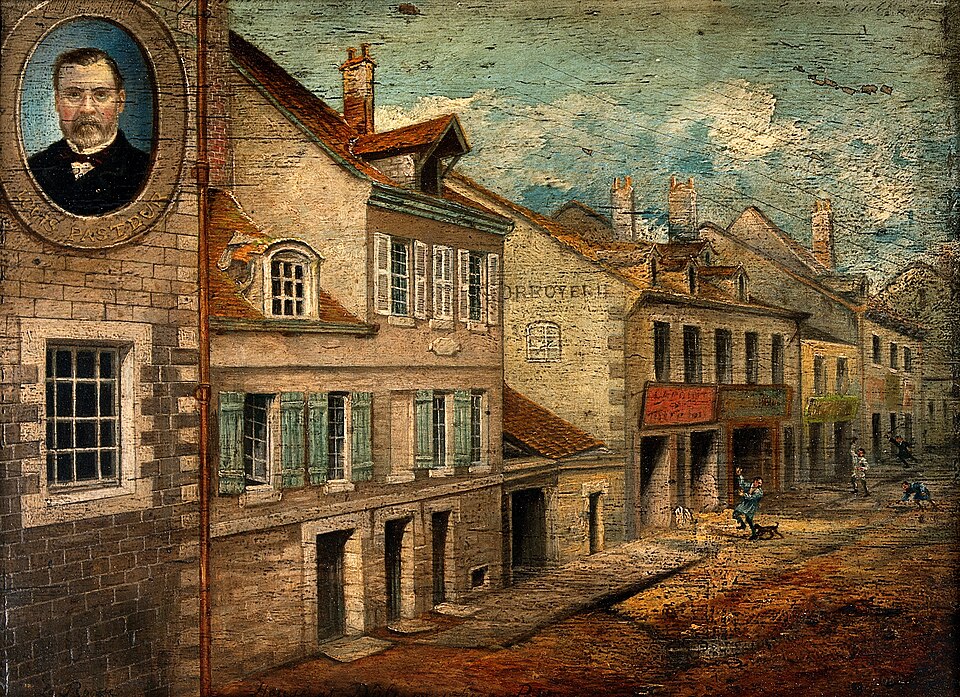
—How did you go from a sick chicken to the very principle of vaccination?
Through a chance that I was lucky not to disdain. A culture of chicken cholera had aged, forgotten in the air over the summer. Inoculated, it no longer killed the animals. Better: those chickens then resisted the most virulent culture. I wrote that these aged cultures lose their virulence while retaining their properties, and that animals thus treated resist. There it was: one could weaken a microbe and use it as a shield. Jenner had his cow and his smallpox; I had a general law, attenuation. Anthrax followed, and then much more. Chance, they say, favors only the prepared mind. Mine had been watching for twenty years.
One could weaken a microbe and use it as a shield.
—Let us come to that night in July 1885. Do you remember the moment when young Joseph Meister was brought to you?
I will remember it until my last hour. They brought me a nine-year-old child, bitten in fourteen places, so deeply that walking was painful for him; the bites were more than two days old. The child's death seemed inevitable. Now I was not a physician, and my method had only succeeded on dogs. I resolved, not without intense and cruel anxiety, to try on Joseph Meister what had consistently succeeded in the stable. Each evening, for ten days, they injected him with increasingly virulent spinal cords. I no longer slept. If the child died, it would not be a scientific failure; it would be murder. He lived.
If the child died, it would not be a scientific failure; it would be murder.
—What did you feel when you measured the global echo of this cure?
A mixture I cannot name. Fame fell upon me like an avalanche: the bitten from all over Europe, even from Russia, flocked to my laboratory on rue d'Ulm as if to a sanctuary. It terrified me as much as it touched me. A single saved child was worth everything, but suddenly I was made a prophet, when I was only a man bent over his notebooks, counting his doses, dreading error. From this influx came the idea of a dedicated house: the Pasteur Institute, inaugurated in 1888, paid for by a subscription from around the world. I now live there, half-paralyzed since my stroke in 1868, but my mind has never yielded on the left side.
—You returned an honorary diploma to the University of Bonn. Should science then have a homeland?
Science does not; the scientist does. That is what I replied to the Germans when I sent back my doctorate parchment. The defeat of 1870, the loss of Alsace-Lorraine, I carry them like a wound that never closes. Let there be no mistake: a truth discovered in Berlin is worth as much as a truth found in Paris, and I read foreign publications every morning, even Prussian ones. But the man who seeks this truth has a heart, a language, dead to avenge. I cannot receive an honor from a country that has humiliated mine. They will judge me narrow-minded; I can live with that. My laboratory is open to all nations; my gratitude is not.
Science does not; the scientist does.
—At the twilight of your life, how do you look back on the path traveled since the Jura?
With astonishment, above all. The tanner's son from Dole, the schoolboy from Arbois where I return each summer to breathe the air of the vineyards, did not imagine ending up in a marble crypt. My body has betrayed me since that stroke in 1868; I dictate more than I write, I lean on Marie, my wife, who transcribes my thoughts as she always has. But when I think of the still-sealed flasks, the saved herds, that Alsatian child who walks today because one night I dared, I tell myself that the work was worth it. I did not have sudden genius; I had willpower, and the stubborn refusal to believe what an experiment had not confirmed.
I did not have sudden genius; I had willpower.
This imaginary interview was generated by artificial intelligence from sources documented in Louis Pasteur's profile. It dramatises what the figure might have said based on what we know about them, but does not constitute attested historical testimony. For primary sources and factual documentation, refer to the full profile.