Kids interview Louis Pasteur
by Charactorium · Louis Pasteur (1822 — 1895) · Sciences · 6 min read
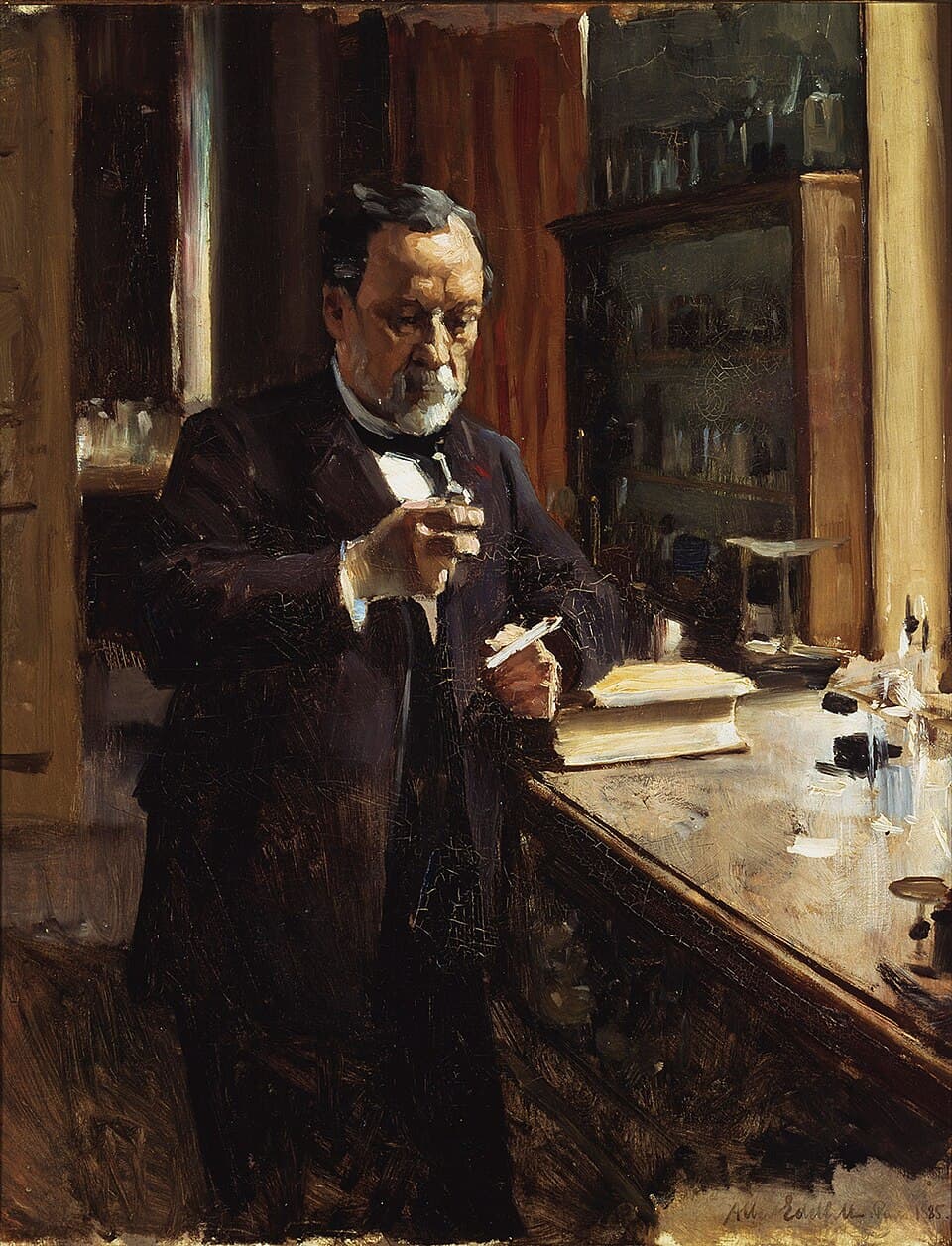
That morning, a school group pushes open the door of an old laboratory cluttered with flasks. Two young visitors step forward toward an old gentleman in a lab coat, his left hand a bit stiff. He looks at them gently and motions for them to come closer to the microscopes.
—Why do you hold your left hand like that, against you?
You have a sharp eye, my child. You see, in 1868, my brain had something like a breakdown. Doctors call it a stroke. Overnight, my entire left side froze. Imagine your hand suddenly refusing to obey you, as if asleep forever. I was 45, and I thought my life as a scientist was over. And yet... my greatest discoveries came after that! I could no longer write quickly, so I dictated everything to my assistants. I looked into the microscope and told them, "Note this, note that." My body was broken, but my mind was still working very well.
My body was broken, but my mind was still working very well.
—What were your mornings in the lab like when you were sick?
I rose very early, before the noise of horses in the street. My first move was to check the experiments I had started the day before. Imagine dozens of small broths in flasks: I had to see which ones had changed overnight. I pressed my eye to the microscope to observe creatures so tiny that no one sees them. And since my hand trembled, I dictated every detail aloud. My assistants wrote for me. You know, I was born in the Jura, in Arbois, and every summer I returned there to breathe. It was there, in fact, that my stroke had struck me. But I always came back to my flasks.
—What's that funny flask with a long twisted neck?
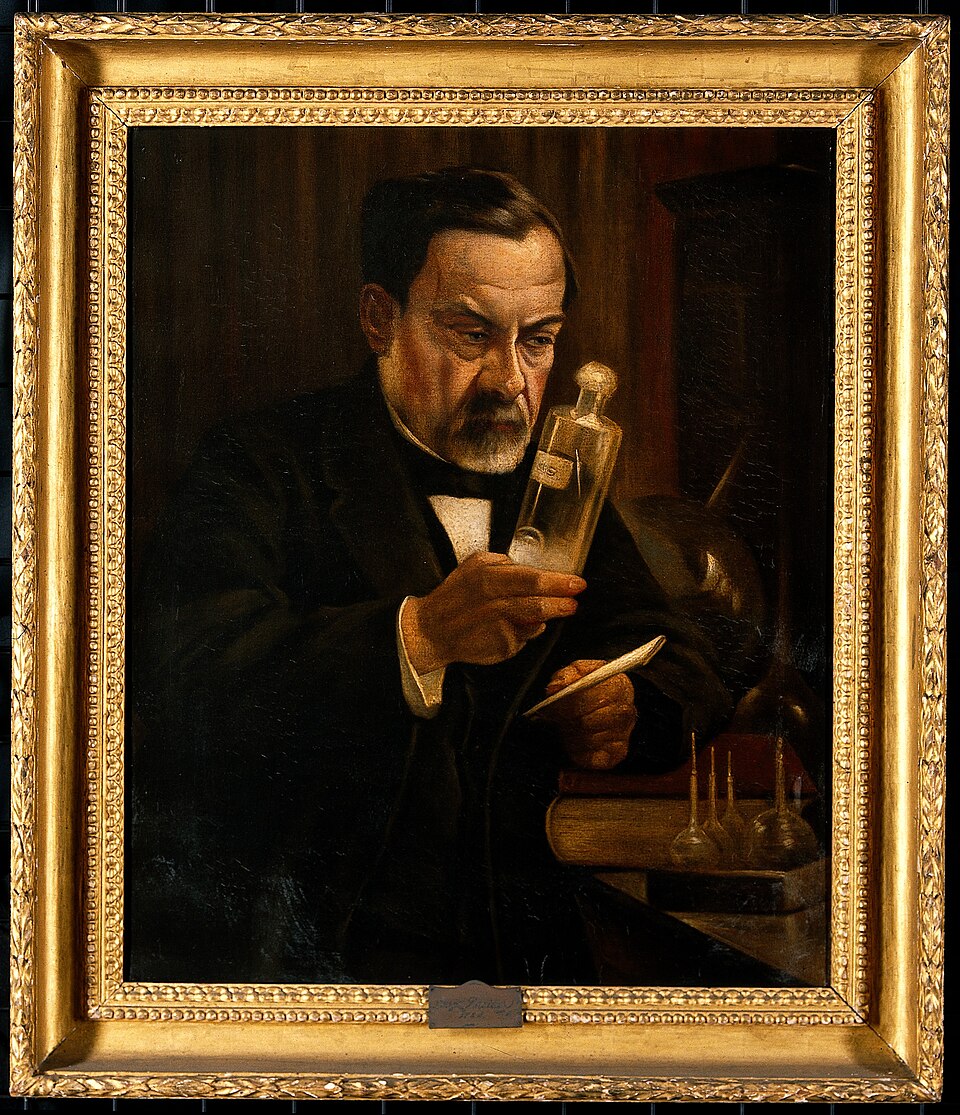
Ah, my favorite! It's called the swan-neck flask, because its neck curves like that of the bird. In my time, many scientists believed that life could arise spontaneously in broth. They called it spontaneous generation: creatures appearing out of nothing. I didn't believe it. So I heated the broth to make it very clean, with no creatures inside. The twisted neck let air in but trapped dust at the bottom of the curve. And guess what? The broth never spoiled. Life did not come from nothing: it came from the dust in the air.
Life did not come from nothing: it came from the dust in the air.
—How were you so sure you were right against all the other scientists?
I wasn't sure at first, you know. I was afraid of being wrong in front of everyone. But I had one idea: never believe, always verify. In 1861, I wrote that lifeless matter never gives rise to life, and I proved it through experiment, not fine speeches. Imagine a dispute that had lasted for centuries, finally settled with a simple glass flask! My opponents shouted, but they could not answer my flasks. A well-done experiment, my child, is worth more than a thousand fine words. That's science: you look at nature and let it answer you.
Never believe, always verify.
—Is it true that you made a wager with sheep in front of everyone?
A real wager, yes! In 1881, in a village called Pouilly-le-Fort, I wanted to prove that my vaccine worked. Anthrax is a terrible disease that killed entire herds. I took sheep: to half I injected my vaccine; to the other half, nothing. Then I gave them all the disease. Imagine the crowd around me, journalists from everywhere, and me trembling inside. A few days later, the vaccinated sheep were gamboling, alive. The others were all dead. The public couldn't believe their eyes. I had risked big, and nature had proven me right in front of everyone.
I had risked big, and nature had proven me right.
—Weren't you afraid of losing your wager in front of the journalists?
Very afraid, my child! I hardly slept. If my vaccinated sheep had died, I would have been pointed at all over Europe. But you know, a vaccine is a simple idea. I took the germ of the disease and made it weak, tired, by letting it age in the air. Weakened like that, it no longer kills: it just teaches the body to defend itself. That's called attenuation. I had already tried it on chickens with cholera, and it had worked. So I dared to repeat it in public. Being afraid is not serious. The main thing is to do the experiment anyway.
Being afraid is not serious; the main thing is to do the experiment.
—And the little boy bitten by a dog, did you really treat him?
Yes... and that memory still grips my heart. In 1885, they brought me Joseph Meister, a 9-year-old child, almost your age. A rabid dog had bitten him in fourteen places. Rabies, in my time, meant certain and horrible death. My vaccine had never been tried on a human. And I wasn't even a doctor! Imagine my anguish: did I have the right to inject this little one? I wrote myself that I did it "not without lively and cruel anxieties." For nights, I trembled at each injection. And then Joseph lived. He grew up. That day, I understood that my work could save children.
That day, I understood that my work could save children.
—Do you regret injecting Joseph without being a doctor?
That's a good question, and a difficult one. No, I don't regret it, but I don't forget the risk. You see, without doing anything, Joseph would surely die; the bites were already two days old. I had the choice between trying and letting him die. So I chose to act, with a pounding heart. Many people later gave money to build the Pasteur Institute in Paris, where other bite victims could be treated. That's where I am buried today. But remember one thing: you never try such a thing lightly. You must first have verified it a thousand times on animals. Courage without caution is recklessness.
Courage without caution is only recklessness.
—Is it true that you returned a diploma to the Germans?
It's true, and you touch upon my anger. In 1870, my country went to war with Prussia, and we lost. They even tore away Alsace-Lorraine, two French regions. My heart was broken. Now, a German university in Bonn had given me a fine honorary diploma. Well, I sent it back! I wanted no honors from those who made my country suffer. Yet I knew well that microbes have no nationality. A discovery serves the whole world. But the scientist who makes it has a homeland, and he loves it. Both things lived in me at once.
Science has no homeland, but the scientist does.
—Why do we talk about "pasteurizing" milk, does it come from your name?
Yes, and it gives me a strange feeling! It all started with wine. In 1863, Emperor Napoleon III asked me why so many wines turned and went bad. I discovered that tiny microbes spoiled them. So I had a very simple idea: gently heat the liquid, to about 55 or 60 degrees, just enough to kill the microbes without ruining the taste. Imagine warming the wine like a lukewarm bath, and poof, the creatures die. They called it pasteurization, after my name. Even today, the milk you drink is treated that way. A little heat, and millions of people get sick less.
—If we ran into you on the street, what would we notice first?
You would probably notice my left hand, stiff against my body, and my somewhat slow gait. Then my black frock coat, well buttoned, like all serious gentlemen of my time. But above all, you would be surprised by one thing: I refuse to shake hands! Even those of ministers. People found me odd. But I knew something they didn't know: on hands hide invisible microbes that pass from one person to another. So I preferred to refrain. If you remember one lesson from me, keep this one: wash your hands well. This small gesture, my child, saves more lives than you imagine.
Wash your hands: this small gesture saves more lives than one imagines.
This imaginary interview was generated by artificial intelligence from sources documented in Louis Pasteur's profile. It dramatises what the figure might have said based on what we know about them, but does not constitute attested historical testimony. For primary sources and factual documentation, refer to the full profile.