Imaginary interview with Ludwig van Beethoven
by Charactorium · Ludwig van Beethoven (1770 — 1827) · Music · 5 min read
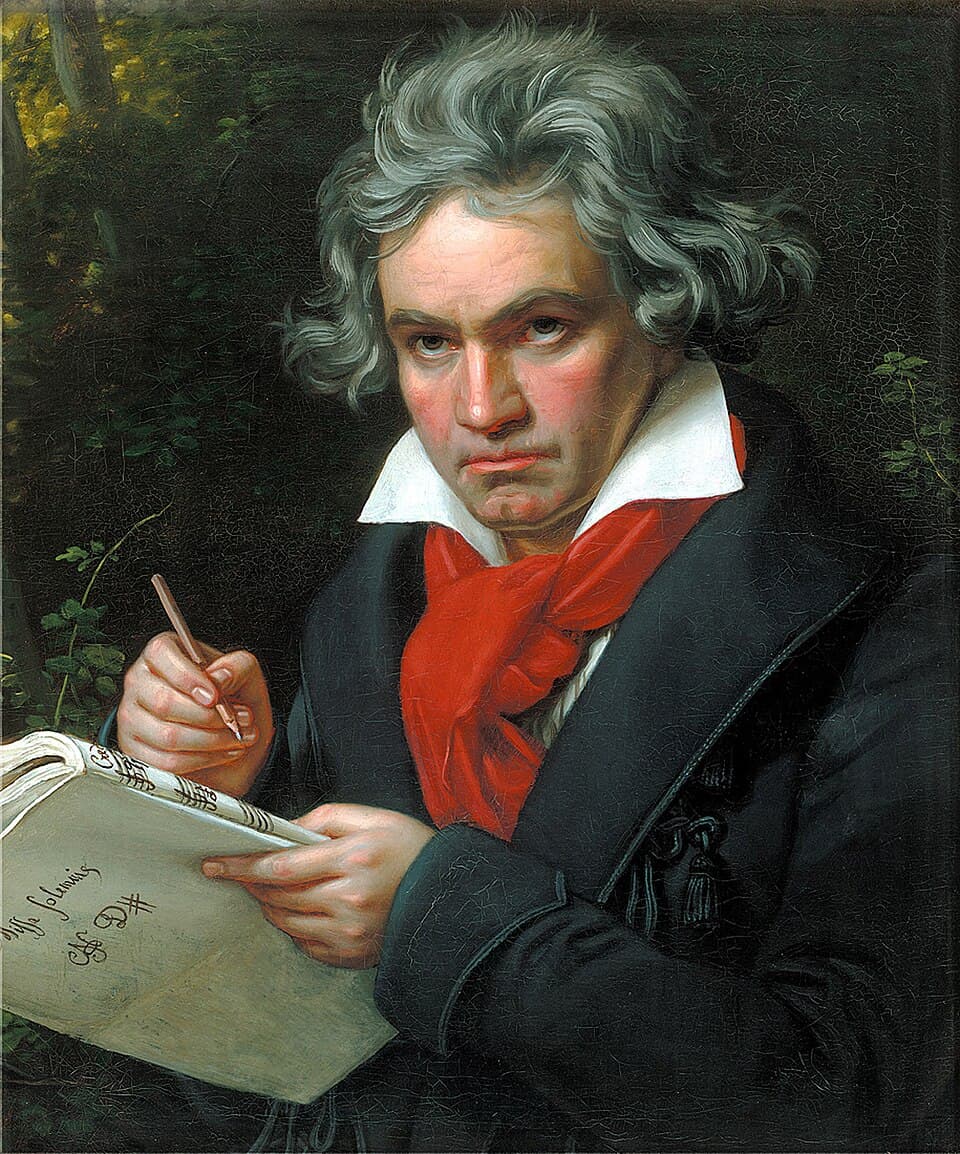
Vienna, an evening in the winter of 1826. In a cluttered apartment strewn with scores, dirty cups, and a piano with sawn-off legs, a man with wild gray hair gestures for us to write our questions in a notebook. He will not hear us, but he will answer aloud, sometimes too loudly, as one speaks when one has forgotten the sound of one's own voice.
—How would you describe an ordinary morning at home, in Vienna?
I rise with the day, often after a night when music kept me awake longer than I wished. The first thing I do is make my coffee — and there, I tolerate no approximation: sixty beans, counted one by one, not a single one more. Then I work standing at my desk, in my shirt, scribbling in my Skizzenbücher before I even think of dressing. They say my lodgings are a battlefield, and it's true: scores on the floor, forgotten plates, overturned inkwells. I have moved so many times in this city that my landlords no longer remember my face. But in this disorder, believe me, I know exactly where every idea is.
Sixty beans, counted one by one, not a single one more.
—You are called eccentric, neglectful. What do you reply to those who are shocked by your appearance in elegant salons?
Let the salons keep their mirrors; I can do without. Yes, my cravat hangs crooked, my coat looks thrown on — because it is. In the afternoon, I go walking alone in the countryside around Vienna, notebook in pocket, and I come back soaked, muddy, sometimes laughing to myself at a melody that came to me between two trees. The fine people of the Congress find this unseemly. But it is outside, in the wind, that music comes to me; never in a perfumed salon. A rumpled coat has never prevented a symphony from being born. I would rather be reproached for my ill-pulled stockings than for my silences in society.
A rumpled coat has never prevented a symphony from being born.
—Why did you always refuse a position as Kapellmeister, the most prestigious post a musician could hope for?
Because a Kapellmeister serves a master, and I serve only the work. In Vienna, I was fortunate to have patrons — Prince Lichnowsky, Archduke Rudolf, the Lobkowitzes — who paid me annuities so that I could compose as I wished. It is a strange arrangement, I admit: I dine at their table, I dedicate my opus to their names, and yet I remain free. The day Lichnowsky wanted me to play before French officers, I slammed the door. A prince is made by chance of birth; a Beethoven, there is only one. I prefer poverty that thinks to comfort that obeys.
A prince is made by chance of birth; a Beethoven, there is only one.
—Do you remember the moment when you learned that Napoleon had proclaimed himself Emperor?
I still see it. My great symphony — the third, the longest, the most ambitious I had dared — bore his name on the title page. Bonaparte, the man who was to embody the liberty of the peoples, the consul of the people. And then I was told, in 1804, that he had crowned himself with his own hands. I seized the score, I scratched out his name with such rage that I tore the paper. So he was just an ordinary man, who would in turn trample the rights of men to serve his ambition. I renamed it Eroica Symphony — to celebrate no longer a tyrant, but the hero that each person carries within.
So he was just an ordinary man, who would in turn trample the rights of men.
—What would you say about the ideals that run through your work, from the Eroica Symphony to Fidelio?
That music is not made to lull the powerful. When I composed Fidelio, my only opera, I wanted a woman who disguises herself as a man to rescue her husband from a tyrant's dungeon. Leonore descends into the cell with a lamp in hand — and at bottom, it is freedom descending to fetch the innocent. The French Revolution broke out when I was nineteen, in Bonn, and those words — liberty, fraternity — never left me. Even my Emperor Concerto, I wrote in 1809 while Napoleon's cannons pounded Vienna and I hid in the cellar, a pillow over my head to save the little hearing I had left.
Music is not made to lull the powerful.
—At what moment did you realize you were losing your hearing, you, a musician?
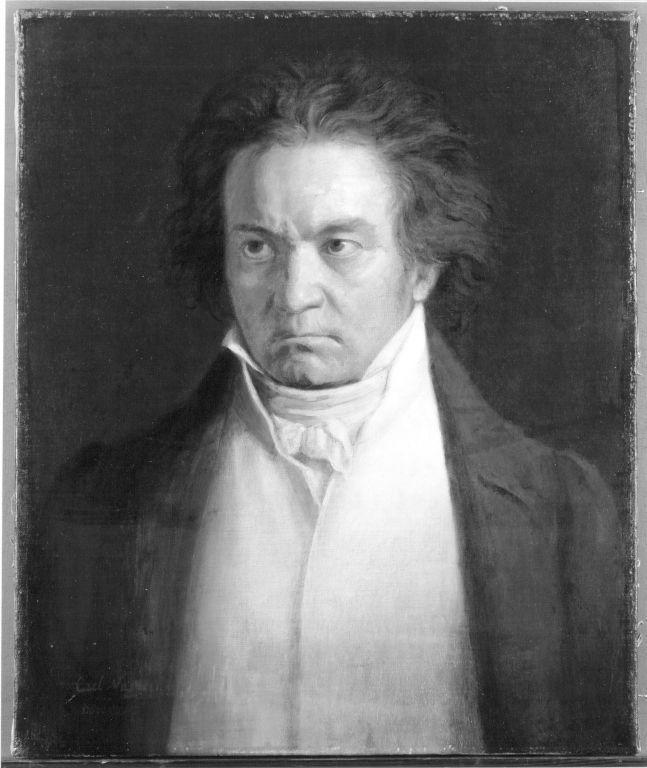
Around 1798, first a buzzing, a whistling that would not stop. I did everything to hide it — out of shame, out of terror. In 1800, I wrote to my old friend Wegeler these words I will never forget: 'I lead a miserable life. For two years I have avoided all society because it is impossible for me to tell people: I am deaf.' Imagine the absurdity: the man whose trade is hearing, condemned to silence. I avoided dinners for fear someone would guess, I had things repeated without having heard, I laughed at the wrong time. The worst was not no longer perceiving an orchestra — it was no longer daring to look at a face that was speaking to me.
The man whose trade is hearing, condemned to silence.
—In 1802, in Heiligenstadt, you came close to the worst. What held you back?
Art. Nothing else. I had gone to that village on the outskirts of Vienna to treat my ears in the quiet, and I found only my own despair. I took up the pen to write to my brothers what you today call the Heiligenstadt Testament. I confessed everything, even that temptation to leave the world. But an idea stopped my hand: how could I leave when I felt within me so many works still mute? It seemed unworthy to die before having given what I carried. To continue, I sawed off the legs of my piano so that I could place the instrument directly on the floor, and I clamped a baton between my teeth against the wood — to feel, through the bones, what I could no longer hear.
How could I leave when I felt within me so many works still mute?
—How do you compose an entire symphony without hearing a single note played?
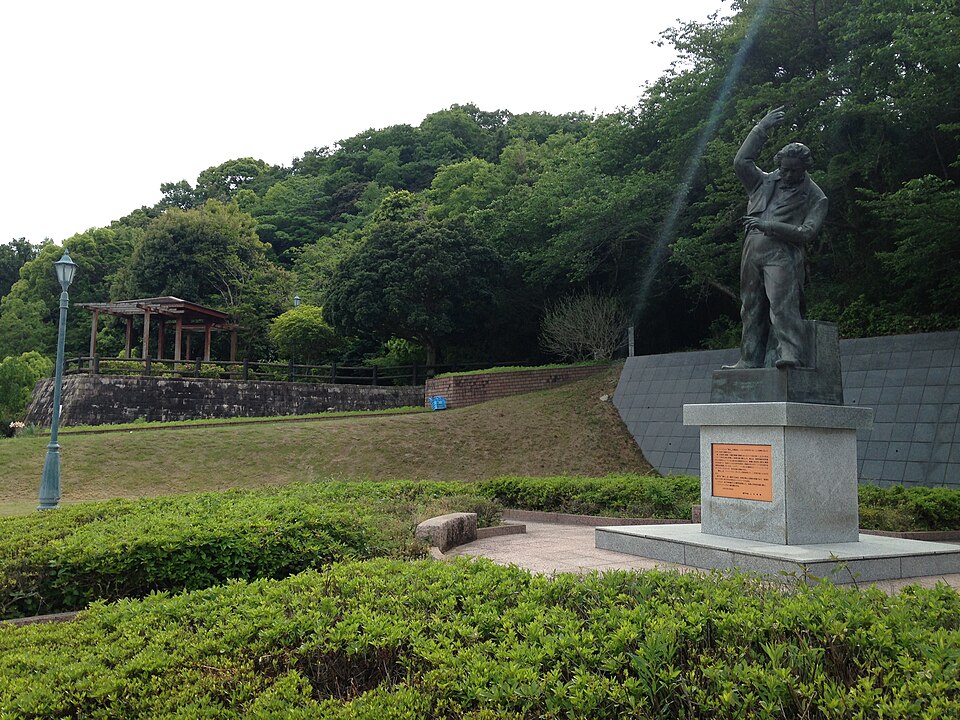
One hears differently. Since 1818, I have been completely deaf, and my visitors write their words in notebooks that I keep carefully — hundreds of little books in which all my Viennese life is inscribed. But music no longer passes through my ear: it lives in my head, complete, architectured, before a pen fixes it. I see the score as one sees a landscape. When asked how I know a chord will sound right, I reply that I hear it where no noise of the world can reach it. Deafness took from me the rumor of men; it never took music from me. Perhaps it even gave it back to me purer.
I hear it where no noise of the world can reach it.
—In your Ninth, you wanted a chorus to sing Schiller's Ode to Joy. Why this audacity?
Because there comes a moment when instruments alone are no longer enough, when human voices must speak the words. Schiller's poem, An die Freude, I had carried within me since my youth in Bonn. Joy as a divine spark, all men become brothers — that is what I dreamed of raising from an orchestra. I was told it was impossible, that one did not mix song with a symphony. But who decides the impossible? I wanted my Ninth to open like a night and end in a blaze, thousands of throats crying a fraternity that I could no longer hear, but that I could still hope for the world.
Joy as a divine spark, all men become brothers.
—Tell us about the premiere of this Ninth, in 1824. What happened at the end of the concert?
I was placed on the stage of the Kärntnertortheater, near the podium, as if to conduct — but in truth another led the musicians, for I could no longer follow the measure of the world. I beat time to my inner music, sometimes ahead, sometimes behind theirs. When the last chord fell, I remained turned toward the orchestra, my back to the audience, knowing nothing. A singer approached, gently took me by the arm and turned me toward the hall. Then I saw: hands clapping, handkerchiefs waving, mouths open in cries I would never hear. 1824. I saw the triumph without perceiving a single sound. It was at once the most beautiful and the cruelest of spectacles.
I saw the triumph without perceiving a single sound.
This imaginary interview was generated by artificial intelligence from sources documented in Ludwig van Beethoven's profile. It dramatises what the figure might have said based on what we know about them, but does not constitute attested historical testimony. For primary sources and factual documentation, refer to the full profile.