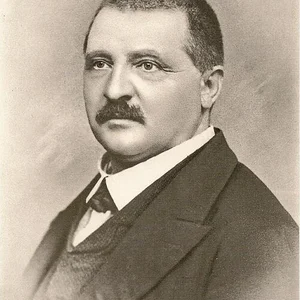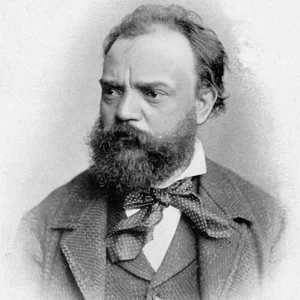

Antonín Dvořák was a 19th-century Czech composer, a major figure of Romanticism and of the nationalist movement in music. He drew on the folklore of his homeland and, during a stay in the United States, on African American and Native American music.
Antonín Dvořák(1841 — 1904)
Antonín Dvořák
royaume de Bohême, Cisleithanie
6 min read
Frequently asked questions
Key Facts
- Born in 1841 in Nelahozeves, Bohemia (present-day Czech Republic)
- Composed the Slavonic Dances from 1878 onward, which earned him international fame
- Director of the National Conservatory of Music in New York from 1892 to 1895
- Premiered his 9th Symphony “From the New World” in 1893, his most famous work
- Died in 1904 in Prague
Works & Achievements
Orchestral pieces inspired by Slavic folk dances that established his international reputation.
A vast sacred work for soloists, choir and orchestra, composed after the death of several of his children; a pinnacle of Romantic choral music.
His most famous symphony, written in the United States and steeped in African American influences; a worldwide classic of the repertoire.
A luminous quartet composed in Spillville over the summer, infused with folk colors.
Considered one of the greatest cello concertos ever written.
A Czech opera based on a water-nymph legend, whose aria “Song to the Moon” is universally known.
A joyful, pastoral symphony marked by the spirit of the Czech countryside.
Anecdotes
In 1892, Dvořák crossed the Atlantic to direct the National Conservatory of Music in New York, where he was offered a colossal salary of 15,000 dollars a year — roughly twenty-five times what he earned in Prague. He stayed nearly three years before returning home, eaten up by homesickness.
Dvořák was so passionate about railways that he noted down locomotive numbers and train timetables. In New York, when his health no longer allowed him to go to the station, he sent his pupil (and future son-in-law) Josef Suk to record the locomotive numbers for him.
Before becoming a famous composer, Dvořák long earned his living as a violist in the orchestra of the Provisional Theatre in Prague and as a church organist, while being too poor in his early days to afford a piano.
It was the great German composer Johannes Brahms who spotted Dvořák's talent while judging an Austrian scholarship competition, then recommended him to his own publisher, Simrock. This friendship launched the Czech composer's international career.
During his time in America, Dvořák took a keen interest in negro spirituals and Native American music, which he believed to be the seedbed of a truly national American music — a bold idea for the time.
Primary Sources
I am now satisfied that the future music of this country must be founded upon what are called the negro melodies. They can be made the foundation of a serious and original school of composition in the United States.
While reviewing the applications for state stipends, I took great pleasure in the works of Antonín Dvořák from Prague. This year, he notably submitted a collection of vocal duets that seem to me entirely suitable for publication.
Z nového světa (From the New World) — note inscribed in the composer's own hand on the manuscript.
Key Places
Village on the banks of the Vltava where Dvořák was born into the family of an innkeeper-butcher. His rural childhood brought him into early contact with folk music.
Capital of Bohemia where Dvořák studied, played the viola, taught at the Conservatory and died. The heart of his professional life and of the Czech national awakening.
City where Dvořák directed the National Conservatory of Music from 1892 to 1895. There he composed the “New World” Symphony.
Village of Czech immigrants where Dvořák spent the summer of 1893. This rural stay reminded him of his homeland and inspired his “American” Quartet.
City where Dvořák was given a triumphant welcome on several occasions from 1884 onward to conduct his works. England commissioned important pieces from him.
Country estate in Bohemia where Dvořák loved to retreat to compose, raise pigeons and enjoy the rural calm.
Typical Objects

A bowed string instrument that Dvořák played professionally in the orchestra of Prague's Provisional Theatre. It was through the viola that he came to know the repertoire from the inside before composing.

Dvořák was organist at the Church of St. Adalbert in Prague, a modest but essential post in his early years. The organ nurtured his taste for sacred music.

Sheets of music paper on which Dvořák wrote out his symphonies and operas in pen. His autograph scores sometimes bear personal notes, such as the title “From the New World.”

The conductor's tool that Dvořák used to lead his own works in Prague, London, and New York. Conducting brought him recognition and touring income.

An object of fascination for Dvořák, who passionately jotted down train numbers and timetables. The railway embodied the industrial modernity of his age.

Scores published by the publisher Simrock that made Dvořák known throughout Europe. They transposed the rhythms of the folk dances of Bohemia and Moravia.
School Curriculum
Vocabulary & Tags
Key Vocabulary
Daily Life
Morning
Dvořák rose early, often around five o'clock, and made the most of the morning calm to compose at his desk. He liked to begin the day with a walk and placed great importance on prayer and Mass.
Afternoon
The afternoon might be devoted to teaching at the Conservatory, to orchestra rehearsals, or to correcting scores. Whenever he could, he would slip off to the station to admire the locomotives or tend to his pigeons in the countryside.
Evening
Evenings were often filled with concerts, the opera, or musical gatherings among friends and colleagues. On tour in London or New York, he frequently conducted his own works before the public.
Food
Dvořák enjoyed traditional Czech cuisine: soups, roast meats, knedlíky (bread dumplings), and Bohemian beer. A simple man, he remained attached to the hearty dishes of his rural childhood.
Clothing
Like the middle-class men of his time, he wore a dark suit, a stiff-collared shirt, a waistcoat, and a tie. His trimmed beard and austere appearance contrasted with his reputation as a modest figure.
Housing
He lived mainly in middle-class apartments in Prague, but cherished his country house in Vysoká, surrounded by nature. In the United States, he stayed in a New York apartment, and later in the Czech community of Spillville.