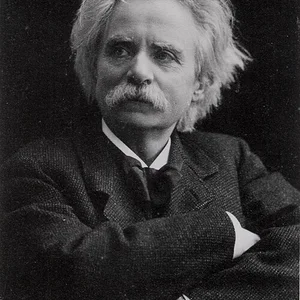

Edvard Grieg (1843-1907) was a Norwegian pianist and composer, a major figure of national Romanticism. He is famous for drawing on Norwegian folklore to create music expressing a national identity.
Edvard Grieg(1843 — 1907)
Edvard Grieg
Norvège
6 min read
Frequently asked questions
Key Facts
- Born on 15 June 1843 in Bergen, Norway
- Studied at the Leipzig Conservatory from 1858
- Composed the incidental music for Henrik Ibsen's Peer Gynt in 1875 (including 'Morning Mood' and 'In the Hall of the Mountain King')
- Wrote his famous Piano Concerto in A minor in 1868
- Died on 4 September 1907 in Bergen
Works & Achievements
His most famous orchestral work, a pinnacle of the Romantic concerto that blends virtuosity with Nordic colors.
Composed for Ibsen's play, it contains “Morning Mood” and “In the Hall of the Mountain King,” known the world over.
A collection of 66 short piano pieces composed throughout his life, like a musical diary.
A suite for string orchestra inspired by old dances, a tribute to the writer Ludvig Holberg.
One of his most passionate and most frequently performed chamber works.
Numerous songs for voice and piano, often written for his wife, the singer Nina, blending Nordic poetry and folklore.
Anecdotes
As a child, Edvard Grieg was bored at school and preferred daydreaming about music. According to family legend, he supposedly walked through a puddle on purpose so he would arrive in class soaking wet and be sent back home! It was the famous violinist **Ole Bull**, a friend of the family, who spotted his talent and persuaded his parents to send him to study at the Leipzig Conservatory at only 15 years old.
In **1874**, the playwright **Henrik Ibsen** asked Grieg to compose the incidental music for his play *Peer Gynt*. Grieg found the task very difficult and took nearly two years to finish it. Yet this commission gave rise to *Morning Mood* and especially *In the Hall of the Mountain King*, which became some of the best-known melodies in the world.
Grieg was very short (about 1.52 m) and in fragile health: a bout of pleurisy he caught in Leipzig left him with only one fully functioning lung for the rest of his life. Despite this, he led an exhausting international career as a pianist and conductor all across Europe.
Grieg had a villa built on the edge of a fjord near **Bergen**, which he named *Troldhaugen* (the hill of the trolls). To compose in peace, he built a small isolated hut by the water, below the house, where no one could disturb him.
At his death in **1907**, tens of thousands of people attended his funeral in **Bergen**. In accordance with his wishes, his ashes were placed in a hollow of a cliff overlooking the fjord, near his home at **Troldhaugen**.
Primary Sources
I am also working on 'Peer Gynt', but it is moving along terribly slowly, and there is no chance of it being ready this autumn.
Even today I still remember the wonderful, mysterious satisfaction I felt as I let my hands fall upon the piano keys and discovered, not a melody — that was far beyond me — but a harmony.
What warmth and passion lie hidden in his melodic phrases, what a welling spring of inspiration flows through his music.
Key Places
Port city in western Norway where Grieg was born in 1843 and died in 1907. It remains deeply associated with his name.
Institution founded by Mendelssohn where Grieg studied from 1858 to 1862. There he received a solid German classical training.
Villa that Grieg had built in 1885 by the edge of a fjord, with his secluded composer's hut. Today it has been turned into a museum.
Capital of Norway where Grieg founded a music academy and led the musical scene; site of the premiere of 'Peer Gynt' in 1876.
City where the young Grieg stayed after his studies, met the composer Rikard Nordraak, and committed himself to a new Nordic music.
Typical Objects

Grieg's instrument of choice, both for composing and for performing in concert across Europe. His Steinway piano still stands today in his villa at Troldhaugen.

A traditional Norwegian fiddle with sympathetic strings, adorned with mother-of-pearl and decorations. Its tone and folk melodies deeply inspired Grieg's writing.

Sheets of music paper on which Grieg penned his compositions, from the *Lyric Pieces* to the *Piano Concerto*. He worked on them in his secluded hut by the fjord.

A small frog figurine that Grieg always kept in his pocket and stroked before every concert to ward off stage fright. It became his famous good-luck charm.

Collections of traditional melodies and dances (notably those transcribed by Ludvig Mathias Lindeman) from which Grieg drew to nourish his national music.

A traditional regional dress, a symbol of the revival of Norwegian national identity that Grieg's music likewise embodied.
School Curriculum
Vocabulary & Tags
Key Vocabulary
Daily Life
Morning
Grieg liked to start his day early, in the calm of Troldhaugen. After a simple breakfast, he often walked down to his little composing hut at the edge of the fjord to work alone, away from visitors.
Afternoon
The afternoon was devoted to composing at the piano, correcting scores, and the abundant correspondence he kept up with publishers and musicians across Europe. When he was on tour, he rehearsed with orchestras and singers.
Evening
In the evening, Grieg welcomed friends and artists, or played chamber music with his wife Nina, who sang his songs. During the concert seasons, he performed on stage as a pianist or conductor.
Food
Nineteenth-century Norwegian food was based on fish (cod, herring), potatoes, rye bread, and dairy products. In frail health, Grieg led a rather sober life, but enjoyed the conviviality of meals shared with friends.
Clothing
Grieg wore the middle-class suits of his time: jacket, waistcoat, high-collared shirt, and a tie or an artist's lavallière. His slight frame, tousled hair, and large moustache made him recognizable among all.
Housing
From 1885 onward, he lived at Troldhaugen, an elegant light-painted wooden villa overlooking a fjord near Bergen. The house included a large drawing room with a piano, and a separate hut served as his composing studio.