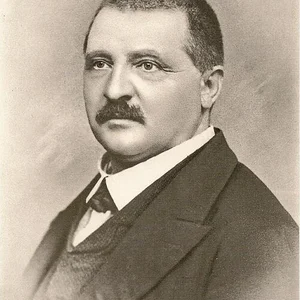

An Austrian composer and organist of the Romantic period, Anton Bruckner is famous for his nine monumental symphonies and his sacred works. A deeply devout Catholic, he left his mark on symphonic music through its grandeur and his religious fervor.
Anton Bruckner(1824 — 1896)
Anton Bruckner
empire d'Autriche, Cisleithanie
6 min read
Frequently asked questions
Key Facts
- Born in 1824 in Ansfelden (Austria), died in 1896 in Vienna
- Organist of Linz Cathedral from 1856, renowned for his improvisational talents
- Professor of composition and organ at the Vienna Conservatory from 1868
- Author of nine symphonies, the Ninth left unfinished at his death
- Composer of great sacred works: three masses and a Te Deum (1884)
Works & Achievements
One of his most frequently performed symphonies, evoking horseback rides and forests through its horn calls. It showcases his broad, luminous style.
The work that brought him recognition, whose adagio was composed in tribute to the dying Wagner. Its premiere in Leipzig in 1884 finally made Bruckner known.
A vast sonic fresco often regarded as his symphonic masterpiece, owing to its scope and power.
Dedicated “to dear God,” it remained unfinished at his death. Its missing finale makes it a deeply moving final testament.
A great sacred work for soloists, choir and orchestra, a flamboyant expression of his Catholic faith. Bruckner considered it among his most successful.
An imposing mass for soloists, choir and orchestra, the pinnacle of his religious music at the crossroads of liturgical tradition and symphonism.
A rare foray by Bruckner into chamber music, whose adagio is especially admired.
Anecdotes
Anton Bruckner was extremely humble and deeply awkward in social settings. While conducting, he would sometimes slip a tip into the hand of a famous conductor like Hans Richter to thank him, not understanding that one does not pay a master in this way. The anecdote, recounted by Richter himself, reveals his disarming naivety.
Bruckner suffered from a genuine obsession with numbers and counting: he compulsively counted the windows of buildings, the beads on chandeliers, or the notes in his scores. This mania, which doctors today link to an obsessive-compulsive disorder, also drove him to meticulously date and number everything he wrote.
So devoted to perfection that he endlessly revised his symphonies, Bruckner left several versions of nearly every one of them. This stems partly from his personal doubts, but also from the insistent advice of pupils and friends who urged him to cut and alter his works, creating a puzzle for conductors to this day.
A fervent admirer of Richard Wagner, Bruckner dedicated his Third Symphony to him. Legend has it that he once asked Wagner which of the two symphonies he had proposed Wagner preferred, then forgot which one had been chosen, writing to Wagner: “the symphony where the trumpet begins the theme?”
His Ninth Symphony, which he dedicated “to the good Lord” (“dem lieben Gott”), remained unfinished at his death in 1896. Bruckner worked on the finale until his very last day, and sketches were found on his desk. The work is most often performed today in three movements.
Primary Sources
Bruckner dedicated his final symphony *dem lieben Gott* (“to the dear God”), reflecting the Catholic fervour that pervaded all his work.
Eager to dedicate his Third Symphony to Wagner, Bruckner wrote to ask for his consent, calling him his “unreachable master, famous the world over”.
At the head of his Te Deum, Bruckner inscribed his formula of gratitude to God, a work he considered one of his most accomplished and which he proposed as a possible finale for his Ninth.
Key Places
Village in Upper Austria where Anton Bruckner was born in 1824, the son of a village schoolteacher and organist.
Augustinian abbey where Bruckner was a choirboy, then organist; the founding place of his spiritual and musical life, where he rests today beneath the organ.
City where Bruckner served as cathedral organist from 1855 and composed his first major works.
Austrian capital where Bruckner taught at the Conservatory and the university, composed most of his symphonies, and died in 1896.
German city where the triumphant premiere of his Seventh Symphony in 1884 brought him international recognition.
Wagnerian city where Bruckner made a musical pilgrimage, holding boundless admiration for Richard Wagner.
Typical Objects

The great Baroque organ of the Saint Florian monastery, on which Bruckner played and improvised, and beneath which he was buried. An emblematic instrument of his art as an organist.

The manuscripts of his nine symphonies, endlessly revised, dated, and numbered in his meticulous hand. They bear witness to his doubts and his quest for perfection.

A small metal instrument that gives the reference note, indispensable to the organist and composer for tuning voices and instruments.

A Catholic object of devotion that Bruckner, a deeply religious man, carried with him. His faith permeated his daily life as much as his sacred music.

The writing instruments with which Bruckner set down on paper his immense scores and his carefully written correspondence.

The loose, dark, old-fashioned suit that Bruckner wore, with baggy trousers he found convenient for playing the organ, adding to his peasant-like appearance amid elegant Vienna.
School Curriculum
Vocabulary & Tags
Key Vocabulary
Daily Life
Morning
An early riser and a man of duty, Bruckner often began his day with prayer and Mass, his faith shaping every morning. In Linz and later in Vienna, he devoted his first hours to teaching the organ, harmony, and counterpoint.
Afternoon
Afternoons were dedicated to teaching at the Conservatory and at the University of Vienna, where he trained many pupils. Between classes, he worked on his compositions, tirelessly crossing out and starting his scores over again.
Evening
In the evening, Bruckner composed by lamplight, sometimes late into the night, absorbed in his monumental symphonies. He also attended Viennese concerts, especially to hear the music of Wagner, whom he revered.
Food
Of peasant stock, Bruckner enjoyed simple, hearty food typical of Upper Austria: bread, beer, meat dishes, and pastries. He was said to have a robust appetite, in contrast to his austere figure.
Clothing
Bruckner wore loose, old-fashioned black suits and wide trousers that he claimed were practical for playing the organ. This rustic attire stood out against the elegance of Viennese high society and reinforced his image as a provincial.
Housing
He lived in modest lodgings in Linz and later in Vienna, as a man of few needs. At the end of his life, Emperor Franz Joseph gave him an apartment at the Belvedere, where he died in 1896.