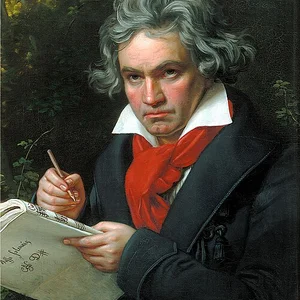
Ludwig van Beethoven
1770 — 1827
empire d'Autriche, électorat de Cologne
German composer (1770–1827) who marked the transition between musical classicism and romanticism. Despite his progressive deafness, he created major works that revolutionized Western music, including the famous 9th Symphony.
Émotions disponibles (6)
Neutre
par défaut
Inspiré
Pensif
Surpris
Triste
Fier
Famous Quotes
« Music is the mediator between the spiritual and the sensual life »
Key Facts
- 1792: moves to Vienna to study under Haydn
- 1801: begins to suffer from progressive deafness, an event that profoundly shapes his life
- 1808: premiere of the 5th and 6th symphonies at a memorable concert in Vienna
- 1824: premiere of the 9th Symphony with chorus, including Schiller's Ode to Joy
- 1827: dies in Vienna, recognized as one of the greatest composers in history
Works & Achievements
A revolutionary work in its duration and ambition, it marks the turning point toward Beethoven's heroic and Romantic style. Its dedication to Napoleon, erased after the imperial proclamation, illustrates the composer's republican ideals.
One of the most famous musical works in the world, opening with four iconic notes (da-da-da-DUM). It symbolizes fate that man confronts and overcomes, a reflection of Beethoven's struggle against deafness.
The first program symphony, describing in five movements the emotions felt in the countryside. It illustrates Beethoven's profound love of nature, his source of inspiration and refuge.
Among the most performed piano sonatas in the world, its first movement of melancholic arpeggios is immediately recognizable. It was composed during a period of intense personal anguish linked to his emerging deafness.
Beethoven's only opera, it depicts a woman who disguises herself as a man to rescue her unjustly imprisoned husband. A hymn to freedom and fidelity, it reflects the composer's humanist and revolutionary ideals.
An absolute masterpiece composed when Beethoven was completely deaf, it incorporates for the first time in a symphony a choir singing Schiller's Ode to Joy. The European anthem is derived from it and it is inscribed in UNESCO's Memory of the World.
The most grandiose of Beethoven's piano concertos, composed during Napoleon's bombardment of Vienna. Its majesty and virtuosity quickly made it an iconic work of the late Classical style.
Anecdotes
Beethoven was famous for his absent-mindedness and disorder. He frequently changed lodgings in Vienna, sometimes several times a year, leaving behind scattered scores, dirty plates, and unemptied chamber pots. His neighbors regularly complained about his unpredictable behavior.
Going progressively deaf from 1798 onwards, Beethoven tried to conceal his disability for as long as possible. In 1802, in despair, he wrote the 'Heiligenstadt Testament', a poignant letter to his brothers in which he confessed his anguish but also his resolve to keep composing in spite of everything.
At the premiere of his 9th Symphony in 1824, Beethoven was present on stage to conduct, but since he was completely deaf, another conductor was actually leading the musicians. At the end of the concert, a soloist had to turn him to face the audience so he could see the enthusiastic ovation he could not hear.
Beethoven was a fervent admirer of Napoleon Bonaparte, whom he saw as the embodiment of the revolutionary ideals of freedom. He had dedicated his 3rd Symphony to Napoleon. But when he learned that Napoleon had proclaimed himself Emperor in 1804, he flew into a furious rage, violently crossed out the dedication, and renamed the work the 'Eroica Symphony'.
To compensate for his deafness, Beethoven used ingenious tricks: he sawed off the legs of his piano to place it directly on the floor and feel the vibrations by resting his jaw on the wood. He also used long rods held between his teeth and pressed against the piano to perceive sounds through bone conduction.
Primary Sources
O you men who think or say that I am malevolent, stubborn, or misanthropic, how greatly do you wrong me! You do not know the secret cause which makes me seem that way to you. [...] It was impossible for me to say to people: speak louder, shout, for I am deaf.
My angel, my all, my very self — only a few words today and at that with pencil [...] Why this deep sorrow when necessity speaks? Can our love endure except through sacrifices, through not demanding everything?
I am living a wretched life. For two years I have avoided almost all social gatherings because it is impossible for me to say to people: I am deaf. If I had any other profession it would be easier, but in my profession it is a terrible situation.
These notebooks, in which his visitors would write their questions and remarks that Beethoven could not hear, bear witness to his daily life in Vienna from 1818 onward and his exchanges with publishers, friends, and pupils.
Key Places
Beethoven's birthplace, where he was born in 1770 and received his early musical training from his father and Christian Gottlob Neefe. He lived there until the age of 22.
The musical capital of Europe where Beethoven settled in 1792 and lived until his death. It was there that he studied under Haydn, composed his major works, and achieved fame.
A village on the outskirts of Vienna where Beethoven stayed in 1802 to seek treatment for his deafness. It was there that he wrote his famous testament, a testament to his despair and his determination to overcome his disability.
Historic concert hall where Beethoven's 5th and 6th Symphonies were premiered in 1808 during the same legendary four-hour concert.
Viennese imperial theatre where the premiere of the 9th Symphony was given in 1824, met with a memorable standing ovation that the deaf composer could not experience aurally.
Typical Objects
Beethoven owned several instruments, including a grand Broadwood piano given to him by the English manufacturer in 1818. Having gone deaf, he sawed off its legs to feel the vibrations directly through the floor.
From 1818 onwards, his visitors would write their messages in these notebooks since he could no longer hear. Around 400 books have been preserved, forming a valuable source on his life.
Beethoven used ear trumpets designed by his friend Johann Nepomuk Mälzel in an attempt to amplify sounds. These primitive devices only partially compensated for his growing deafness.
Beethoven meticulously recorded his musical ideas in sketchbooks that he carried everywhere. These drafts bear witness to his relentless and methodical compositional process.
Beethoven was one of the first composers to use and champion the metronome invented by Mälzel, marking precise tempos on his scores, revolutionising the practice of musical performance.
Beethoven's manuscripts, covered in frantic crossings-out and corrections, bear witness to a perfectionist composer who endlessly worked and reworked his scores before publication.
School Curriculum
Vocabulary & Tags
Key Vocabulary
Tags
Mouvement
Daily Life
Morning
Beethoven rose at dawn, often after a restless night, and immediately began to work. He prepared his own coffee with obsessive care, counting exactly sixty beans for each cup. He composed standing at his desk, scribbling sketches in his notebooks before even getting dressed.
Afternoon
The afternoon was devoted to long solitary walks in the countryside around Vienna, notebook in pocket to jot down musical ideas as they came to him. He often returned soaked and exhausted, but with pages of new sketches. He sometimes received students or visitors, communicating in writing as his deafness progressed.
Evening
Evenings were divided between late-night composition, dinners at the homes of aristocratic patrons (the Lichnowskys, the Lobkowitzes) and, during his years of glory, performances of his works. He enjoyed Viennese taverns where he would meet a few close friends, drinking wine and observing the society around him.
Food
Beethoven had irregular and unsophisticated eating habits. He enjoyed bread soup (Brotsuppe), fish from the Danube, Rhine wine, and above all his very strong morning coffee. He often ate alone and frugally, neglecting meals when he was deep in composition.
Clothing
Beethoven was known for his unkempt appearance: crumpled clothes, poorly knotted cravat, and disheveled hair that scandalized the elegant Vienna of the early 19th century. He wore the bourgeois dress of the era (dark coat, breeches, white stockings) but always seemed to have thrown it on hastily, far removed from the elegance of aristocratic drawing rooms.
Housing
Beethoven changed apartments more than sixty times in Vienna over thirty-five years, leaving disorder and unpaid bills everywhere he went. His lodgings were invariably overrun with scores, sketch notebooks, dirty dishes, and dismantled pianos. He favored apartments with a view of the countryside and always dreamed of a house in the country that he never owned.
Historical Timeline
Period Vocabulary
Gallery
German: Portrait Beethovens mit der Partitur zur Missa SolemnisPortrait of Ludwig van Beethoven when composing the Missa Solemnistitle QS:P1476,de:"Portrait Beethovens mit der Partitur zur Missa Sol

Ludwig van Beethoven (nach Waldmüller)
Beethoven
Portrait of Beethoven by Koizumi Kishio
Beethoven with the manuscript of the Missa solemnis
Park of Roadside Station "Town of Symphony No. 9" and Sculpture of Ludwig van Beethoven
Congressional Library. Beethoven statue in the gallery, public reading room LCCN2013646344
Bonn, Kasernenstraße Ecke Sternstraße -- 2020 -- 6520
Haus des Heiligenstädter Testaments Beethoven Statue 2
Visual Style
L'univers visuel de Beethoven évoque le clair-obscur des portraits romantiques, les intérieurs viennois bourgeois et aristocratiques aux boiseries sombres, les salles de concert néoclassiques dorées et l'intense expressivité du début du XIXe siècle.
AI Prompt
Late 18th and early 19th century Viennese classical and early Romantic visual aesthetic. Oil painting style reminiscent of Joseph Karl Stieler's 1820 portrait of Beethoven. Dramatic chiaroscuro lighting, intense brooding expression, disheveled dark hair. Rich warm tones of candlelit interiors: deep burgundy, ochre, and dark oak wood. Concert halls with gilded neoclassical moldings, chandeliers casting warm amber glow. Sheet music, quill pens, and inkwells scattered on cluttered desks. Vienna skyline with baroque spires at dusk. Romantic period costume: cravat, dark frock coat, breeches. Mood: intense, stormy, passionate yet disciplined.
Sound Ambience
L'ambiance sonore de Beethoven mêle la grandeur des salles de concert viennoises aux sons intimes d'un atelier de compositeur : pianoforte, orchestre qui s'accorde, bruits de la ville impériale du début du XIXe siècle.
AI Prompt
Vienna classical concert hall ambience, circa 1800-1820. The resonance of a fortepiano in a high-ceilinged salon, candlelit and intimate. Distant church bells from Viennese steeples, cobblestone streets with horse-drawn carriages clattering below open windows. The rustling of formal attire, the murmur of aristocratic audiences, quill scratching on manuscript paper in a cluttered composer's study. Wind instruments warming up backstage, a full orchestra tuning, crescendos of strings echoing against stone walls. The creak of wooden floors, a coal stove crackling in winter, rain against glass panes.
Portrait Source
Wikimedia Commons — domaine public — Joseph Karl Stieler — 1820