Imaginary interview with Lyudmila Pavlichenko
by Charactorium · Lyudmila Pavlichenko (1916 — 1974) · Military · 6 min read
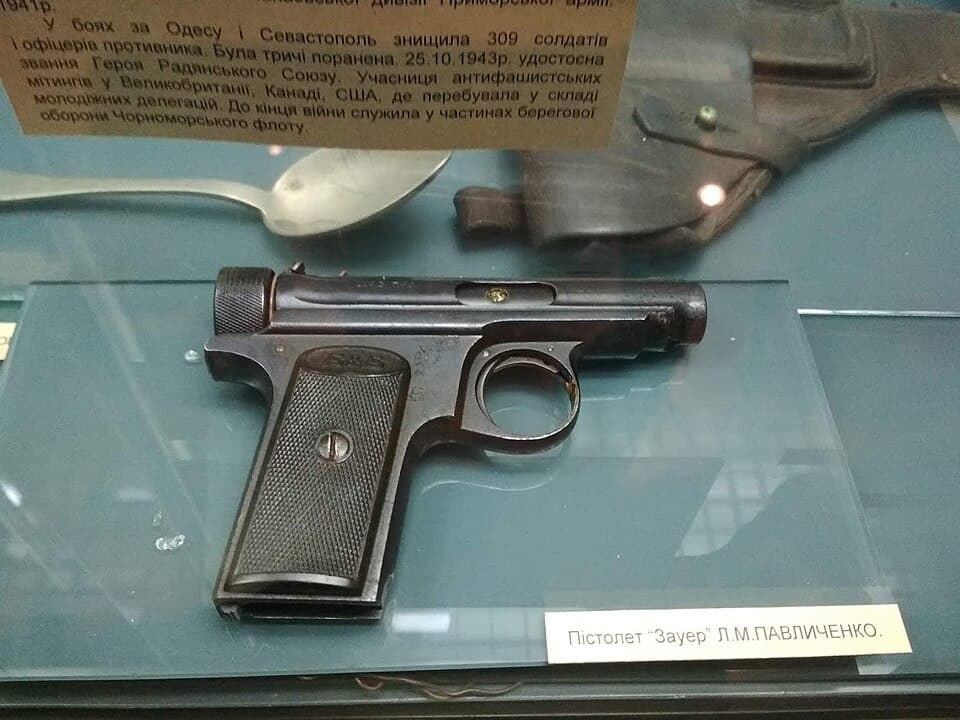
Moscow, winter 1965. In a modest apartment piled with staff reports and yellowed newspaper clippings, a forty-nine-year-old woman pours black tea. She has placed on the table, like a familiar object, an old telescopic sight. Guard Major, Hero of the Soviet Union, “Lady Death” to the Americans: Lyudmila Pavlichenko agrees to revisit the days when she waited, motionless, for death to change sides.
—How did you go from a sports shooting club in Kiev to the trenches of Odessa?
When Germany crossed our border on June 22, 1941, I was finishing my history studies in Kiev. I had learned to handle a rifle at a shooting club, for fun, out of pride; I never thought I would become a soldier. But when the enemy trampled our soil, there was no other choice for me. I reported to the recruitment office, and the officer smiled and offered me a nurse’s post. I demanded a rifle. In Odessa, for seventy-three days, I understood what it meant to defend a city port by port, cellar by cellar. One hundred and eighty-seven times, there, I pulled the trigger. War, you see, did not teach me to shoot: it taught me why.
War did not teach me to shoot: it taught me why.
—What remains in your memory of the siege of Sevastopol?
Sevastopol is the Crimea burning and refusing to fall. There, my count rose to 309, and there too my war as a combatant ended. We slept in the cellars of gutted buildings, in trenches lined with planks, under shells. The ration shrank week by week: black bread, barley porridge, salted fish when available. The siege was one of the deadliest of the entire Eastern Front. A staff report wrote that I had shown “exceptional composure”; I assure you that composure, that day, was just another name for fear kept on a leash.
Composure was just another name for fear kept on a leash.
—They say a sniper duel can last hours. What really happens in those moments?
Of three hundred and nine, thirty-six of my targets were enemy shooters—the most dangerous, because they were looking for me as I was looking for them. A duel is not a gunshot: it is a whole day of total immobility. You dig your ambush, what we called zasada, before dawn, the only time you can move without being seen. Then you wait. You observe through binoculars, you watch for a reflection, a blade of grass bending wrong, the mist of a breath. The camouflage suit, white on snow, green and brown in summer, made me disappear into the landscape. The first one who gets impatient, who shifts a shoulder, who thinks the other has left—that one dies. I won because I knew, better than my enemy, how not to exist.
I won because I knew, better than my enemy, how not to exist.
—Your Mosin-Nagant rifle, what was it to you, exactly?
A Mosin-Nagant 91/30 with a PU scope, three-and-a-half times magnification—enough to hit a man at eight hundred meters. It was a tool, but a tool I cleaned before checking my own hands. Every morning on the front, I disassembled it, wiped the scope clear of mist, watched it like a musician tunes his instrument. Next to it, I kept a notebook: each kill had to be confirmed by a witness, recorded, attested. That cold bookkeeping might seem macabre, but it distinguished us from butchers: we fired at designated soldiers, not at random. My rifle hated no one. I only knew that for every name written in that notebook, a village somewhere breathed one more day.
—In 1942, you crossed the Atlantic. How does a sniper end up as a speaker before American crowds?
My superiors decided I had become too precious a symbol for the front. So they sent me to Washington to plead a cause: the opening of a second front in the West, to relieve the Red Army, which had been bleeding alone for a year. I was received by President Roosevelt at the White House, the first Soviet citizen to shake the hand of a sitting American president. But it was before the Congress of the International Student Union that I spoke the words that are remembered: “Gentlemen, I am twenty-five years old and I have killed 309 fascist occupants by now. Don't you think, gentlemen, that you have been hiding behind my back for too long?” The silence that followed was worth any speech.
Are you hiding behind my back for too long?
—Did American journalists really ask you about the war?
Not always, alas. In Chicago, before a huge crowd, a female journalist asked me whether Soviet women wore lipstick in combat and what I thought of the cut of my uniform. I represented a country fighting for its survival; I saw no point in discussing my lingerie. I said so, calmly, and the room rose to its feet. What those people did not yet understand is that in Sevastopol, a woman and a man died from the same bullet. Later, in Pravda, I recounted the warm welcome of American workers—for they, at least, had grasped that our fight was also theirs. But we needed a second front now, not tomorrow.
In Sevastopol, a woman and a man died from the same bullet.
—The nickname “Lady Death” followed you all your life. How did you receive it?
“Lady Death”—the Western press stuck it on me during the 1942 tour, as one christens a poster. Three hundred and nine confirmed kills made a good newspaper headline. I never liked that name: it turned me into a spectacle, when I was just a soldier among millions. But I understood its usefulness. A face, a number, a striking nickname: that rallies public opinion better than a long report. Propaganda is not a dirty word when a country is fighting for its life; it is one more weapon, and I carried it like my rifle. If my image on a poster could hasten the Allied landings by a single day, then “Lady Death” had well earned her keep.
—Did you know that an American singer, Woody Guthrie, wrote a song about you?
I was told, yes. Woody Guthrie, that folk singer, wrote after the war a ballad, Miss Pavlichenko, celebrating my three hundred and nine and promising that “the fascists would fall” under my rifle. Strange fate: a girl from Bila Tserkva sung in the farmlands of the Midwest. On our side, it was my portrait on a Soviet stamp that sealed things—the image spread across the entire bloc, from Moscow to East Berlin. A song on one side of the curtain, a stamp on the other: that is how a legend is made, without my knowledge, from a young woman who only wanted to defend her land. I believe heroes do not really exist; it is the peoples who need to invent them.
Heroes do not really exist; it is the peoples who need to invent them.
—You were wounded several times. Why were you never sent back to combat?
Wounded four times, and the last was the worst: a mortar fragment in the shoulder, in 1942, which evacuated me from Sevastopol. My body healed, but they never gave me back my rifle. I begged, wrote, insisted: they answered that I had become too precious a symbol to risk on a ridge. Do you understand the irony? I had survived thirty-six sniper duels, and it was my own legend that pulled me from the front. A fighter turned into a poster loses the right to die like the others. That, I think, was the longest wound to heal—not the shoulder, but the wound of uselessness.
I had survived thirty-six duels, and it was my own legend that pulled me from the front.
—What did you seek to pass on to the young shooters you trained after the war?
From 1943 until the end of the conflict, I trained new snipers for the Red Army. I taught them what the manuals do not say: that a sniper is not a man who knows how to aim, but a man who knows how to wait. Accuracy is acquired in a few weeks; the patience of the ambush, mastery of camouflage, composure before a target that is still breathing—that you pay for in years and sometimes in nightmares. I also told them to keep their notebook honestly, because a soldier who lies about his kills ends up lying about the war. I had wanted to be a historian; I became one in my own way, passing on not numbers, but a living memory of combat.
A sniper is not a man who knows how to aim, but a man who knows how to wait.
This imaginary interview was generated by artificial intelligence from sources documented in Lyudmila Pavlichenko's profile. It dramatises what the figure might have said based on what we know about them, but does not constitute attested historical testimony. For primary sources and factual documentation, refer to the full profile.