Imaginary dialogue between Franklin Delano Roosevelt and Lyudmila Pavlichenko
by Charactorium · Lyudmila Pavlichenko (1916 — 1974) · Military · 6 min read
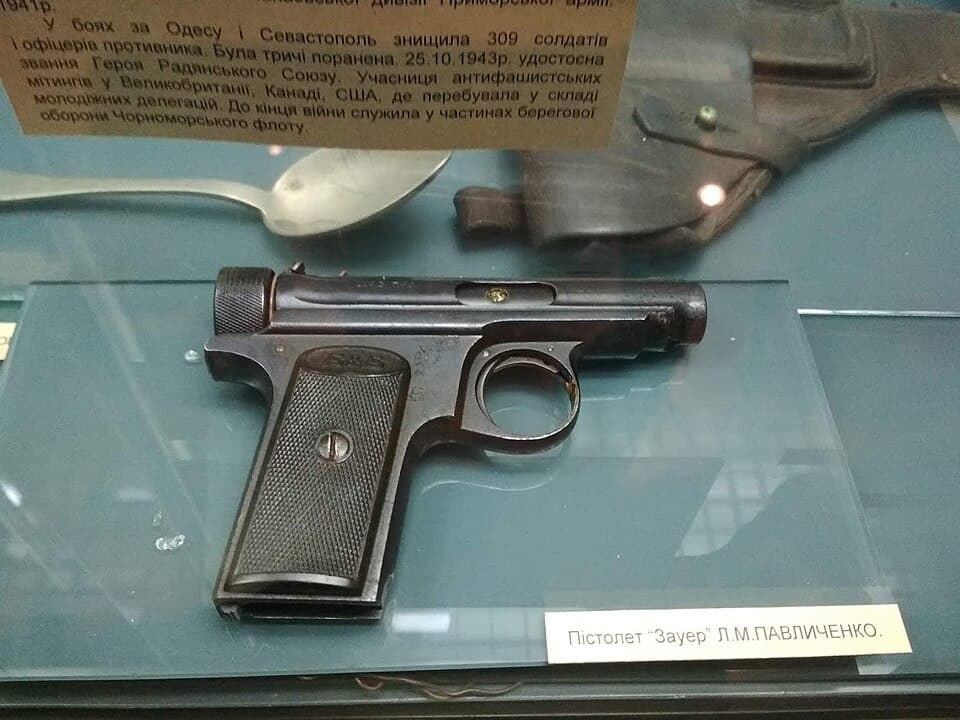
It is in the Oval Office of the White House, on this afternoon in August 1942, that President Franklin Delano Roosevelt receives the young Soviet senior sergeant Lyudmila Pavlichenko. The light falls on her khaki tunic, still marked by the dust of the fronts of Odessa and Sevastopol. The President, curious to understand the fighter behind the icon that the American press already calls Lady Death, questions her between official interviews. She has come to plead for a second front; he wants first to grasp who she is.
—I am told, Sergeant, that you have three hundred and nine enemy soldiers to your credit. How is such a number actually counted on the front?
Mr. President, each shot was recorded in a logbook, attested by a witness — without that, no victory was recognized by our headquarters. At Odessa, in seventy-three days of siege, I counted one hundred and eighty-seven. The rest came at Sevastopol. My rifle was a Mosin-Nagant with a PU scope, nothing extraordinary, but I knew it like my own hand. Thirty-six of my targets were themselves enemy snipers. Those ones, you see, were trying to shoot me at the same time I was aiming at them. A duel could last hours, sometimes an entire day of total immobility, each waiting for the other to blink, breathe, move. The first to weaken died. I did not weaken.
The first to weaken died. I did not weaken.
—You speak of waiting an entire day without moving. Tell me, in those long hours before dawn, what was your daily life as a soldier like?
I got up before daylight, Mr. President — that was the only time to reach my position without being seen. I checked the rifle, cleaned the scope, then I stayed with binoculars, silent, reading the terrain. We called it the ambush: immobility counted as much as accuracy. My camouflage suit, the khalat, was white on snow, green and brown in summer. Hunger, above all, never left us during sieges: black bread, buckwheat porridge, very strong tea when there was any. We slept in holes dug in the earth, in basements of gutted buildings. The Ukrainian cold seeped into the bones. One gets used to everything, except the silence before the shot.
Immobility counted as much as accuracy.
—Forgive my old man's frankness: that first fatal shot, do you remember it? What does one feel aiming at a living being?
I remember it, yes. They had put me to the test before entrusting me with a rifle — they doubted that a history student from Kiev could kill. The first German I shot, I felt nothing, and that is what troubled me. But understand: those men had crossed our border on June 22, 1941, they were burning our villages, they were shooting at our children. I no longer saw beings, I saw fascist occupiers on the soil of my homeland. Every target I eliminated meant one more comrade would live. The sniper does not hate; he calculates, he breathes, he waits. Emotion is saved for the evening, around a frugal meal, when one rereads letters from home.
I no longer saw beings, I saw occupiers on the soil of my homeland.
—So here you are in America, received at my home in Washington. You demand a second front. Do you really believe my fellow citizens understand what your war costs?
I believe so, Mr. President, because I spoke to them bluntly. In Chicago, before a hundred thousand people, I told them I was twenty-five years old and already had three hundred and nine fascists to my account — and that they had been hiding behind my back for too long. The crowd rose. Your workers understand, I think, that our fight is also theirs. While we talk in this office, men are dying in Sevastopol by the thousands every week. A second front in the West would not be a favor to Moscow: it would be the war finally waged on two fronts, as it must be. I did not come to beg. I came to tell the truth of the front to those who have not seen it.
I did not come to beg. I came to tell the truth of the front.
—The press in my country harasses you with questions about your clothes, your hair. Doesn't that irritate you, coming from the fire?
At first, it stunned me. A female journalist asked me if Soviet women wore lipstick in combat. I calmly replied that I represented a country fighting for its survival, and I saw little point in talking about my lingerie. People laughed, applauded — but understand my discomfort, Mr. President. Where I come from, I was judged on my shots, not on my skirt. Your reporters wanted a curiosity, a pretty exotic soldier. I had to teach them that the uniform I wear, I earned in the mud of Odessa. A woman can hold a rifle as straight as a man. Perhaps that is the real scandal they dare not name.
I was judged on my shots, not on my skirt.
—When you crossed the threshold of this White House, you were the first Soviet citizen ever received by a president. How did you feel at that moment?
I confess, Mr. President, the girl from the shooting club of Kiev did not expect to shake the hand of the President of the United States. When you received me earlier, and the photographers rushed in, I thought of my comrades left in the trenches of Crimea — they will never see this office. This handshake is not mine: it is that of millions of Soviets holding the front. They tell me my image will go around the world as a symbol of our alliance. So be it. If a photograph can hasten by even one day the arrival of your soldiers in Europe, then it is worth all the speeches. I wear this honor as I wear my uniform: in the name of those who are no longer here to wear it.
This handshake is not mine: it is that of millions of Soviets.
—The nickname Lady Death now runs through all our newspapers. This legend being built around you — do you recognize it, or does it escape you?
That name, your journalists gave it to me, not I. Lady Death — it sounds good in a headline, I imagine. But on the front, I was not a lady, and death had nothing elegant about it: it was mud, blood, sleepless nights. I fear they are fabricating a movie heroine where there is only a soldier who did her duty. It does not displease me entirely, mind you: if this legend serves the cause, if it makes your fellow citizens understand that my people are bleeding, then let them tell it. But between us, Mr. President, I would prefer they remember the three hundred and nine reasons for that nickname rather than the nickname itself.
They are fabricating a movie heroine where there is only a soldier who did her duty.
—Your doctors, I am told, pulled you from the front. You, a front-line fighter. How did you receive that decision?
With anger, Mr. President, I will not hide it. I was wounded four times; the last time, a mortar fragment tore my shoulder at Sevastopol. I begged to be sent back to the fire as soon as I could stand. They refused. They told me I had become too precious a symbol to risk under a bullet. Understand my pain: my comrades were fighting and dying while I was paraded through drawing rooms. A soldier wants to serve where the shots are fired, not where speeches are made. I eventually accepted it, because an order is an order, and because they entrusted me with something else — training those who would take my place in the scope. It was another way to continue the fight.
A soldier wants to serve where the shots are fired, not where speeches are made.
—You say you train new shooters. What exactly does one pass on to a young soldier who will take your post facing the enemy?
First, one passes on patience, Mr. President — it is patience that kills, long before the bullet. A beginner wants to shoot fast; I teach them to wait, to breathe, to blend into the terrain until they are nothing but a shadow. I teach them the ambush, camouflage according to the season, the art of spotting the counter-sniper before he spots you. Many of these techniques, I learned in blood, at my own expense, in Odessa. If I can spare a young soldier the mistake that nearly cost me my life, then my wound will have served some purpose. The Soviet school of marksmanship is not just about accuracy: it is a discipline of body and mind. I am not training assassins. I am training guardians of our land.
First, one passes on patience — it is patience that kills, long before the bullet.
—Before you hit the road again, tell me: what will you bring back from this America to your comrades still there, in the snow?
I will tell them that your workers welcomed us with warmth and brotherhood, that they understood, themselves, that our fight is also theirs. I will tell them that I spoke to immense crowds that rose for us. But I will also tell them the truth, Mr. President: that words do not hold a trench and ovations do not stop a tank. What we need is that second front, now, not tomorrow. I take from your country one certainty: the American people are with us. It remains to be seen whether their leaders will follow as fast as their hearts. You are, I believe, the best placed to answer that question — and it is to hear it that I crossed the ocean.
Words do not hold a trench and ovations do not stop a tank.
This imaginary interview was generated by artificial intelligence from sources documented in Lyudmila Pavlichenko's profile. It dramatises what the figure might have said based on what we know about them, but does not constitute attested historical testimony. For primary sources and factual documentation, refer to the full profile.