Kids interview Lyudmila Pavlichenko
by Charactorium · Lyudmila Pavlichenko (1916 — 1974) · Military · 5 min read
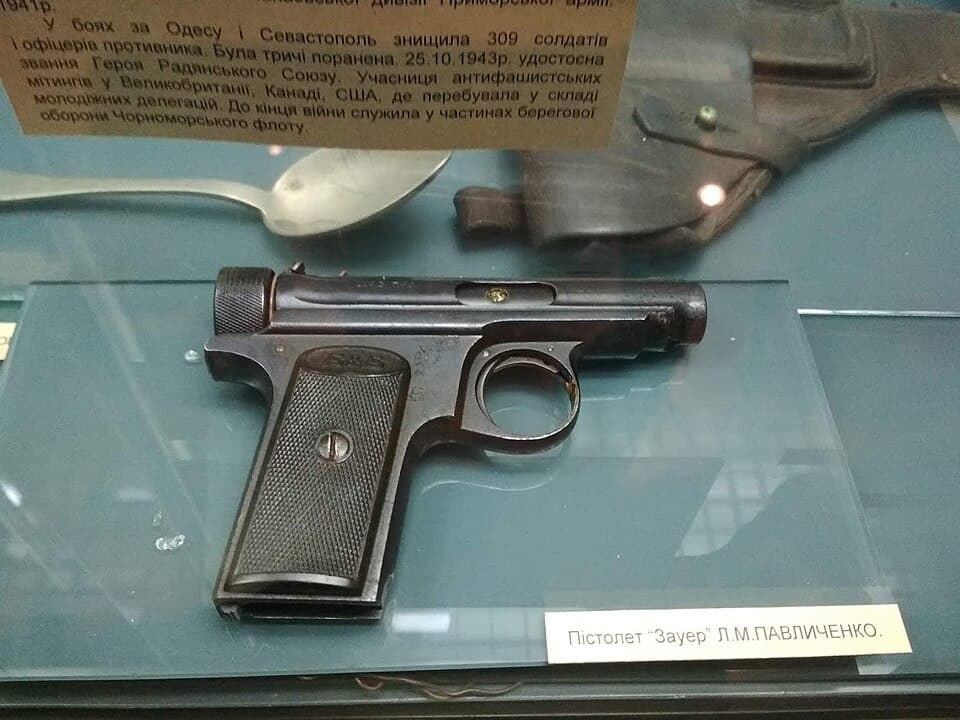
Two twelve-year-old students, on a class trip, have the chance to meet Lyudmila Pavlichenko. A little intimidated, they sit down opposite the most feared sniper of the war. And they discover a woman who speaks to them very softly.
—How did you become a sniper? Were you born with a rifle in your hands?
You know, my child, I didn't grow up with a rifle. In Kiev, I was a history student at the university. One day, I joined a sport shooting club, just for the fun of aiming straight. Imagine a young girl training on Sundays, not suspecting it would change her whole life. When the enemy invaded my country in 1941, I was offered to be a nurse. I refused. I knew how to handle a weapon, so I wanted to fight as a soldier. That's how a simple hobby became my duty.
—What was it like to stay hidden for hours without moving? It must have been horrible.
Imagine you have to lie still, in the mud, from dawn till night, without moving a single finger. That was the ambush — we called it zasada. I would crawl into position before dawn, in the dark, the only time I could move without being seen. I wore a camouflage suit, the khalat: white on snow, green in summer, to blend into the surroundings. Sometimes I didn't fire a single shot all day. Patience, you see, was my most important weapon. Far more than the rifle itself.
Patience was my most important weapon, far more than the rifle.
—Were you afraid when the enemy also had a sniper facing you?
Yes, I was afraid. Anyone who tells you otherwise is lying. Of my 309 enemies, 36 were snipers themselves. And those, you see, were looking for me as much as I was looking for them. A duel could last hours, sometimes whole days. Two people lying still, each waiting for the other to move their head one second too long. The first to move loses their life. My heart beat hard, but my hands had to stay calm. It's a terrible thing to aim at another human being. But he had come to burn my land.
—Where was your first big battle? Did it last long?
At Odessa, a beautiful city on the Black Sea. I fought there for 73 days, in the fall of 1941. The city was surrounded — that's called a siege: the enemy cuts off the city from everything to starve it and force it to surrender. There I counted 187 of my victories. Imagine streets in ruins, buildings gutted where you hide in basements. We slept in holes dug in the earth. Hunger gnawed at us, black bread was scarce. But we held on, day after day, because behind us were our families.
—Were you wounded? What forced you to stop?
Four times, yes. The last time, in 1942, at Sevastopol, a mortar fragment tore my shoulder. The mortar is a cannon that fires shells very high, and they fall on you without warning. I was evacuated from the front. I wanted to go back to combat, I asked again and again. But my commanders refused. They said I had become too precious a symbol to risk my life. It's strange, you know: I had survived enemy bullets, and it was my own legend that finally took me away from the trenches.
—Is it true you went to speak in front of lots of people in America?
Yes! In 1942, I was sent far away, across the ocean, to the United States and Canada. Imagine a young woman in military uniform, standing before tens of thousands of people. My mission: to convince them to open a second front, that is, to attack the enemy in the west to relieve my country in the east. I even shook hands with President Roosevelt, at the White House. In Washington, I told those men that I was 25 years old, that I had already killed 309 invaders, and that they had been hiding behind my back for far too long.
—Did they ask you strange questions there? About you, I mean?
Ah, I remember that very well! In Chicago, before 100,000 people, a journalist asked me... whether Soviet women wore lipstick in combat! Can you imagine? I had just come from a country that was burning. I answered her very calmly: “Gentlemen, I am a representative of a country fighting for its life. I see no point in discussing my underwear.” The whole crowd stood up to applaud me. You see, my child, sometimes a quiet sentence hits much harder than a shout.
Sometimes a quiet sentence hits harder than a shout.
—How did you become famous? Did people know you everywhere?
It's true, I became a kind of legend. The Americans called me Lady Death, because of my 309 victories. Over there, a singer, Woody Guthrie, even wrote a song about me! It's unsettling, you know, to become an image. People no longer saw the young woman who was afraid at night in her hole of earth — they saw an untouchable heroine. In 1943, I received the title of Hero of the Soviet Union, our highest distinction. But deep down, I remained simply a girl from Kiev.
—How did it feel to see your face everywhere, on stamps and newspapers?
Honestly, it was strange. My country used me to give people courage — that's called propaganda: images and speeches to rally public opinion. As early as 1943, my portrait was on a stamp, and they reprinted it much later. Imagine seeing your own face stuck on a letter that strangers send to each other! Part of me was proud of it, I admit. But another part felt lonely. Because behind the heroine Lady Death, there was always a woman who had known mud, hunger, and fear.
—After your injury, what did you do? Did you stay at home?
Oh no! Since I was forbidden to fight, I looked for another way to serve. From 1943 until the end of the war, I trained new snipers. I passed on everything to them: how to breathe before firing, how to stay still for hours, how to read the wind. Imagine a schoolteacher, but whose lessons could save lives on the front. Every young soldier I trained was a bit of my experience that continued to fight, even when I could no longer do so. Passing on knowledge, you see, is also a way to fight.
—If you could tell us one thing to remember, what would it be?
Much later, in 1965, I wrote my memoirs. All I wanted, you see, was to protect my homeland. I had never dreamed of being a soldier, but when the invader set foot on our land, I had no choice. In Moscow, I became a military historian again, like the student I had been. If I have to leave you with one thing, my child, here it is: war is not a glory, it is a terrible duty. I hope that you will never have to hold a rifle. Instead, study history — to understand why we must never repeat it.
War is not a glory, it is a terrible duty.
This imaginary interview was generated by artificial intelligence from sources documented in Lyudmila Pavlichenko's profile. It dramatises what the figure might have said based on what we know about them, but does not constitute attested historical testimony. For primary sources and factual documentation, refer to the full profile.