Imaginary interview with Marcus Aurelius
by Charactorium · Marcus Aurelius (121 — 180) · Philosophy · Politics · 6 min read

Night falls on the camp at Carnuntum, on the banks of the swollen Danube. Under the praetorium tent, an oil lamp illuminates a man crouched over wax tablets — the emperor who commands by day and questions himself by night. He agrees to put down the stylus for a moment to answer.
—Your Meditations were never meant for any eyes but your own. How did this habit of writing for yourself alone begin?
I never thought of composing a book. What today is called my Meditations I called my commentarii — mere notes, like a soldier keeping count of his watches. Each morning, before dawn, I addressed myself to remind myself of what the night had made me forget: that I am a man, and that the day would find me impatient, vain, quick to anger. Epictetus, whose lessons I reread in the evening, had taught me that you cannot correct a fault you have not first named. So I wrote. Not for those who would come after — the idea that anyone would read me one day would have made me smile — but so as not to lie to the only judge who never leaves me.
—You are described as a man who examined himself relentlessly. What were you seeking in this self-examination?
Peace, but not the kind one thinks. Men run through Rome from one forum to another to know what the neighbor thinks, what the Senate whispers, what is said of them at the palace. I too gave in to it. So I wrote this rule for myself one evening, in Book II: 'Do you waste your time thinking about what others are doing? Come back to yourself: seek in yourself the rule of your conduct, not in the opinion of men.' That is it. The apatheia my teachers preached is not the coldness of marble — it is ceasing to be tossed about by what does not depend on us. An emperor governed by rumor is emperor of nothing.
—On the Danube, you wrote by night after commanding by day. How did you hold these two lives together?
They were only one life, but the day showed me only half of it. At Carnuntum, my headquarters, the bright hours belonged to the legates, the reports from the limes, the councils where men's blood was decided. When the camp fell asleep, I became again the disciple I had always been. I do not think a man can order a battle in the morning if he has not, the night before, meditated on the brevity of it all. The death I dealt to the enemy I also carried within me; writing it at night kept me from giving it lightly. Zeno taught that living according to reason, the logos, is accepting one's part in the order of the world — even if that part is that of a man who kills reluctantly.
A man cannot order a battle in the morning if he has not, the night before, meditated on the brevity of it all.
—What did you write with, there under that tent, between battles?
Simple wax tablets — pugillares — which I scratched with a stylus and smoothed with a thumb when the thought slipped away. A lucerna, my oil lamp, whose flame trembled under the river wind. Nothing monumental: a man crouched on his knees, like a legion scribe. My teacher Fronto had trained me in eloquence, in brilliant periods, and I hold him dear for it. But I wrote to him one day: 'I thank you, my master, for teaching me to express what I feel with true words. But philosophy now teaches me that words must serve truth, not ornament.' On wax, you do not write to please; you write what holds, or what does not hold.
—In 166, a terrible epidemic returned from the East with your legions. How did you endure this scourge?
As one crosses a river in flood: without the illusion of coming out dry. The disease — a fever that covered the skin with pustules — entered Rome with the victorious soldiers from Parthia, and it would not leave for twenty years. I had the dead burned even in my own gardens, so that the contagion would not gnaw at the city. I ordered public funerals at the treasury's expense for the poor left without burial. And as the legion ranks emptied faster than the enemy fell, I armed gladiators, slaves, men never thought worthy of the gladius. I was reproached for emptying the arenas; I replied that an empire is not defended with games. The plague taught me what my books already said: nothing belongs to us, not even the next breath.
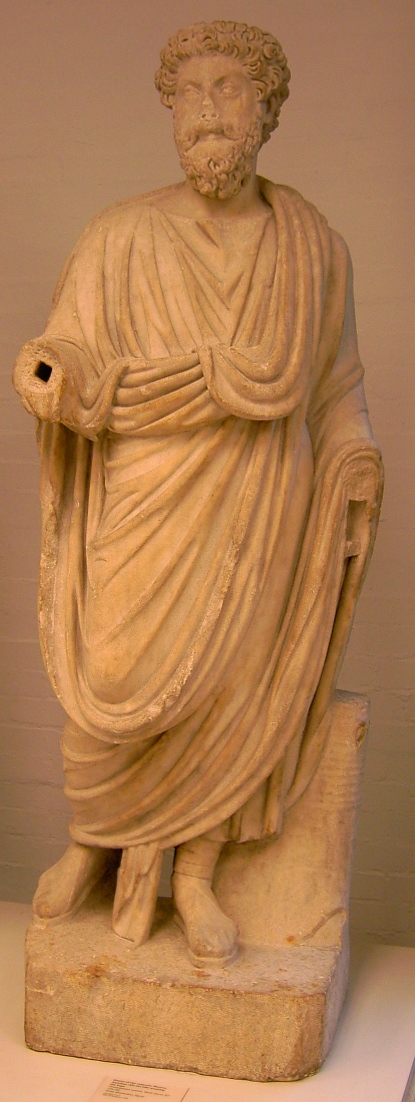
—For the first time in centuries, Germanic peoples crossed the Danube and threatened Italy. What did you feel facing this danger?
That the world owed nothing to Rome's greatness. The Marcomanni and their allies crossed the limes in 167, and their push came almost to the gates of Italy — our fathers had not seen that. I left the marble of the Palatine for the mud of the camps, and I hardly ever returned. I am sometimes painted as a dreamy philosopher; yet I spent most of my reign under canvas, plugging a frontier that leaked everywhere. Perhaps another, after me, will make these lands won back at the cost of so many winters — I do not know, and that is well. The Stoic does not ask if his work will last. He does what is his, and leaves the rest to the logos.
—You enacted laws protecting slaves and orphans. Where did this concern for the weakest come from?
From a simple idea my teachers repeated: all men share the same logos, the slave as well as the senator. If that is true in the school, it must also weigh in the law. So I limited the power of masters over the lives of their slaves — a master is not a god — and watched over wards, orphans, those whom no one defends. The Greeks call this philanthropia; I called it more modestly doing my part. Hadrian, who had chosen me as a child, said, it is said, that I was truer than gold; I do not know if I deserved the word, but I wanted the law to be truer than custom. To govern is not to rise above men: it is to remember that one is one of them.
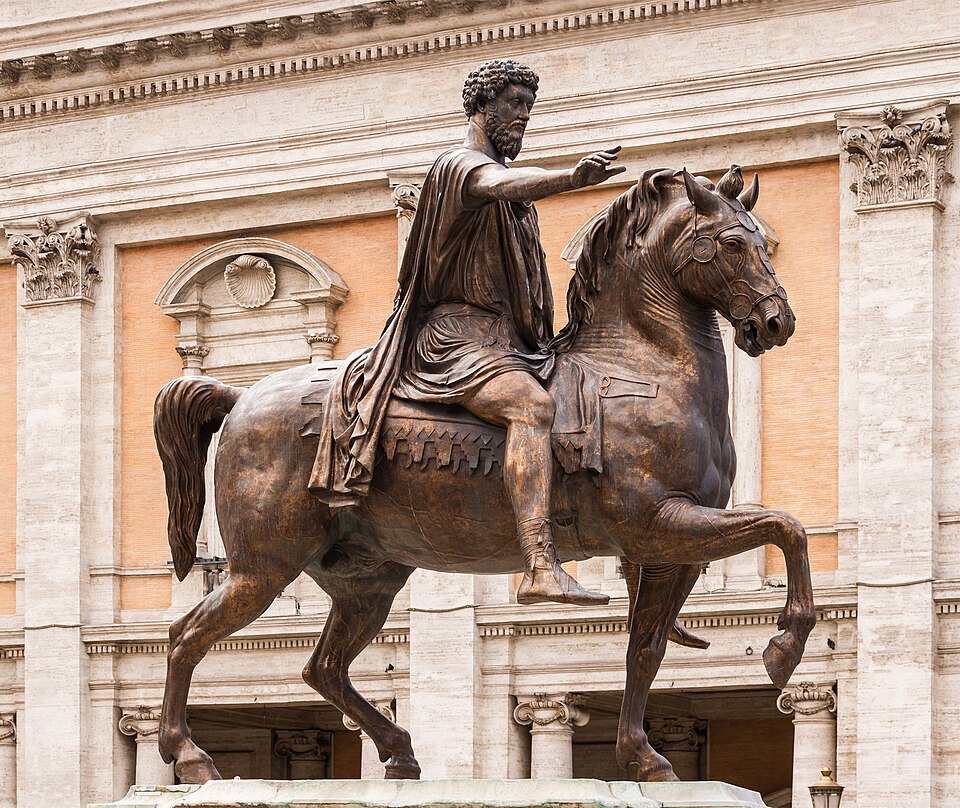
—In 175, your best general, Avidius Cassius, proclaimed himself emperor. You pardoned him rather than punished him. Why?
Because vengeance is a confession of weakness disguised as justice. When the news came — Avidius Cassius, clad in purple in the East — I first thought not of him, but of what I would become if I hated him. A man had taken my trust; would he also take my clemency? The rebellion died before I crushed it: his own camp killed him. I was almost saddened, for I had hoped to pardon him face to face, to show him that one can disarm an enemy without shedding his blood. I burned his correspondence unread, so as not to be tempted to seek accomplices. My Meditations say it in their own way: the best way to avenge yourself on a man is not to become like him.
Vengeance is a confession of weakness disguised as justice.
—You shared the throne with your adoptive brother Lucius Verus. How does one live as two at the summit of an empire?
One lives by remembering that neither of them owns it. On the death of Antoninus, in 161, I could have reigned alone; I wanted Lucius Verus at my side and made him my equal — Rome had never had two Augusti together. He was said to be frivolous, more a friend of pleasure than of paperwork; it was true, and I knew it. But you do not correct a brother by humiliating him before the Empire. In public I defended him; between us, I rebuked him. Duty, you see, is not to have only good companions — it is to hold your rank with those fate gives you. When he died, in 169, I bore the burden alone, and I believe the heaviest part was having no one left to spare.
—You, who were chosen for your virtues, appointed your own son, Commodus, as successor. Many saw it as a betrayal. What guided you?
You touch my wound there. Since Nerva, the Empire had passed to the worthiest and not the closest by blood — four emperors chosen as one chooses a good steward, and I was the fifth. In 177, I associated Commodus, my son, with the purple. Was it a betrayal of what had made me? Perhaps. But I had no other living son, and setting mine aside would have opened the door to ten claimants and the civil war that plague and Germans had barely spared us. I bet on education against birth, hoping to form the man that blood does not guarantee. If the future proves me wrong — and I sense it might — let this at least be remembered.
I did what seemed least unjust, knowing that no choice was entirely so.

This imaginary interview was generated by artificial intelligence from sources documented in Marcus Aurelius's profile. It dramatises what the figure might have said based on what we know about them, but does not constitute attested historical testimony. For primary sources and factual documentation, refer to the full profile.