Imaginary dialogue between Pierre Curie and Marie Curie
by Charactorium · Marie Curie (1867 — 1934) · Sciences · 6 min read
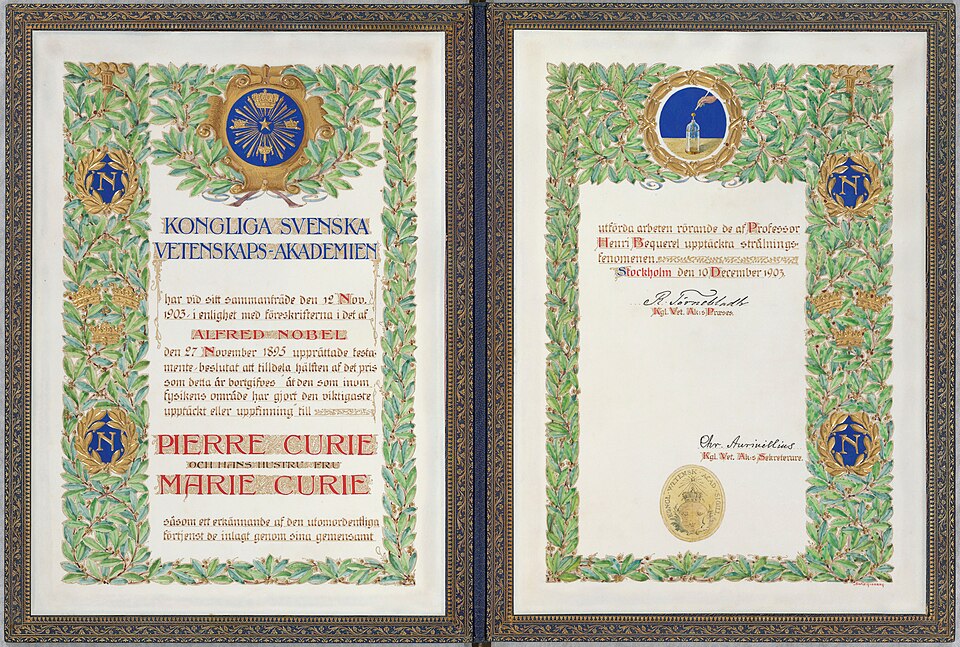
It is spring 1905, and pale April light falls through the grimy skylights of the hangar on rue Cuvier, striping the workbenches and their rows of glass vessels and stoppered vials. On the far table, in the dimmer corner, a small tube of radium salts glows with the faintest blue luminescence — barely perceptible in daylight, but neither of them needs darkness to know it is there. Pierre Curie sets down his notebook and looks across at Marie, his wife and the person with whom he has shared this cramped, acid-smelling shed for seven years; the Nobel diplomas are at the apartment in Sceaux, but here, among the instruments, everything is still simply work. Pierre has questions he has never thought to ask in words before.
—Marie, do you remember the evening you first looked at the pechblende readings — what convinced you a new element was hiding in that ore?
You were there, so you know exactly what the numbers showed. The radioactivity of the raw ore was far stronger than uranium alone could explain, and that gap refused to close no matter how many times I checked the instrument. We had two choices: accept that the electrometer was wrong, or accept that something unknown was present. I was not prepared to distrust the electrometer — you had built it with too much care. That discrepancy became the entire project. Everything that followed — four years of grinding and dissolving and filtering, tonne after tonne of ore shipped from Bohemia — rested on that single refusal to let one number go unexplained. I think this is the only true discipline in experimental science: not allowing yourself to be satisfied when the measurements do not agree.
I was not prepared to distrust the electrometer — you had built it with too much care.
—We worked in terrible cold, with acid vapours and no proper ventilation. What kept you going through the worst of it?
The arithmetic kept me going — the knowledge that each batch brought the concentration a little higher, that the count on the electrometer was slowly, measurably climbing toward something real. I will admit the hangar was dreadful. The winters made the acid crystallise in the vessels, the roof leaked, and more than one afternoon I spent coughing with the doors thrown open in the freezing air. But there is a satisfaction in work that demands both the body and the mind at once. Stirring a boiling vessel while watching an instrument reading requires a divided attention I found, oddly, calming. What I resented was not the hardship but the waste of time that proper equipment would have prevented. The radium was there regardless. We simply had to be patient enough to reach it.
—You have said so little to me about Warsaw — about learning in borrowed apartments. What did clandestine study give you that the Sorbonne never could?
It gave me the habit of learning without anyone's sanction. At the Flying University meetings in private drawing rooms in Warsaw, there were no diplomas to be earned, no examinations to pass, no professor whose approval mattered — only the ideas and the seriousness of the small group gathered around them. The women who organized those sessions had understood something I have never forgotten: that an institution can exclude you, but it cannot revoke your capacity to reason. When I arrived in Paris in 1891, I already knew how to teach myself. The Sorbonne gave me credentials, colleagues, and laboratory access — all of which mattered enormously. But the determination had already formed. I did not need permission to think.
An institution can exclude you, but it cannot revoke your capacity to reason.
—From the Flying University in Warsaw to your post at Sèvres — you are now on the other side of the teaching. Has that surprised you?
It surprises me less than it perhaps should. Teaching at Sèvres is different in every practical way from those Warsaw evenings — there is a building, a curriculum, a title, students who have been officially enrolled. But the underlying obligation feels the same: you have understood something, and someone else has not yet, and the entire task is to make the passage between those two states as clear and as honest as possible. What I notice most at Sèvres is the students' relief when they find that a woman can explain physical phenomena precisely and rigorously. I find that relief unnecessary, and also telling. I hope in time it disappears entirely — that it simply becomes unremarkable for a woman to stand at a lectern and work through an equation.
—After Stockholm, several newspapers described you as my collaborator, barely mentioning your name. Did that surprise you?
I had expected it, which perhaps made it worse. There is a logic to it I understand and refuse to accept simultaneously. It is easier for people to imagine a discovery of this kind coming from one clear source — preferably a man — than to hold the actual process in mind, which was genuinely shared. You and I designed the experiments together, compared readings together, argued about interpretations together. The polonium and the radium emerged from that exchange, not from either of us alone. What troubles me more than the newspaper attributions is the deeper assumption behind them: that a woman in a laboratory must by definition be secondary. That assumption will not be corrected by one Nobel Prize. It requires a generation of evidence, and I intend to provide as much of it as I am able.
—You have always said the radium belongs to everyone, not to us. Is that conviction, or deliberate policy?
It is conviction, and I will tell you why: because the alternative seems to me absurd. We did not create the properties of radium — we found them. The radioactivity was there before any instrument was pointed at it, before either of us was born. What we did was develop the method and the patience to isolate the material and measure its behaviour precisely. That is important work, but it is not the same as invention. I am wary of anything that would place a fence around a natural phenomenon and call it property. The science must remain open — open to verification, to contradiction, to improvement by whoever comes after. If I lock the radium behind a patent, I do not protect a creation; I obstruct the next person who needs to work with it.
—Röntgen's rays are already being used in surgery — broken bones, foreign fragments. How far could you bring that work closer to the patient?
I think about this often, and I believe the main obstacle is not the X-ray tube itself but the power source — generators are heavy and require maintenance. But none of this is fixed; the technology will become smaller and more reliable. There is no fundamental reason a mobile unit could not be built: a vehicle, a generator, a tube, an operator trained to produce and read a clear image. In emergency medicine, in a field hospital, the difference between localising a metal fragment in a wound and not localising it can be the difference between a life and a death. If the equipment can be brought to the patient rather than waiting for the patient to reach a fixed laboratory, the possible applications expand enormously. I find myself imagining what a well-organised network of such units could accomplish.
—Would you train the operators yourself — including women, if they were willing and capable?
Especially women, if they were willing and capable. The competence required is specific but not arcane: understanding the geometry of the image, handling the equipment safely, reading the plate clearly enough to guide a surgeon. There is no reason a woman cannot acquire this as well as a man, and several reasons she might be more readily accepted in certain medical settings. I have always believed that practical scientific training — as opposed to purely theoretical education — is one of the most direct routes to demonstrating what women are capable of in technical fields. If I had the resources and the occasion, I would establish such training myself. The science is already there. What is missing is the will to organise it and the conviction that those being trained can carry it out. On the second point, I have no doubts whatsoever.
—I have seen you carry a tube of radium in your pocket even at home. Does the glow not unsettle you at all?
The glow is beautiful, Pierre — you know that as well as I do. In a dark room, that faint bluish luminescence is one of the most striking things I have ever seen in a laboratory, and I confess I am not unmoved by it. Whether it should unsettle me is another question. We know the rays affect living tissue — we have both experienced that on our hands. Whether sustained proximity to the material itself carries a serious long-term risk, I cannot say with certainty because the necessary measurements do not yet exist. What I can say is that I am more careful than I was five years ago: I no longer hold the tubes by hand for extended periods, I handle concentrated preparations less casually. The question of danger is real and needs proper investigation. But the beauty of the phenomenon and the work are not, for me, separate things.
—Our hands have both changed — the skin, the sensitivity. When you look at yours, what do you think?
I think the price of the work is written there, and that I do not yet know the full ledger. My hands are roughened and discoloured in ways that soap and rest do not correct, and the sensitivity in certain fingertips has changed — I have noticed this for two or three years without quite naming it. Whether this is a consequence of the acid work or of the radium itself, or some combination, I cannot yet determine. I hold the question open because it is not yet answerable, but I do not hold it lightly. If it turns out that the material we have spent seven years concentrating is also affecting the health of those who work with it, that will be essential to know — not to abandon the work, but to understand it and handle it differently. The science cannot be built only on what is pleasant to discover.
The price of the work is written there, and I do not yet know the full ledger.
This imaginary interview was generated by artificial intelligence from sources documented in Marie Curie's profile. It dramatises what the figure might have said based on what we know about them, but does not constitute attested historical testimony. For primary sources and factual documentation, refer to the full profile.