Imaginary interview with Mary Anning
by Charactorium · Mary Anning (1799 — 1843) · Sciences · 6 min read
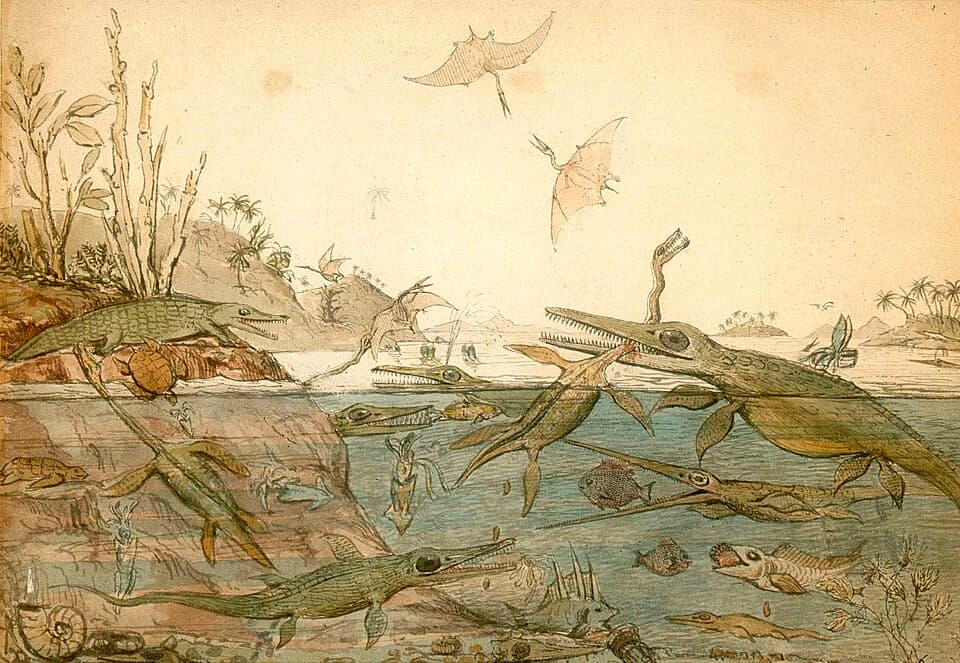
Lyme Regis, a low-tide morning. The mist lifts from the blue-gray cliffs of Dorset, and we find Mary Anning where she is always sought: on the foreshore, basket on arm and hammer in hand, eyes fixed on the freshly fallen strata. She agrees to sit for a moment on a rock to answer, without stopping listening to the sound of the rock.
—There's a story about a storm that supposedly marked your childhood. What happened?
I was fifteen months old, or so I was told, for I have no memory of it. A violent storm broke over Lyme Regis and lightning struck the group sheltering me. Three people died instantly; I alone was picked up alive. The neighbors, who love omens, have since sworn that this flame left me with a sharper mind than other children. I don't believe a word of it: what awakened me was the cliff, not the sky. Very early on, my father took me to scratch the rock after the spring tides, and it was there, nose to the pebbles, that I learned to see what others trample underfoot. Lightning makes a pretty legend; the hammer does the rest.
Lightning makes a pretty legend; the hammer does the rest.
—How did your life change after your father's death?
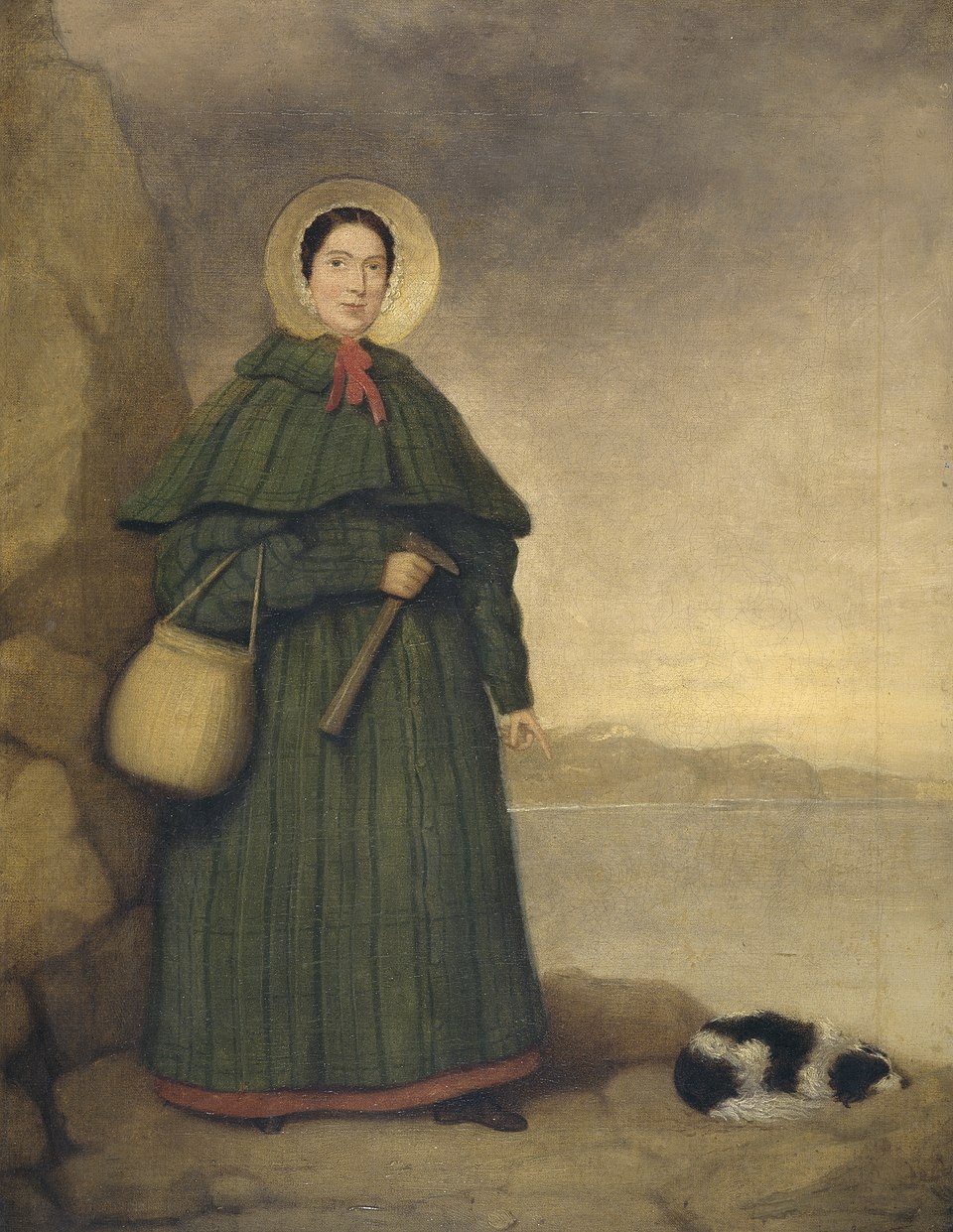
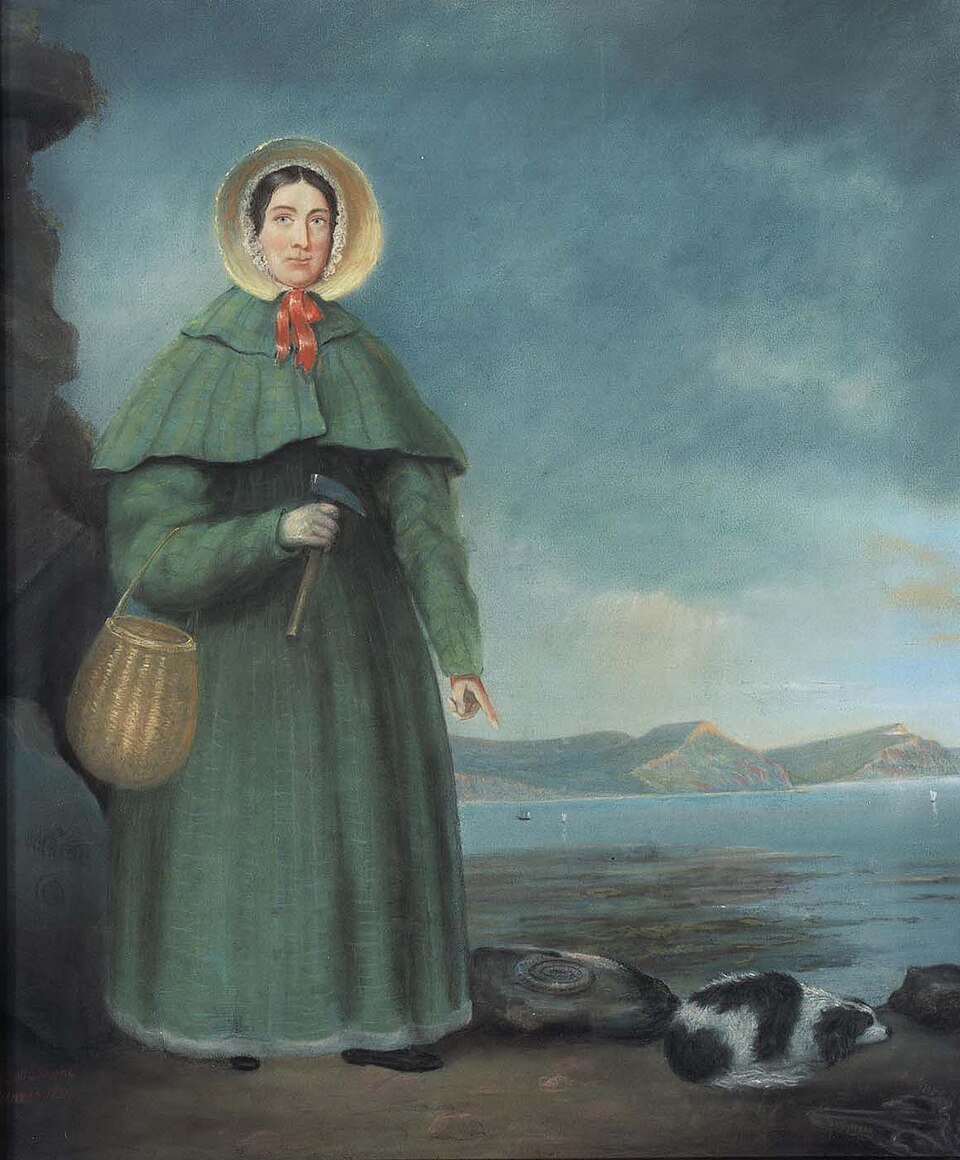
My father, Richard, died in 1810. He was a cabinetmaker, but his true passion, the one he passed on to me, was hunting for curiosities from the cliff, which he sold to visitors on the seafront. At his death, he left us only debts and a knowledge: where to look, when to look, how to extract a piece without breaking it. I was still a child, but the house on Church Street had to be fed. So I rose before dawn, my wicker basket and hammers of various sizes slung over my shoulder, and I went down to the foreshore when the sea retreated, for it is at low tide that the fresh rock yields its treasures. Selling shells and stone bones was not a lady's pastime: it was our bread.
—Do you remember the find that started it all, that first big skeleton?
It was in 1811. My brother Joseph first spotted a strange skull, long, lined with teeth and with an immense eye socket, protruding from the wall. It took months for the rest to appear to me, after a landslide uncovered the body; I cleared vertebra after vertebra from this complete skeleton nearly five meters long. It was later named ichthyosaur, the 'fish-lizard', though it was neither. At the time, no one knew what to make of it: a crocodile? a monstrous fish? The beast was sold for twenty-three pounds and ended up in London. I was not yet thirteen, but I had understood something that many still refused to admit: that animal no longer swam in any sea on earth. It had lived, and then vanished.
—Your plesiosaur, they say, caused quite a stir among scholars. Why all the fuss?
In 1823, I unearthed an almost complete skeleton with an enormous neck, four flippers, like a tortoise that had been stretched. The creature seemed so improbable that from Paris, the great Cuvier suspected it was a fraudulent assembly, bones glued together to deceive the world. Imagine the affront: I was taken for a forger. The Geological Society convened its gentlemen, they examined my drawings, they compared the stone. And Cuvier, an honest man, acknowledged that the beast was authentic, just as the rock had given it to me. That plesiosaur shook many certainties about the extinction of species. For me, it proved above all this: the cliff does not lie; it is men who doubt what their own eyes have not seen.
The cliff does not lie; it is men who doubt what their own eyes have not seen.
—Tell us about those stones called bezoars, which you learned to read differently.
Often, lodged in the belly of skeletons or nearby, we found small gray masses that the ancients called 'bezoars' or 'serpent stones', attributing magical powers to them. By breaking them open and examining the cross-section under a magnifying glass, I noticed they contained bones, scales, sometimes half-digested tiny bones. The conclusion was obvious: they were not stones, but the fossilized excrement of my reptiles, hardened over centuries. They were named coprolites. This may raise a smile, but think of what it reveals: through these humble droppings, in 1824, I could tell who ate whom in those vanished seas. The ichthyosaur fed on fish and sometimes its own kind. The cliff tells even the feasts of a thousand centuries ago.
—Your shop attracted the greatest geologists. How did those visits go?
My little shop on Church Street looked like nothing: a window, some stone bones, the back room where I cleaned my finds. Yet learned men came there from all over England. The Reverend Buckland would sit for hours listening to me; I showed him which layer held the fossil fish, and explained the order of the strata as surely as one recites a familiar path. De la Beche, my childhood friend, drew. I had received no university education; I copied entire memoirs of the Geological Society by candlelight at night to master them. My knowledge, I drew from my hands and my eyes, layer after layer. And these gentlemen in frock coats, who left with my observations in their notebooks, knew that better than anyone.
—Despite these visits and tributes, the learned societies remained closed to you. How did you experience that?
The Geological Society of London, founded in 1807, admitted only gentlemen. A 'naturalist', you see, was in the spirit of the time a gentleman of leisure and fortune, who collected for pleasure. I was a woman, and poor on top of that: two closed doors instead of one. I could provide the specimens, explain the rock, correct an error in a paper — but sit among them, never. They admired my hands and forgot my name. I do not say this out of bitterness; I observed it as one observes a tide. But there is something bitter about seeing a world feed on your work while leaving you at its door, your basket still full of foreshore mud.
They admired my hands and forgot my name.
—Your discoveries were often published under other names. What would you say about that?
Take my plesiosaur. It was Conybeare who wrote the paper and read it before the Society, under his name alone, in 1824; he acknowledged, of course, in his text, that the specimen came from my hands and that many additions to science had come from my cliff. But the credit, the public honor, the remuneration commensurate with the thing — that, I did not have. Such was the rule: the woman finds, the man names and signs. I accepted it because I had to live, not because I found it fair. Toward the end, the British Association for the Advancement of Science voted me a small annual pension; it was, I believe, the first time it was recognized that my stone bones were worth a salary. Late, but I took it.
—The cliffs you love so much nearly cost you your life. What happened in 1833?
The Jurassic Coast is generous, but it exacts a price. The rock that feeds me is also the one that crushes me. In 1833, during one of my ordinary outings, a section of cliff detached without warning. My faithful dog, Tray, who accompanied me everywhere on the foreshore, was killed outright under the debris; I escaped by only a step. I wept for that beast as one weeps for a work companion, for he was that. And yet, the next day, I went back down. What can I say: the tide does not wait for mourning, and the fresh rock yields its treasures only a few hours before the sea reclaims them. Hunting fossils is not a lady's walk: it is walking every day at the foot of a wall that may fall.
The rock that feeds me is also the one that crushes me.
—They say a famous nursery rhyme was inspired by you. Are you really that seaside seller?
They attribute to me that little rhyme, 'She sells seashells by the seashore', the one who sells shells by the water. If it owes me something, let it keep it: it is true that I spent my life selling the fruits of the cliff to tourists and collectors who came to take the waters at Lyme Regis. A belemnite, a well-polished ammonite, a vertebra of an ichthyosaur — each had its price, and on that price depended our table. They would have a scholar disdain commerce; for me, commerce allowed me to be a scholar. Without the coins left by tourists in my wicker basket, I could never have stayed on those cliffs to uncover the great beasts. My science always smelled a little of salt and merchandise.
They would have a scholar disdain commerce; for me, commerce allowed me to be a scholar.
This imaginary interview was generated by artificial intelligence from sources documented in Mary Anning's profile. It dramatises what the figure might have said based on what we know about them, but does not constitute attested historical testimony. For primary sources and factual documentation, refer to the full profile.