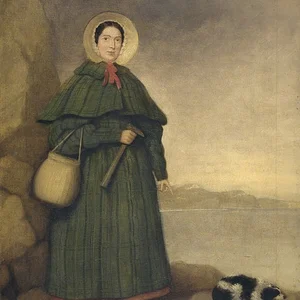

Mary Anning was a self-taught English paleontologist who, from childhood, collected fossils along the cliffs of Lyme Regis. She discovered the first complete skeletons of an ichthyosaur and a plesiosaur, revolutionizing the understanding of extinct species. Despite her major contributions, she was long excluded from scientific circles because of her sex and her modest background.
Mary Anning(1799 — 1843)
Mary Anning
Royaume-Uni de Grande-Bretagne et d'Irlande
7 min read
Frequently asked questions
Key Facts
- Around 1811–1812: discovery of the first complete ichthyosaur skeleton, together with her brother Joseph
- 1823: unearthing of the first complete plesiosaur skeleton
- 1828: discovery of the first pterosaur identified in Great Britain (Dimorphodon)
- Excluded from the Geological Society of London because of her sex, despite recognition from her peers
- Her work contributed directly to theories on species extinction and informed the thinking that preceded Darwin
Works & Achievements
Mary and her brother Joseph uncovered the first complete ichthyosaur skeleton (a Jurassic marine reptile) at Lyme Regis. This find was one of the first concrete pieces of evidence for the existence of extinct species.
Mary unearthed a nearly intact plesiosaur skeleton, sparking an international debate among scientists. The naturalist Georges Cuvier ultimately confirmed the authenticity of the specimen.
She discovered Dimorphodon macronyx, the first fossil flying reptile identified in Great Britain. William Buckland described the species but explicitly acknowledged Mary's role in the find.
Mary Anning was the first to understand that the 'bezoars' found near fossil skeletons were in fact fossilised excrement (coprolites). This discovery made it possible to study the diet of extinct species.
She identified a fossil of a shark-ray (Squaloraja) representing a transitional link between two groups of fish. Louis Agassiz, the foremost specialist in fossil fish, acknowledged the exceptional precision of her observations.
Anecdotes
At the age of fifteen months, Mary Anning was struck by lightning during a violent storm in Lyme Regis. Three people who were with her perished on the spot, but the little girl miraculously survived. Her neighbours attributed her exceptional intelligence and curiosity to this event.
In 1823, Mary Anning discovered the first complete plesiosaur skeleton ever unearthed. The palaeontologist William Conybeare, who published the findings under his name alone, nonetheless acknowledged that without her, the discovery would never have been made. Mary received neither official credit nor compensation commensurate with the scientific importance of the find.
In 1833, during one of her daily outings along the cliffs, a rockfall killed her faithful dog Tray and very nearly took her own life as well. She nonetheless continued her research in the aftermath of this tragedy, as selling fossils was the only way for her to support her family.
The English tongue twister 'She sells seashells by the seashore' is said to have been inspired by Mary Anning, who did indeed sell her fossil finds to tourists and collectors along the seafront at Lyme Regis.
Despite her groundbreaking discoveries, Mary Anning was never accepted as a full member of the Geological Society of London, which was reserved for men. She was, however, one of the first women to receive an annual pension from the British Association for the Advancement of Science, shortly before her death.
Primary Sources
I beg to inform you that I have lately discovered a new animal... which I believe will prove a great curiosity to all who take an interest in Natural History.
This specimen was discovered by Miss Mary Anning of Lyme Regis, in whose hands have been found so many valuable additions to our knowledge of the fossil ichthyosauri.
I dedicate these species to Miss Mary Anning, whose name deserves to be remembered by all those who are interested in the progress of science.
Miss Anning pointed out to me the layers in which the fossil fish are found, and explained with great accuracy the geological succession of the strata.
Key Places
Mary Anning's hometown, on the English Channel coast. The region's Jurassic cliffs are among the most fossil-rich in Europe, and it is here that she spent her entire life prospecting.
A 185 km coastline designated as a UNESCO World Heritage Site, of which Lyme Regis is the historic heart. Mary Anning was its first systematic explorer and revealed its exceptional palaeontological potential.
Several of the fossils discovered by Mary Anning are preserved and displayed there, including the 1811 ichthyosaur. She sold them to institutions and collectors who later bequeathed them to the museum.
A small shop run by Mary and her mother, where she displayed and sold her fossil finds. She welcomed renowned scientists there, including William Buckland and Henry de la Beche.
Typical Objects

An essential tool for Mary Anning to carefully extract fossils from the limestone cliffs. She always carried several of different sizes depending on the hardness of the rock.

The discovery of a complete ichthyosaur in 1811 was the find that launched Mary's career. These marine reptiles from the Jurassic era revolutionized the nascent field of palaeontology.

Mary transported her fossils in sturdy baskets during her expeditions on the beach. She would then sell them to collectors and museums to support her family's needs.

Mary used a magnifying glass to examine the details of fossils and belemnites. Despite having no academic training, she developed an expert eye recognised by the greatest scientists of her time.

She carefully recorded the exact location and nature of the geological layers where she found her specimens. Her notes are today considered valuable sources for modern geologists.
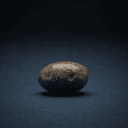
Mary Anning was the first to identify 'bezoars' as fossilised excrement from marine reptiles, later renamed 'coprolites'. This discovery made it possible to reconstruct the diet of prehistoric animals.
School Curriculum
Vocabulary & Tags
Key Vocabulary
Tags
Daily Life
Morning
Mary rose early, before the high tides, as it was the best time to prospect the freshly eroded cliffs. She set out alone or with her dog on the beach at Lyme Regis, her basket and hammers slung over her shoulder, methodically inspecting the Jurassic rock faces.
Afternoon
In the afternoon, she cleaned and prepared the fossils found that morning in the family's back shop. She occasionally received geologists and collectors who had come from across England, explaining local stratigraphy to them with great precision.
Evening
In the evenings, Mary read whatever scientific works she could obtain, studied fossil anatomy by candlelight, and wrote up her observations. She copied entire articles from the Transactions of the Geological Society by hand in order to have them in her personal library.
Food
Like most English working-class families of the 19th century, the Annings lived modestly: bread, cheese, garden vegetables, and fresh fish from the English Channel. Prosperous periods — following the sale of a major fossil — allowed them to eat meat and improve their daily fare.
Clothing
Mary wore a dark, practical wool dress, a waterproof cape on the frequent rainy days along the Dorset coast, and a bonnet tied under her chin. Her sturdy ankle boots were suited to walking on pebbles and slippery rocks.
Housing
The Anning family lived in a small, modest house on Church Street in Lyme Regis, whose ground floor served as both shop and workshop. The home was cramped but well known among the scientists and tourists who came to admire the fossils displayed in the shop window.
Historical Timeline
Period Vocabulary
Visual Style
Esthétique côtière victorienne austère : falaises jurassiques stratifiées en gris et ocre, lumière d'argent sur la Manche, personnage en tenue pratique dégageant des fossiles dans la roche.
Sound Ambience
L'univers sonore de Mary Anning mêle le fracas des vagues sur les falaises jurassiques du Dorset, les cris des mouettes et les coups réguliers de son marteau de géologue sur la roche calcaire.
Liens externes & ressources
Références
Œuvres
Découverte du premier ichthyosaure complet
1811
Découverte du premier plésiosaure complet
1823
Identification du premier ptérosaure britannique (Dimorphodon)
1828
Identification des coprolites
1824
Découverte du Squaloraja (poisson fossile)
1829