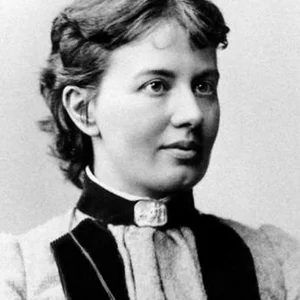

Sofia Kovalevskaya (1850–1891) was the first woman to earn a doctorate in mathematics in Europe and the first female professor of mathematics at a modern university. A pioneer in analysis and mechanics, she broke through the barriers of the male academic world to establish herself as a leading mathematician.
Sofia Kovalevskaya(1850 — 1891)
Sofia Kovalevskaya
Suède, Empire russe
8 min read
Frequently asked questions
Famous Quotes
« It is impossible to be a mathematician without having the soul of a poet.»
« Many things that seem impossible until they are accomplished.»
Key Facts
- 1874: earned her doctorate in mathematics from the University of Göttingen, becoming the first woman in Europe to receive such a degree
- 1883: appointed professor at Stockholm University, the first woman to hold such a position at a modern European university
- 1888: won the prestigious Prix Bordin from the Paris Academy of Sciences for her work on the rotation of rigid bodies
- Her research focused notably on partial differential equations and the theory of Saturn's rings
- 1891: died at age 41 from pneumonia, leaving behind a major body of mathematical and literary work
Works & Achievements
A landmark mathematical memoir on classical mechanics that solves the complex problem of the rotation of solid bodies. This work earned her the Bordin Prize from the Paris Academy of Sciences.
An innovative mathematical study on the stability of Saturn's rings using the theory of differential equations. This work demonstrates the concrete application of mathematics to astronomy.
A major contribution to mathematical analysis on functions of complex variables, produced as her doctoral dissertation and recognized for its rigor and originality.
A mathematical study of light refraction phenomena that applies partial differential equations to physical optics.
An academic career at the Royal University of Stockholm, where she became a professor of mathematics — the first female professor in Scandinavia and one of the first in Europe.
An autobiographical literary work published posthumously that explores the challenges and passions of a woman scientist in the 19th century.
Anecdotes
As a child, Sofia Kovalevskaya had no means to buy mathematics textbooks. Her uncle had wallpapered her room with pages from Mikhail Ostrogradsky's differential calculus lecture notes. She would spend hours deciphering those mysterious formulas on the walls, developing an intuitive fascination for mathematics before she even knew the basics.
To study abroad — forbidden for women traveling alone in 19th-century Russia — Sofia entered into a marriage of convenience with paleontologist Vladimir Kovalevsky in 1868. This legal arrangement allowed her to obtain a passport and travel to Germany, first to Heidelberg then to Berlin, where she took private lessons with the great mathematician Karl Weierstrass.
A skeptical Weierstrass gave Sofia a series of extremely difficult problems he considered unsolvable for a beginner. She returned with original, elegant solutions the very next day. Astounded, he became her mentor for four years and later declared she was the most gifted student he had ever taught.
In 1888, Sofia Kovalevskaya won the prestigious Prix Bordin from the Paris Academy of Sciences for her paper on the rotation of a solid body around a fixed point. The usual prize was 3,000 francs, but the jury, impressed by the exceptional quality of her work, decided to raise the sum to 5,000 francs. It was the first time a woman had received this distinction.
Sofia Kovalevskaya was also a writer and playwright. She authored short stories, a stage play, and an autobiographical memoir titled 'Recollections of Childhood.' Her friend Dostoevsky — whom she had met as a teenager — said she could have been as great a novelist as she was a mathematician. She embodied the Romantic ideal of the 19th century: the woman of both science and letters.
Primary Sources
My father used to say that he never gave me any formal instruction in mathematics, but he often puzzled his head to invent problems and arithmetical tricks to keep me amused. I remember that I was not more than four or five years old when he showed me the wall of my room which had been covered with the manuscript pages of logarithmic tables.
The problem of the rotation of a solid body about a fixed point is one of the most important in mechanics, and its complete solution presents considerable difficulties.
I thank you most cordially for your kind letter. Your words have encouraged me greatly and given me new courage to continue my mathematical work.
I have always been convinced that a woman can do anything which a man can do, and this conviction, which arose in me during my childhood, has sustained me throughout my life.
Key Places
Sofia Kovalevskaya's birthplace in 1850. She grew up in an aristocratic family there and received her early education before going on to pursue advanced studies in mathematics.
The Russian capital where Sofia studied and developed her early passion for science. There she acquired the knowledge that would allow her to pursue an academic career.
A prestigious institution where Sofia studied mathematics under the mathematician Karl Weierstrass. She conducted foundational research there in mathematical analysis.
The city where Sofia secured a professorship at Stockholm University in 1889. She taught mathematics there and continued her scientific work until her death in 1891.
An important city in Sofia's academic life, where she studied and built connections with prominent European mathematicians in the 19th century.
A major European intellectual hub where Sofia also conducted research and maintained ties with the French scientific community. She presented her mathematical work there.
Typical Objects

Essential tools for scientific correspondence and the writing of mathematical papers. Sofia Kovalevskaya used these instruments to communicate with the greatest mathematicians of her time, most notably Karl Weierstrass.

Symbols of her teaching at Stockholm University, where she became the first female professor of mathematics in Europe. She used them to share her knowledge of mathematical analysis and mechanics.

Documents containing her groundbreaking research, including her work on the rotation of solid bodies and differential equations. Her writings left a lasting mark on 19th-century mathematics.

The formal attire of the Victorian era, worn at her academic presentations. It symbolizes her struggle to gain access to scientific spaces reserved for men, in defiance of prevailing social conventions.

Represents her work in astronomy and celestial mechanics. These tools were essential for the observations and mathematical calculations related to the astronomical phenomena she studied.

A symbol of her academic distinctions, including the Prix Bordin from the French Academy of Sciences in 1888, awarded for her outstanding mathematical work.

A representation of her correspondence with the German mathematician who served as her mentor and de facto academic sponsor. These letters document her scientific development and her recognition by the academic community.

Such as the Journal de mathématiques pures et appliquées, where she published her findings. These publications represent her major contribution to the dissemination of mathematical knowledge in the 19th century.
School Curriculum
Vocabulary & Tags
Key Vocabulary
Tags
Daily Life
Morning
Sofia wakes up in her university lodgings or residence, usually between 7 and 8 in the morning. She has a light breakfast of tea, bread, and cheese, then prepares for her studies or mathematical research. She dedicates the early hours of the day to reading and mathematical calculations, the activities she finds easiest to focus on.
Afternoon
Afternoons are often devoted to lectures, university seminars, or meetings with fellow scientists and mathematicians. Sofia moves in academic and intellectual circles, taking part in stimulating discussions. She also enjoys walking through the cities where she lives — Stockholm, Berlin, Saint Petersburg — visiting literary salons or attending scientific gatherings.
Evening
Evenings bring family or close friends together for dinner, usually a more substantial meal. Sofia then spends time on scientific correspondence, writing articles or mathematical papers. She also unwinds by reading literature or attending cultural performances, as she has a genuine appreciation for the arts and music.
Food
Sofia's diet reflects her standing as a woman of the educated Russian and European upper class in the 19th century. She regularly eats dairy products, bread, seasonal fruit and vegetables, as well as meat and fish. Tea and coffee are her everyday drinks, occasionally joined by wine or champagne at social gatherings.
Clothing
Sofia wears long dresses in keeping with Victorian and Russian 19th-century fashion, with fitted bodices and full skirts. For formal occasions, she dresses elegantly in high-quality, tailored clothing. She maintains a polished, distinguished appearance that reflects both her standing in Russian high society and her place in European academic circles.
Housing
Sofia lives successively in Russia, Switzerland (Zurich), Germany (Berlin), and Sweden (Stockholm), occupying residences befitting her elevated social status. Her homes are generally comfortable and well-furnished, with access to personal or university libraries. These spaces reflect her intellectual dedication and her life spent between continental Europe and her homeland.
Historical Timeline
Period Vocabulary
Visual Style
Un style pictural conjuguant le portrait académique du XIXe siècle avec l'imagerie scientifique et mathématique. L'ambiance évoque les salons savants victoriens, mêlant réalisme minutieux, notations mathématiques délicates et instruments de découverte, baignés d'une lumière chaleureuse et studieuse.
Sound Ambience
Une ambiance sonore de raffinement intellectuel du XIXe siècle, mêlant les notes délicates d'un piano aux bruits de recherche scientifique, aux conversations échangées en français et en russe, et à l'atmosphère poétique de la Russie aristocratique du siècle dernier.
Liens externes & ressources
Références
Œuvres
Théorie de la rotation d'un corps solide autour d'un point fixe
1888
Recherches sur la structure des anneaux de Saturne
1883
Sur les fonctions d'une variable complexe
1874
Mémoire sur la réfraction de la lumière
1883
Introduction aux mathématiques à l'Université de Stockholm
1884-1889
La jeune fille d'une scientifique (roman)
1892