Imaginary dialogue between Pape Grégoire IX and Mechthild of Magdeburg
by Charactorium · Mechthild of Magdeburg (1207 — 1282) · Spirituality · Literature · 5 min read
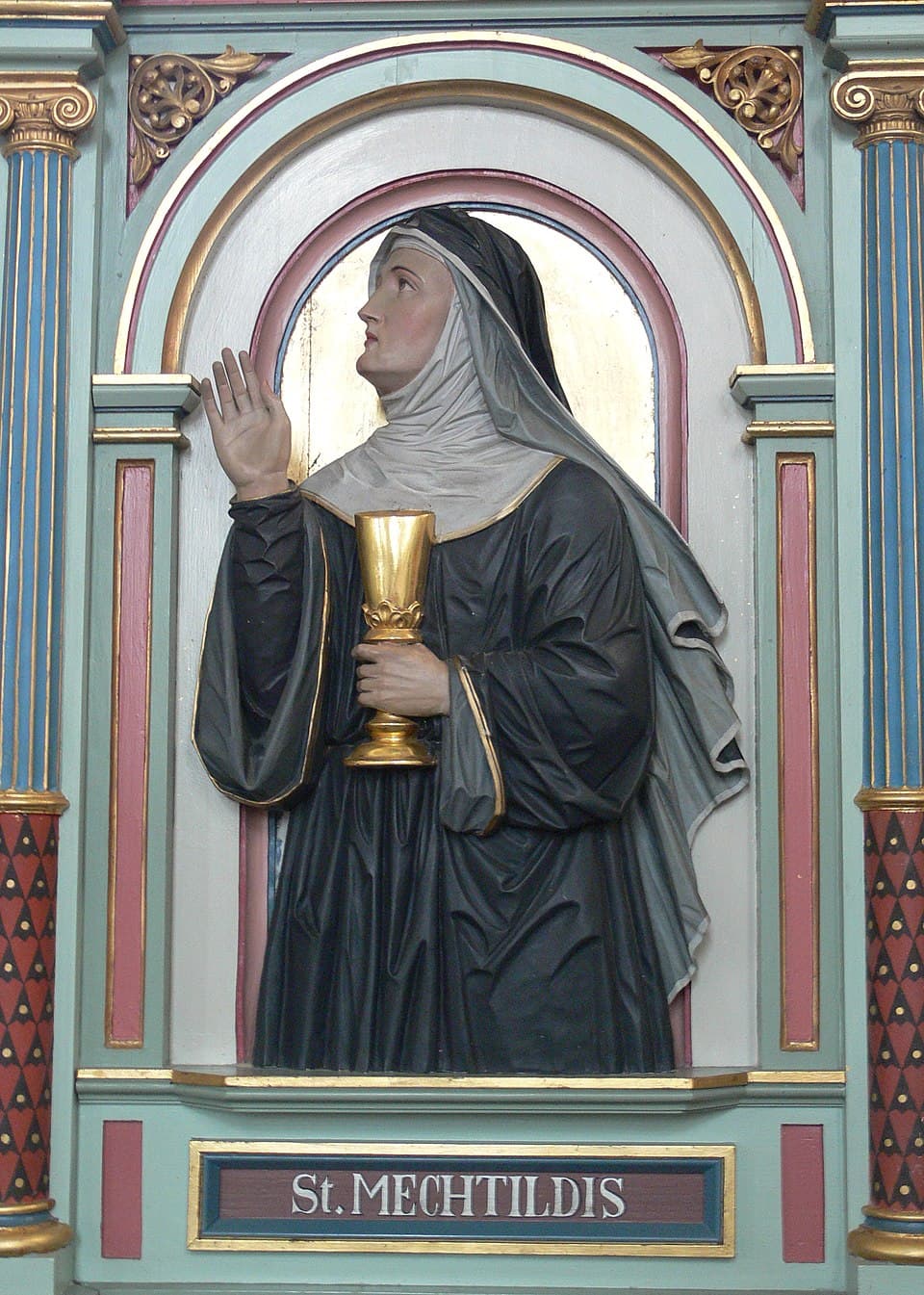
It is in a vaulted parlor in Magdeburg, in the year 1239, that a beguine dressed in grey is received by the legates of Pope Gregory IX, who has come in person to inquire about the visions that are being spoken of all the way to Rome. The light from a narrow window falls on her bare hands, without ring or seal. The pontiff, who has already chosen to protect these writings rather than silence them, observes her with grave curiosity. He approaches not as a judge, but as a father worried about the flame burning in a woman without habit or vows.
—My daughter, I am told that at twenty-three you left a courtly household for this grey veil. What did you flee?
Most Holy Father, I fled nothing: I followed. Since childhood, a light visited me, and my family's wealth weighed on my soul like a cloak. The day I entered the community of beguines in Magdeburg, I wept only one thing: that I had waited so long. I knew no one here, I was a stranger, without rank, without name. That was precisely what I desired — to be nothing in the eyes of men in order to be something in the eyes of God. The court offered me mirrors; the veil offered me silence. And in that silence, at last, I could hear Him.
The court offered me mirrors; the veil offered me silence.
—And what did that light tell you, my daughter? The visions of a woman always trouble my legates — explain to me what you receive.
I receive what I hardly dare name before you, Most Holy Father. Once, in prayer, I felt my soul expand in a sweetness that no human word can contain, and the Lord spoke to me. He called me His beloved spouse. How could a poor beguine bear such a word? I tremble as I repeat it. These are not images I fabricate in my head: it is He who descends, and I who stand, burning, to receive Him. I command nothing. I choose neither the hour nor the grace. I am only the cup into which love is poured, and which overflows despite itself.
I am only the cup into which love is poured, and which overflows despite itself.
—I am told that you write these things not in Latin, but in the language of the Saxon people. Why depart from the language of the Church?
Because I do not know Latin, Most Holy Father, and because God did not speak to me in Latin. When the light comes to me, it comes in the language in which I breathe, in which I weep, in which I have prayed since childhood — the speech of our homeland. My clerics reproach me for this audacity; they say that divine things require the learned tongue. But the love that burns in me, must I translate it before confessing it? I write what I hear, as I hear it. If a servant girl in Magdeburg one day opens these pages and recognizes her God in her own words, then my clumsiness will have served better than all the eloquence of the schools.
God did not speak to me in Latin.
—And these pages, how are they born? Are you seen, reed pen in hand, like a monk in the scriptorium?
Not quite, Most Holy Father. I have neither the learning nor the workshop of the monks. Often, what passes through me is so vivid that I have no time to take up the pen; I must hold it within, as one keeps an ember in the hollow of one's hands. Then, in the quiet, I trace the words, and it is a struggle: human speech is too narrow for what has been shown to me. My confessor gathers what I dictate and sometimes writes it out neatly. But I tell you — each page costs me. Writing these visions is like trying to pour a river into a thimble. There is always some left on my hands.
Writing these visions is like trying to pour a river into a thimble.
—You know that a woman who writes about God disturbs. Some around me murmur the word heresy. Are you not afraid?
I am afraid, Most Holy Father. I would be lying to say otherwise. I know the looks: a beguine without vows, without consecrated habit, who dares to say that the Lord calls her His spouse — that disturbs. They reproach me even for the freedom of my language. Some would burn my pages, and perhaps me with them. But what must I do? Be silent, and betray what is given to me? If I lie about my visions to have peace, I lose my soul to save my body. I prefer the risk. The truth I carry does not belong to me; I have no right to stifle it out of prudence. Let God judge my words — He alone inspired them.
If I lie about my visions to have peace, I lose my soul to save my body.
—When I learned of your writings, I could have condemned them. I chose to protect them. Do you understand what that spared you?
I understand it better than you think, Most Holy Father, and I did not sleep the night I was told of your decision. A word from Rome can save a woman like me, or lose her forever. You could have silenced me with a single word; you extended your hand instead of closing it. I know what I owe you. Without your protection, my pages would already be ash, and my name would be that of a wayward woman. I pray for you every day — not out of flattery, but because you did for a poor beguine what is rarely done for women: you listened to her before judging her.
You did for a poor beguine what is rarely done for women: you listened to her before judging her.
—This union you speak of, this ecstasy — describe it to me, my daughter, as one confides in a father.
Then I will speak to you without veil, as to a father. There come hours when my soul no longer feels itself in my body. Measureless love flows in me like a river that overflows its banks, and I am no longer mistress of anything. It is neither pain nor pleasure of the senses — it is higher, and it almost hurts, so sweet it is. Then everything withdraws, and I fall back into dryness, poorer than before, begging for the light that has left me. That is my greatest sorrow: not the ecstasy, but the absence that follows it. I am learning to love God even in this desert, when He hides. For he who loves only in consolation still loves only himself.
My greatest sorrow is not the ecstasy, but the absence that follows it.
—And your days, my daughter? Between your visions and your pages, how does a beguine live in this community you have chosen?
Very humbly, Most Holy Father. I rise before dawn for the first prayers, in the cold, by the light of a candle. The day is divided between the office, manual work, and service to others — I am not exempt from laundry or care of the sick because of my visions; on the contrary, they root me in these tasks. Our meal is frugal: coarse bread, vegetables from the garden, water most often. In the evening, after vespers, I withdraw for silent prayer, and it is there, in my narrow cell, that the light finds me most willingly. God does not love idle souls. It is in washing the poor's linen that I best understood what it means to serve.
It is in washing the poor's linen that I best understood what it means to serve.
—Do you not fear, my daughter, that you are mistaken? How do you know that this voice comes from God, and not from your own desire?
That is the question that keeps me awake, Most Holy Father, and I thank you for daring it. I do not trust the sweetness of visions — the Evil One knows how to imitate light. I test them by their fruit: if they make me more humble, more patient, more ready to serve, I believe they come from God. If they swelled me with pride, I would cast them out like poison. And I submit them — to my confessor, and today to you. A woman alone who believes herself infallible is already lost. I do not ask that I be believed on my word; I ask that I be tested. What withstands the test of obedience, I hold as true. The rest, I place in your hands.
A woman alone who believes herself infallible is already lost.
—If you had to present yourself, not to the pope, but to the Lord of whom you speak so much, what would you tell Him about your life, my daughter?
I would tell Him nothing, Most Holy Father — I would be silent, for He already knows everything. I would show Him my hands: empty of riches, stained with ink and hearth ash, worn by service. That is all I have to offer. I left a courtly house for a grey veil, and I do not regret it for an hour. If I am remembered, let it not be as a learned woman nor a saint — I am neither — but as a woman who dared to write what love burned within her. The rest belongs to God. I am only a reed through which the wind has blown; the music was not from me.
I am only a reed through which the wind has blown; the music was not from me.
This imaginary interview was generated by artificial intelligence from sources documented in Mechthild of Magdeburg's profile. It dramatises what the figure might have said based on what we know about them, but does not constitute attested historical testimony. For primary sources and factual documentation, refer to the full profile.