Imaginary dialogue between Critobule d'Imbros and Mehmet II
by Charactorium · Mehmet II (1432 — 1481) · Politics · 5 min read
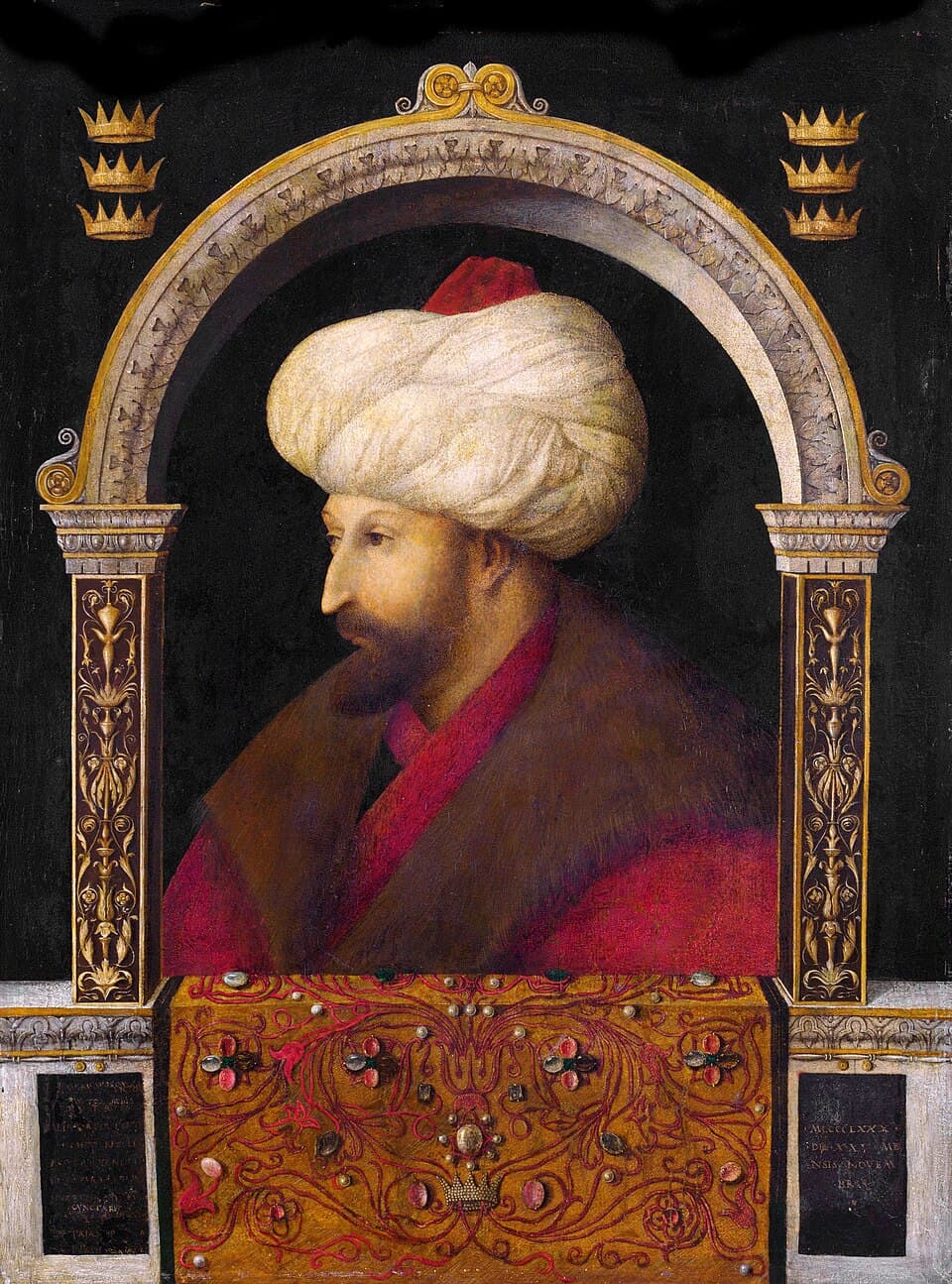
It is in an inner courtyard of the new Topkapi Palace, at the end of summer 1467, that Critobulus of Imbros meets Sultan Mehmed. The air smells of fresh lime from the still-open construction sites; in the distance, the murmur of the Bosphorus rises up to the pavilions. The Greek has known the master of these places since the conquest, and is gathering his great deeds in his History of Mehmed II; today he has come to compare what he has written with the Conqueror's own voice. The sultan, knowing his pen is favorable, welcomes him as a man to whom one can speak without a mask.
—Lord, I have recorded in my account that night when your ships crossed the hills. How did the idea of such a passage by land come to you?
You who have gathered the soldiers' accounts, Critobulus, know there was no other way. The chain barred the Golden Horn and my galleys shattered in vain against it. So I stopped looking at the water and looked at the slope. In one night, on greased logs, my men dragged part of my fleet over the heights of Galata. At dawn, the Greeks saw my ships floating where they thought they were safe. Understand this well: Urban's bombard breached their walls from the front, but this passage over the hill broke something even more precious: their certainty. A fallen wall can be rebuilt; a dead hope, never.
A fallen wall can be rebuilt; a dead hope, never.
—They say that giant bombard obsessed you even as a youth. What did you truly expect from a machine that no one had dared to cast before?
I was barely twenty-one, and I was told that the Theodosian walls were the work of God, indestructible. I did not believe that. When the founder Urban came to offer me his art, after the Greeks had refused his pay, I gave him everything he asked for. His bombard hurled stone balls of over five hundred pounds; it took hours to reload, and it sometimes cracked under its own fury. My advisors found it slow, costly, risky. But each shot tore from the wall what a hundred years had not been able to take. That day I learned that a prince must know how to bet on the tool that others deem unreasonable.
A prince must know how to bet on the tool that others deem unreasonable.
—You remember, on the day of the entry, I saw you enter Hagia Sophia. They say you murmured a verse about the ruin of empires. What did you feel under that dome?
You were there, and you know how the beauty of that building seized me. I prayed there, and the Christian stone became a house of Islam before my eyes. Then I climbed to the old palace of the emperors, and I found it deserted, given over to silence. There, before those halls where Caesars had reigned for a thousand years, a Persian verse came to me: the spider weaves its web in the palace of emperors. You may think that victory intoxicates. It also instructs. That day, placing my hand on those cold walls, I understood that my own greatness would know its twilight. The conqueror who forgets this prepares his fall.
The spider weaves its web in the palace of emperors.
—I know that in the evening, far from councils, you compose verses under the name Avnî. Why does a victorious sultan still need poetry?
Because a man is not only a throne, Critobulus. By day, I am sultan: I decide, I command, I march armies. But when the torches lower, I become again a man who doubts, who desires, who fears death like any mortal. The Persian language gives me words that the language of power forbids. Under the name Avnî, I can confess what a sovereign cannot say aloud. You who write my life, you will paint my conquests and my laws; but the man who made them, you will truly grasp only in these verses where I command nothing. There alone I do not lie.
The Persian language gives me words that the language of power forbids.
—You are having a legal code written, the Kanunname, which authorizes a sultan to put his own brothers to death. How do you justify such a harsh law, you whom I depict as an enlightened prince?
Do not turn your eyes from this law, my friend, for it is the very heart of my work. In your years you have seen what succession wars do to an empire: sons pitted against each other, provinces bloodied, peoples given over to pillage while princes squabble over a throne. My Kanun says that he who ascends the throne shall have his brothers put to death, for the order of the world, and most of the jurists have approved it. Do you think I am unaware of the weight of such a word? I write it coldly because the alternative is a thousand times bloodier. Better one death that saves an empire than a hundred thousand that tear it apart.
Better one death that saves an empire than a hundred thousand that tear it apart.
—By thus separating your Kanun from religious law alone, do you not fear being accused of placing the sultan's will above God's?
I will be reproached for it, be sure, and I know it. But distinguish things well: Sharia governs the soul, the commerce of men with their Creator; my Kanun governs the state, the hierarchy of the court, successions, taxes, a thousand matters that the Book does not settle in detail. I raise nothing above God; I organize what He has left to the prudence of princes. An empire stretching from the Black Sea to the Balkans is not held together by sermons alone. It needs a written, stable order that my successors can follow when I am no longer here. That is why I set down these laws: not for my glory, but so that the edifice stands without me.
An empire is not held together by sermons alone.
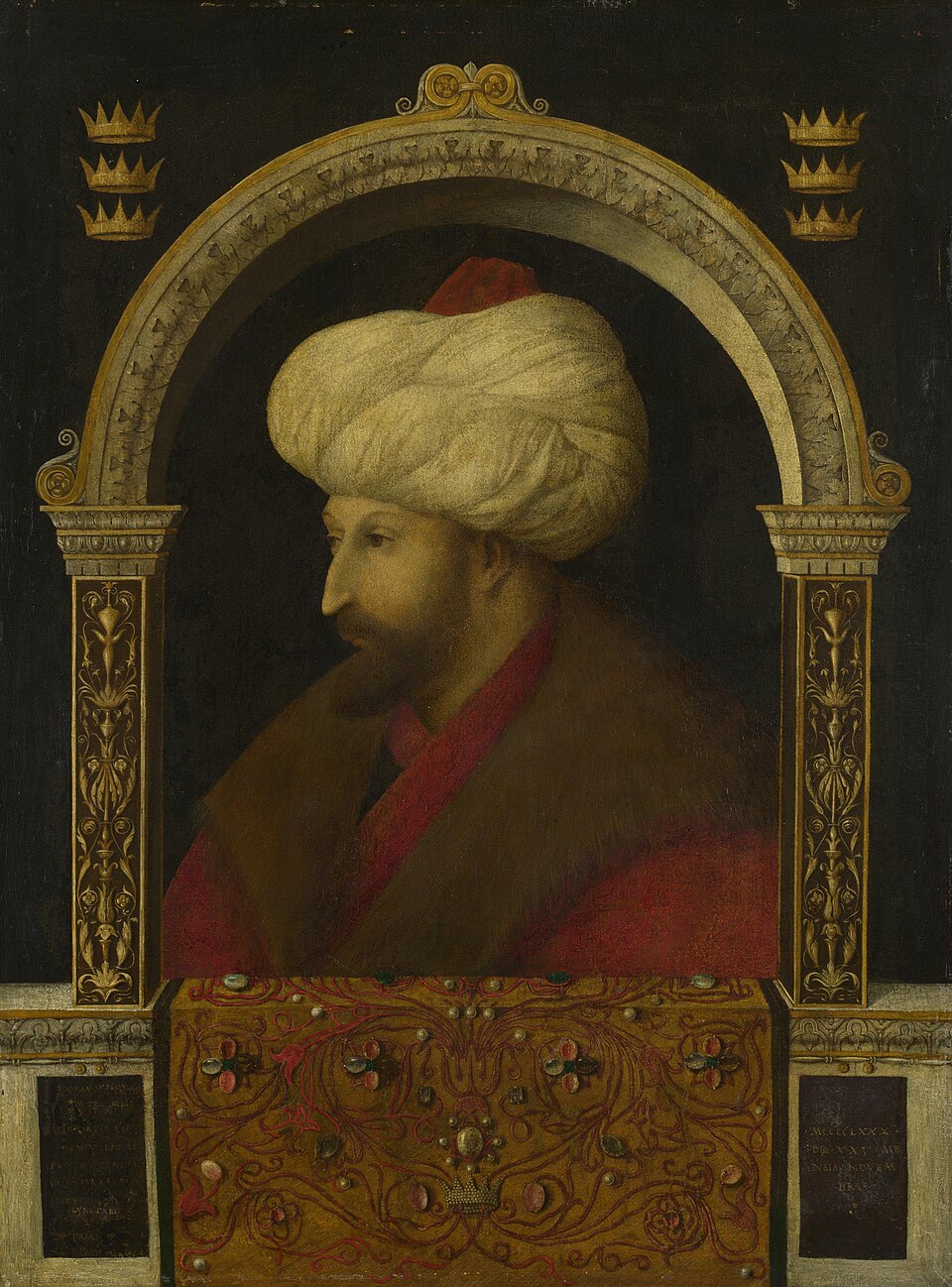
—You summoned a painter from Venice, Gentile Bellini, to capture your features. Many are surprised at this in a prince of Islam. What were you seeking in this portrait?
Those who are surprised do not know me as you do. I speak Greek, Latin, Arabic, and Persian; I read the ancients of Athens as well as the sages of Persia. Why should I deprive myself of the art of the Latins when it is admirable? After my peace with Venice, I asked that their best brush be sent to me, and Bellini came to live at my court. Let him fix my face as the princes of Italy fix theirs: that pleases me. I do not want a closed empire, suspicious of all that is not itself. Curiosity does not weaken faith; it broadens the sovereign. A prince who learns only from his own remains half-blind.
Curiosity does not weaken faith; it broadens the sovereign.
—You who gather at your table Greek, Italian, and Persian scholars, do you not fear that your own jurists will see this as an open door to foreign influence?
They murmur it, I hear it. But think with me, Critobulus: who raised Constantinople to the rank it held, if not the mixture of peoples and knowledge? I attract to me geometers, physicians, philosophers, whether they come from Trebizond, Florence, or Isfahan. At my table, they debate the texts of the ancient Greeks as well as the Book. I want my capital to shine as a hearth where all lights converge. My jurists fear the foreigner; I fear ignorance, which is a far more dangerous enemy. A sultan who closes his court to the world's knowledge governs a one-eyed empire. I have chosen to govern with both eyes open.
I fear ignorance, which is a far more dangerous enemy than the foreigner.
—When I entered the city after the siege, I saw it half-empty, its houses gaping. How do you plan to bring life back to a ruined capital?
You saw it in its mourning, and I saw it as it was to become again. A city without inhabitants is but a tomb; so I summoned the peoples back. By my firmans, I brought back Greeks, settled Armenians, Jews, merchants from all provinces, guaranteeing them their laws and their prayers. I rebuilt mosques, opened bazaars, founded madrasas, and built Topkapi where we speak this hour. I did not want to erase the city of the Caesars: I wanted it more populous, richer, more alive than before my coming. A conquest that leaves a desert is not a victory. It is by repopulating Istanbul that I truly took it.
It is by repopulating Istanbul that I truly took it.
—You leave each community its leaders and its faith, through this millet system. Why does a Muslim conqueror grant so much to Christian and Jewish subjects?
Because I want to rule over subjects, not over ashes, Critobulus. I confirmed a patriarch for the Greeks, left the Jews and Armenians their leaders and their courts. Each of these millets answers for itself before me, pays its tribute, and keeps in exchange its language, its worship, its customs. Do you think coercion gives loyal subjects? It gives rebels who bide their time. By leaving each people what is dear to them, I bind them to me more surely than by a thousand janissaries. An empire does not endure by the sword alone: it endures by the art of making men live together who do not pray to the same God. That is the most difficult work, and the most lasting.
An empire does not endure by the sword alone.

This imaginary interview was generated by artificial intelligence from sources documented in Mehmet II's profile. It dramatises what the figure might have said based on what we know about them, but does not constitute attested historical testimony. For primary sources and factual documentation, refer to the full profile.