Imaginary interview with Mother Teresa
by Charactorium · Mother Teresa (1910 — 1997) · Spirituality · 6 min read
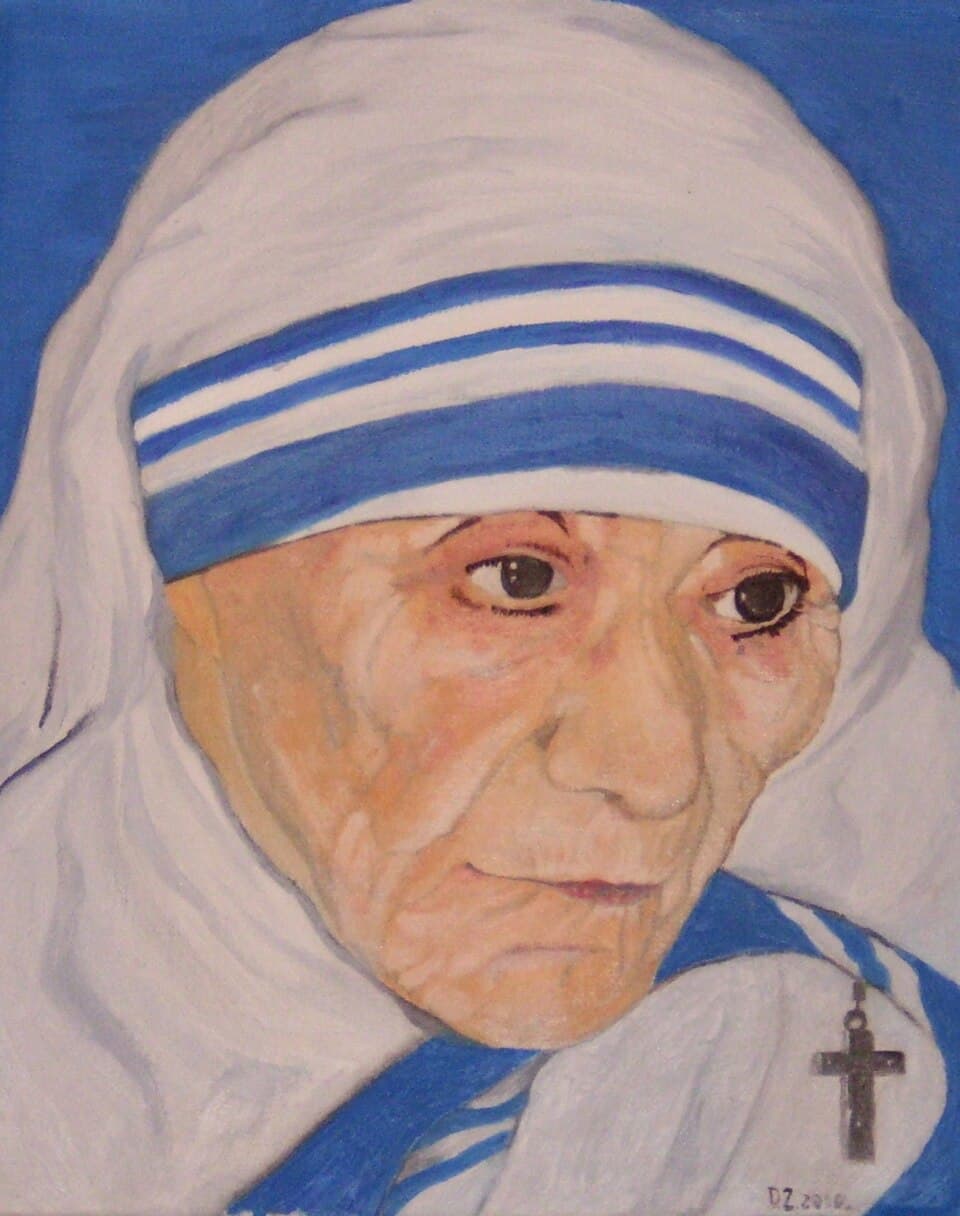
Calcutta, late monsoon afternoon. In a bare cell of the mother house, a wooden bed, a cross on the wall, a small woman in a white sari bordered with blue folds her correspondence. She agrees to speak, in a low voice, between prayers.
—How did you get here, you who were first a teacher behind convent walls?
People think I was born to the poor; I was born in Skopje, into a very pious Albanian family, and it was first to the Sisters of Loreto that I walked, in Dublin, then to India, where I taught for seventeen years in a high school. I was happy behind those grilles, I assure you. But in 1946, on the train going up to Darjeeling for a retreat, I received what I call the call within the call: an inner voice asking me to leave everything to live among the poorest. It was not a suggestion. It was an order I was not free to evade. I wrote to my archbishop: 'Allow me to go into the streets to serve the poorest of the poor.' It took two years before they let me cross the door.
It was not a suggestion. It was an order I was not free to evade.
—What does it feel like to leave the security of an established order for the street, without roof or rule?
Fear, at first, and the cold of having nothing left. I put aside the black habit of the Sisters of Loreto and took a white sari with three blue stripes, like the poor women of Bengal I saw. I went out with a few rupees and the feeling of being a beggar myself. The first days, I was tempted to return behind the grilles, where the meal was sure and the bed warm. But when you have heard that voice once, you can no longer pretend not to have heard it. I went from door to door asking for a room, rice, a little milk for the children. The vow of poverty I had pronounced as a young girl ceased to be a word: it became my address, my only home.
—Do you remember the day that gave birth to Nirmal Hriday?
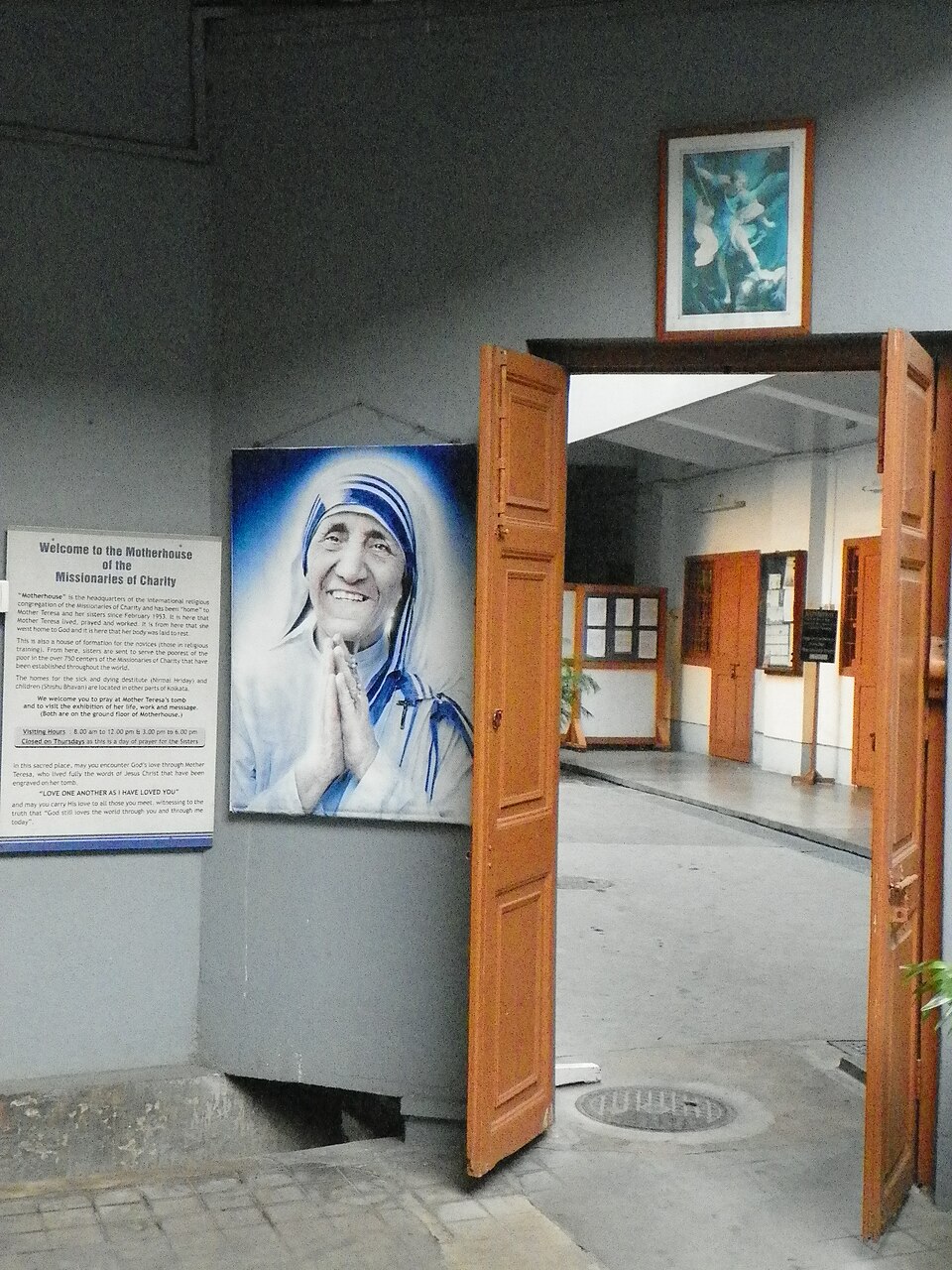
Yes, 1952, on a sidewalk. I found a woman half devoured by rats and ants, still alive. I carried her from hospital to hospital; everywhere they refused her, because she was going to die and a dying person brings nothing. I held her until an establishment agreed to take her in. That night I understood that there had to be a place where one does not ask if you are Hindu, Muslim, useful or lost — only a place to die like a human being. The city gave me an old dharamsala, adjoining the temple of Kali. I was criticized for setting up Christians in the shadow of a Hindu goddess; I saw only a roof for the dying. There we washed the bodies, held a simple metal bowl to their lips, and stayed, until the end.
A dying person brings nothing: there had to be a place where one does not ask if you are useful.
—What does a day spent with these dying people and these children look like?
It begins at 4:40 a.m., in the dark, with prayer, then Mass, then a little rice and dal. By eight o'clock we are already in the streets looking for abandoned bodies. The afternoon belongs to care: changing the bandages of lepers, washing those disfigured by disease, feeding the little ones of Shishu Bhavan, the orphanage where we welcome children no one wants. We have only a jug of clean water, cloths, bandages — no machines, no sophisticated medicines. People often ask me how I bear so many wounds. But I do not treat a wound: I touch a face. In the evening, the rosary gathers us, and I answer letters until lights out. The next day begins the same, and that is very well.
I do not treat a wound: I touch a face.
—Why did you refuse the honorary banquet on the day of your Nobel Prize?
Because in Oslo, in December 1979, they offered me a festive dinner while my people, in Calcutta, went to bed hungry. I asked them to cancel the feast and instead give me the one hundred ninety-two thousand crowns intended to feed them. How could I have raised a glass thinking of the woman on the sidewalk? I took the floor not to rejoice, but to say what I believe: that the greatest destroyer of peace today is abortion, because if a mother can kill her own child, what prevents us from killing each other? I was thought harsh that day. But they had not given me this platform for me to be silent. The prize money, down to the last coin, went to our homes.
How could I have raised a glass thinking of the woman on the sidewalk?
—Did this global recognition change anything in your way of living?
Nothing, except that it gave me more doors to open. The prize made me useful as a key: I was listened to in palaces as in slums. In 1982, during the siege of Beirut, I was able to get them to stop the fire for a few hours — Israelis on one side, Palestinians on the other — long enough to evacuate thirty-seven disabled children caught between the lines. The guns fell silent, for the time of a passage. That is what an old nun can do with a little reputation: not speeches, but crossing a street that armies forbid themselves. For the rest, I kept my two saris and my cell without a fan. Glory does not keep you warm, and it feeds no one if you keep it for yourself.
—Why own only two saris, when the whole world would have given you everything?
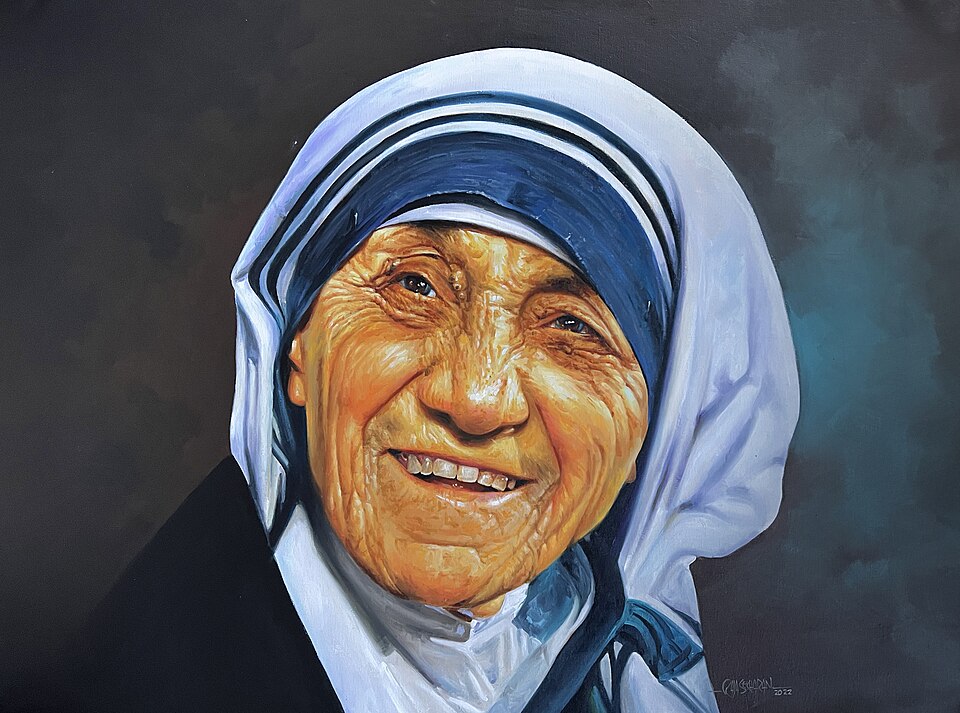
Because you cannot serve a poor person by extending the hand of a rich person. I adopted this white sari with blue stripes in 1948, the day I stopped being a lady to become one of them: one to wear, the other drying while I wash. That is all. On my shoulder, a small medal of the Virgin from my childhood; on my wrist, my rosary, which is my only weapon. Our mother house has neither air conditioning nor heating: we are hot when Calcutta is hot, we are cold when the poor are cold. If I slept in a cozy bed, by what right would I go to the bedside of a man dying on concrete? Renunciation is not a deprivation I inflict on myself. It is the condition for my hand to remain like theirs.
You cannot serve a poor person by extending the hand of a rich person.
—What does this rosary you constantly hold mean to you?
It is the thread that keeps me standing. People imagine I am strong; I am only a woman who recites her rosary between two bodies to wash. In the morning before the streets, in the evening at vespers, and a hundred times during the day when my hands tremble, I pass the beads. People think that love for the poor comes from a great impulse of the heart. No: it comes to me from prayer, as water comes from the jug. Without it, I would not last a week at Nirmal Hriday, amid so many smells and so many agonies. Our Constitution says we work to quench the thirst of Christ on the cross; this rosary is the rope that ties me to that thirst. Take it away, and only a tired old woman remains.
Love for the poor does not come to me from an impulse of the heart: it comes to me from prayer, as water comes from the jug.
—People think you are full of luminous certainties. Is that really how you pray?
I must tell you something I have only told my spiritual directors, in letters I asked them to burn. For years, when I pray, I meet only silence. In my soul I feel only that terrible pain of absence — as if God did not want me, as if God did not exist. I smile at crowds, I speak of His light, and inside it is night. The mystics call this the dark night of the soul; John of the Cross described it four centuries ago. I live it every morning passing the beads of my rosary without feeling anything. And yet I continue, because I did not promise God feelings: I promised Him acts. Faith is not a warmth. It is a yes repeated in the cold.
I did not promise God feelings: I promised Him acts.
—How do you keep serving when you no longer feel the One for whom you serve?
You look at the face before you, and you stop scanning the sky. When I tilt a metal bowl toward the lips of a dying person at Nirmal Hriday, I do not need to feel God: He is there, in that broken man, whether He makes me feel it or not. My inner emptiness, I offer it. If I must share the abandonment of the poor even in my soul, to the point of feeling myself forsaken, then that is still a way of being with them. One day perhaps these letters will be read and people will be scandalized: the saint doubted. Let them be. I prefer that they know the truth — that one can hold a whole life in the night, provided one never lets go of the hand one holds. The smile I give to the poor, I give it first to God, so that He does not see my tears.
One can hold a whole life in the night, provided one never lets go of the hand one holds.
This imaginary interview was generated by artificial intelligence from sources documented in Mother Teresa's profile. It dramatises what the figure might have said based on what we know about them, but does not constitute attested historical testimony. For primary sources and factual documentation, refer to the full profile.