Imaginary dialogue between Mgr Ferdinand Périer, archevêque de Calcutta and Mother Teresa
by Charactorium · Mother Teresa (1910 — 1997) · Spirituality · 6 min read
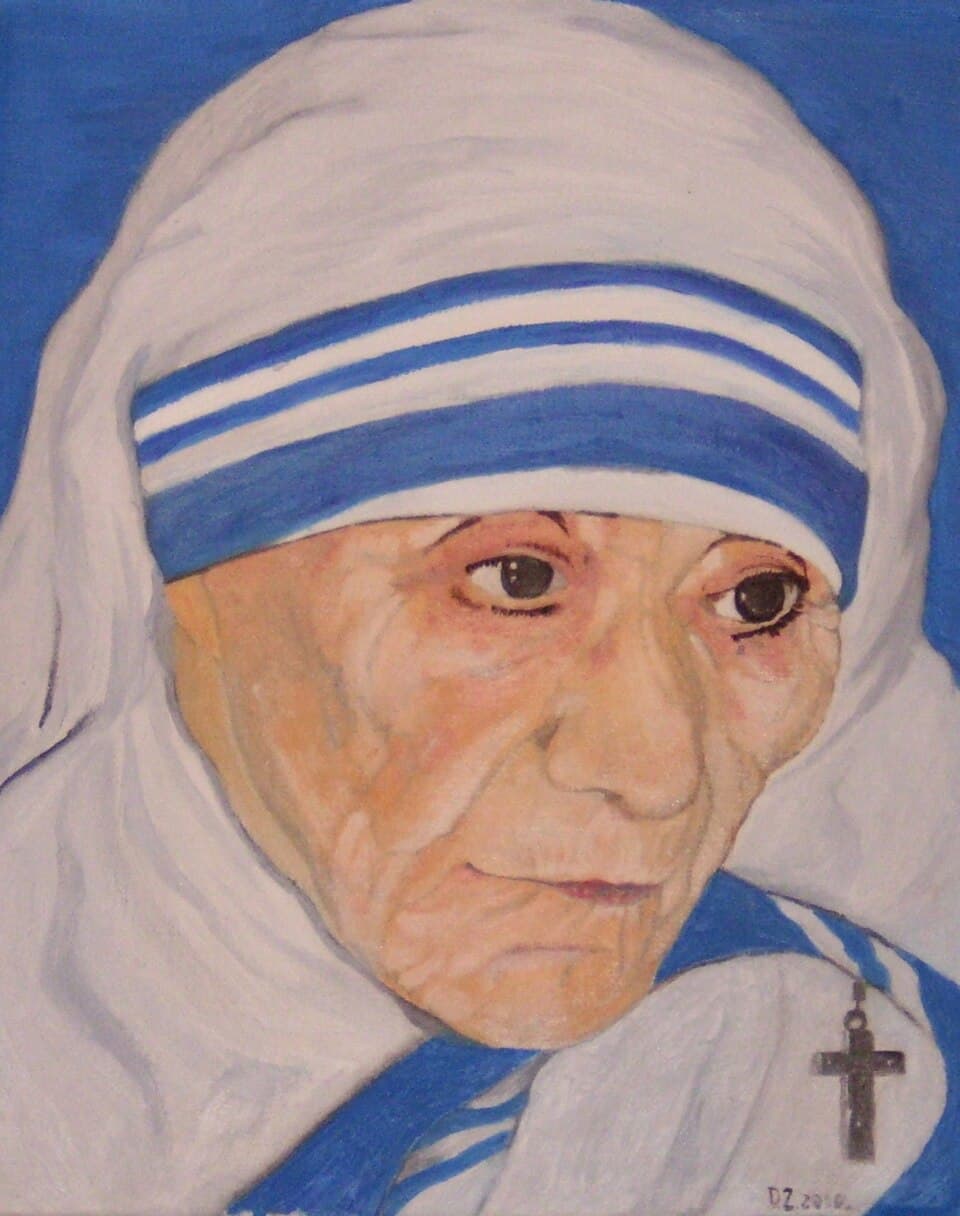
It is in the parlor of the Mother House, on A.J.C. Bose Road in Calcutta, that Archbishop Périer meets Mother Teresa at the end of the year 1960. A ceiling fan stirs the humid air, and in the distance the novices can be heard reciting the rosary. The archbishop has known this small woman in a white sari for thirteen years: it was he who read her letters, probed her vocation, authorized her congregation. He comes that day less as a superior than as a spiritual father, to hear her say what she confides to no one else.
—My daughter, I remember your return from Darjeeling in 1946, distraught. What did you hear in that train that you had never heard before?
Archbishop, you are one of the few to whom I dare say it. On that train, I did not dream: I received an order, clear as water. Our Lord asked me to leave the convent of Loreto, where I was happy and protected, to serve Him in the slums, among the most abandoned. It was not a simple vocation — I already had one — it was a call within the call, a second voice inside the first. I was afraid, as you know, for I had nothing: no house, no money, no permission. But to refuse would have been impossible. When Christ thirsts for a soul, one does not argue with Him; one obeys, or one lies to Him all one's life.
—Do you remember the letter you wrote to me in 1947, when I hesitated to let you go? What were you asking me, deep down?
I asked you for one thing only, Your Excellency, and I wrote it to you almost word for word: to be free only for God, to love Him with all that I am, and that you allow me to go into the streets to serve the poorest of the poor. You delayed a long time — and you were right to test me, for a vocation that does not withstand waiting is worth nothing. But I never doubted that you would say yes. You were the authority that Heaven had placed between His desire and my obedience. Without your signature, Archbishop, there would have been no Missionaries of Charity; I would have stayed behind the walls of Loreto, teaching geography to well-born young ladies.
—I am told of that woman found in 1952, half-devoured by rats. Why did that one, among the thousand miseries of Calcutta, trigger everything?
Because that day, Archbishop, I understood that a stray dog of Calcutta died better than a human being. That woman, the hospitals wanted nothing to do with her: too poor, too lost. I carried her myself, and I was refused door after door. When she died, it was at least in hands that held her. I swore that this must never happen again. The municipality gave me an old dharamsala adjoining the temple of Kali — the Hindu priests first protested, then fell silent when they saw what we were doing. It became Nirmal Hriday, the Pure Heart. We cure almost no one there, you know. We only offer that a man may depart knowing he was loved. To die loved is already to rise a little.
We cure almost no one there; we only offer that a man may depart knowing he was loved.
—In your house, your sisters wash wounds with a simple metal bowl. Is that not pitiful, my daughter, faced with so much pain?
Pitiful in the eyes of the world, yes, Your Excellency. But God does not ask us to empty the ocean; He asks us not to let a single drop go without love. That enameled metal bowl, that water jug, those cloth bandages — these are all our instruments. With these, we feed, we wash, we dress the leprosy that no one dares touch. I do not tell my sisters: save Bengal. I tell them: to this man, now, give everything. The rest belongs to Providence. If everyone in the world swept only their own doorstep and held out a bowl to the hungry, believe me, Archbishop, there would be no more misery. We do not do great things, only small things with great love.
—That white sari with a blue border, you chose it in 1948, against the habit of the Loreto Sisters. Why did you strip yourself even to that extent?
Because one cannot serve the poor by remaining above them, Archbishop. I took the sari of the humblest women of Bengal, the one sold for a few annas at the bazaar, and I bordered it with three blue stripes, the colors of Our Lady. I own only two: one I wear, the other drying after the wash. Pinned to it, this little medal of the Virgin that I have kept since childhood in Skopje — it has never left me. My sandals are simple leather, like those of the beggar women. You once asked me if this renunciation was not inverted pride. I thought about it, and I answer you no: one cannot reach out a hand to a naked man if one wears gilded sleeves.
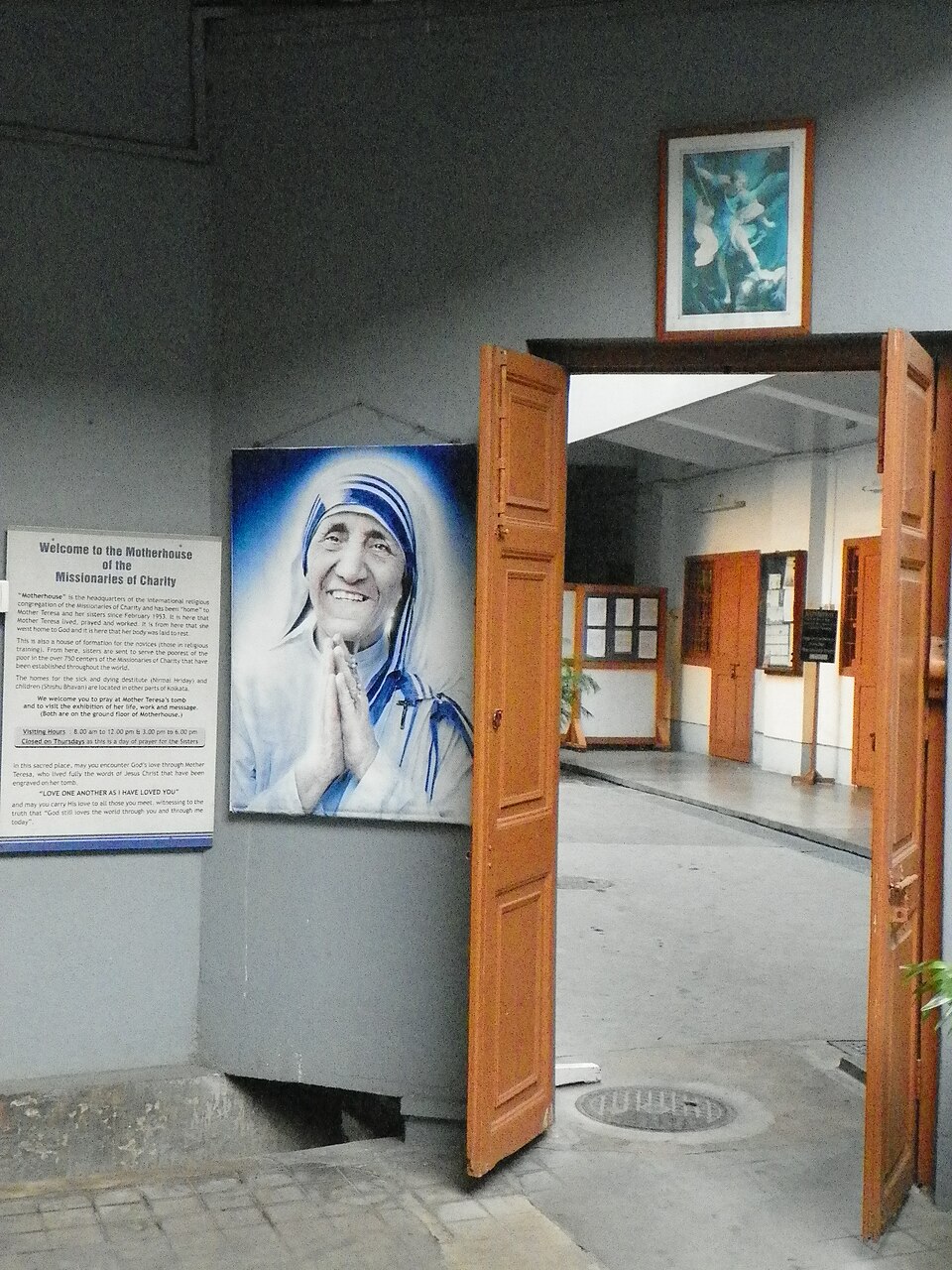
—I have seen your cell: a wooden bed, a crucifix, nothing else. Have you never desired, my daughter, a little rest?
Rest? I will have my fill of it in Heaven, Your Excellency. Here, my cell has only a wooden bed and a crucifix on the wall, and that is already far more than what the dying we pick up have. We refuse fans, heating, anything that would distinguish us from the poor: how can one preach the poverty of Christ from an armchair? We rise at four-forty, Mass, then the streets by eight o'clock. On Fridays, I fast with those who have nothing to eat on other days. The body protests, it is true. But a body too pampered becomes deaf to the misery of others, and I want to keep my ears open. Comfort, Archbishop, is the politest of thieves: it steals the soul without one hearing it enter.
—I have been your director for thirteen years, and your letters frighten me. You write that you no longer feel God. Is that still true?
It is truer than ever, Archbishop, and you are the only one to bear it with me. Since I began this work, Heaven has closed. I pray, and I speak to a wall. I smile at the dying, I console the sisters, and inside there is only a silence, a terrible absence, as if God Himself rejected me — sometimes I catch myself doubting that He exists. You told me that this was not a punishment, but a part of His thirst, and I cling to that. Saint John of the Cross called it the dark night of the soul. I believe the Lord makes me taste, in my spirit, the abandonment that the poor feel in their flesh. If He wants me to live in darkness so that they may know a little light, then let it be so.
The Lord makes me taste, in my spirit, the abandonment that the poor feel in their flesh.
—How, in this night, do you continue to smile at your dying, when everything in you tells you that no one is listening?
Precisely because the smile does not depend on what I feel, Your Excellency. If I waited for consolation to serve, I would never do anything. I decided once and for all: my faith is not a feeling, it is a will. I choose to believe when I feel nothing, and it is perhaps there, in that bare choice, that faith becomes true. The poor must not pay for my inner dryness; they have a right to my most joyful face, for many have never received a single smile in their whole lives. And then I tell myself this: if my darkness can be the ransom for a little of their peace, I do not want it to stop. I love Jesus in the dark as others love Him in the light.
—The world is beginning to talk about you; honors will come. You who have only two saris, what will you do with this glory?
Glory, Archbishop, is something one uses, not something one feeds on. If one day a reward is offered to me, I will accept it — not for myself, but in the name of the poor, for it is to them that homage is paid through this poor woman. And the money, I will give it entirely to the work: what use would an honorary banquet be to me when my children at Shishu Bhavan lack milk? Let them give me platforms, so be it: I will use them to say that every child, even unborn, even dying, has the right to be loved. But the day I believe myself great, Excellency, pray for me, for I would be lost. I am only a little pencil in the hand of God; it is He who writes, not the pencil.
I am only a little pencil in the hand of God; it is He who writes, not the pencil.
—Soon your sisters will leave India, perhaps to war-torn countries. How far would you go, my daughter, to save a single child?
How far would Christ go, Archbishop? That is my only measure. If I must cross a line of fire to snatch a child from death, I will cross it, and I will ask the soldiers of both sides to lower their arms long enough to carry him — one does not refuse much to an old nun who wants only a child. Charity knows neither border, nor flag, nor religion: a little Muslim, a little Hindu, a little Christian, it is the same Jesus hidden under a different distress. Our houses will open wherever there is suffering, among communists as among the rich. The day we are afraid of a country, a war, or a border, we will have ceased to be Missionaries of Charity. Fear does not enter where love commands.
This imaginary interview was generated by artificial intelligence from sources documented in Mother Teresa's profile. It dramatises what the figure might have said based on what we know about them, but does not constitute attested historical testimony. For primary sources and factual documentation, refer to the full profile.