Imaginary dialogue between Marie de Gournay and Michel de Montaigne
by Charactorium · Michel de Montaigne (1533 — 1592) · Literature · Philosophy · 6 min read

It is in the round tower of the Château de Montaigne, in this autumn of 1590, that I meet the man I call my adoptive father. The oblique light streams through the windows and caresses the Greek and Latin sentences carved on the beams; the smell of leather bindings fills the room. It has been two years since we first knew each other, after I wrote to him having devoured the Essays, and he came to visit me in Paris. Today I come not to admire him in silence, but so that he may confide in me the man behind the work I aspire to serve.
—My father, here you are in this tower where the Essays were born. Why did you shut yourself away among these thousand volumes, in 1571, far from the world?
My daughter, at thirty-eight, weary of the Parlement and of business, I retired here as to my back shop. I had those sentences of the Ancients carved on the ceiling so that they might watch over me at every hour. From my armchair, I see all my books arranged in an arc — Seneca, Plutarch, the poets. At first I thought I would do nothing, let my mind rest; but idleness, far from calming it, made it like a runaway horse that gives birth to a thousand chimeras. To capture those fancies, I took up my pen. Thus was born what I called an essay: not a treatise, but an attempt, a sword thrust into the matter of myself.
I thought I would rest my mind; idleness made it like a runaway horse.
—You say you paint yourself. Is it not great boldness, for a gentleman, to make his own person the subject of a book?
Boldness, yes, and I will be reproached for it. But consider: each man bears the entire form of the human condition. In painting myself, I serve not my vanity — I seek man, through my humors, my contradictions, my inconsistencies. I am neither a scholar nor a theologian; I have no authority but my own judgment, which wavers and corrects itself. Thus my book changes as I change; I do not paint being, I paint passage. Others shape man; I recite him, and recite a particular one, very poorly formed. You who read me so attentively, you know I never lie about my weaknesses.
I do not paint being, I paint passage.
—You know the friendship I dream of with you. Tell me about La Boétie: what was that friendship, of which you say you have known no equal?
Ah, Étienne. We sought each other before we met, on the report each heard of the other. And from our first encounter, we found ourselves so taken, so known, so bound to each other, that nothing from then on was so close as one to the other. Why did I love him? If pressed to say, I feel that it can only be expressed by answering: because it was he, because it was I. Only four years were granted us. Since 1563, since his death, I do nothing but drag on, languishing; everything bores me. I was so accustomed to being two that I now feel only half. My daughter, do you understand why I welcomed you as a recovered part of myself?
Because it was he, because it was I.
—You had his treatise On Voluntary Servitude printed and prefaced in 1571. Was it a friend's duty, or the thinker's conviction?
Both, inseparably. Étienne had written it very young, as an exercise, and I wanted his memory not to die with his body. I wanted to erect this paper monument to him, since death had taken the man. Alas, factious spirits seized upon it, mixing this noble text with their pamphlets against the crown — so much so that I had to withdraw it from my own Essays, where I wanted to place it at the heart of the chapter on friendship. The thoughts of the dead are always distorted. But know this, you who will one day watch over my pages: editing the work of a loved one is prolonging his conversation beyond the tomb. It is the tenderest of loyalties.
Editing the work of a loved one is prolonging his conversation beyond the tomb.
—You traveled so much through Switzerland, Germany, Italy in 1580. What were you seeking so far away, you who love your tower so much?
First I sought health, my daughter — those stones that have gnawed at my kidneys since I was forty, and which the thermal waters of Bagni di Lucca were, I hoped, to dissolve. But I also sought the friction of foreign minds. Nothing rusts the mind like always staying in the same place, among the same faces. In Rome, I was received by Pope Gregory XIII, and was made a Roman citizen — a vanity I laugh at as much as I honor it. I observed customs, baths, tables, ways of praying, everything that differs from our own. To travel is to learn that our way is only one way among a thousand. I noted everything in my journal, down to the color of my ailments.
Nothing rusts the mind like always staying in the same place, among the same faces.
—You record your colic with an almost cheerful curiosity. How do you bear this pain that torments you without respite?
What would you have me do? Complaining has never dislodged a single stone. I have chosen to look my pain in the face, and even to study it as an object of knowledge. When the pain seizes me, I observe it, note its progress, its duration, the moment when the stone finally descends and delivers me. There is, believe me, a secret pleasure in that relief. Nature gave me this harsh master to teach me to die, and I want to learn my lesson without whining. The Stoic says one must suffer without a murmur; I say more simply that one must live among the living, and let death find me, if it must, planting my cabbages.
Complaining has never dislodged a single stone.
—You were made mayor of Bordeaux in 1581, even as you were traveling in Italy. Did you accept this office willingly?
Very unwillingly, I confess. The news reached me in Rome, and at first I wanted to excuse myself. But the king gave me an express command, and I had to obey. I took this mayorship as one takes a burden one cannot decline. I strove to serve with loyalty, but without consuming my soul — for the mayor and Montaigne have always been two, with a very clear separation. I never wanted, like so many others, to confuse my office with my skin. I was even re-elected in 1583, a sign that a man lukewarm in zeal can be a more just magistrate than a burning ambitious one. To govern is to know where the role ends and where the man begins.
The mayor and Montaigne have always been two, with a very clear separation.
—When the plague ravaged Bordeaux in 1585, you left the city with your family. Some still reproach you for it: what do you answer them?
I answer them plainly, as I did in my Essays. The contagion was sweeping everything around us; my household wandered the roads, without a sure roof, fleeing a scourge that struck blindly. Should I have sacrificed my wife, my daughter, my people, for a show of courage? False honor demands that one die at one's post; true judgment demands that one protect what one loves. Those years were the harshest I have seen: the Huguenots and Catholics were cutting each other's throats, and no place was safe. I preferred the life of my family to reputation. Let those who blame me have had, like me, six thousand dead at their gates, and we will speak again of their fine constancy.
False honor demands that one die at one's post; true judgment demands that one protect what one loves.
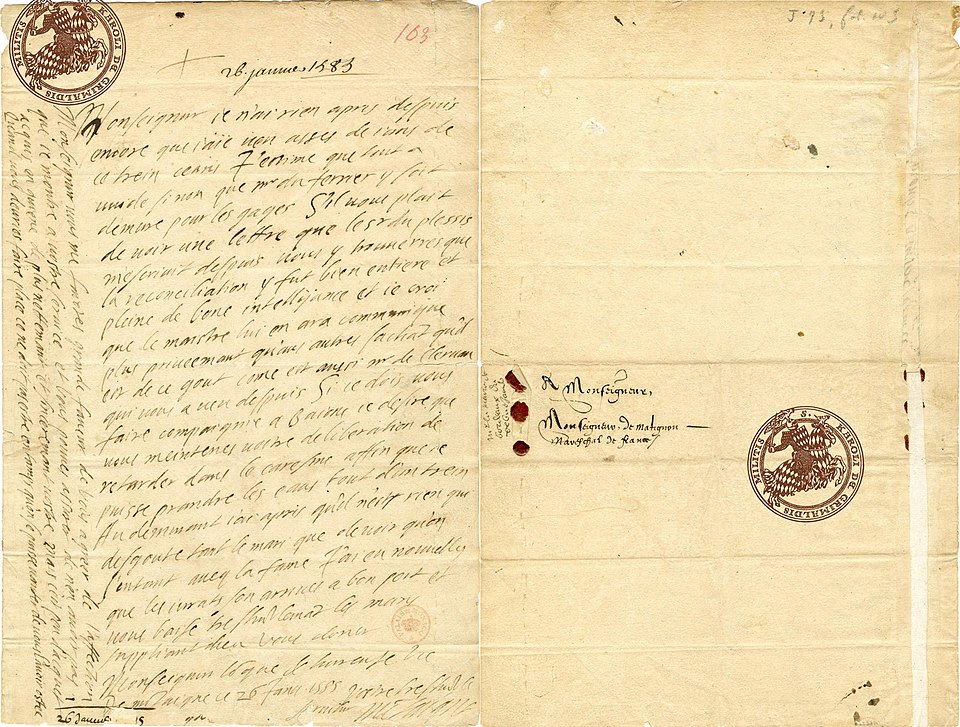
—Last year, 1588, the Leaguers threw you into the Bastille on the road to Paris. How did you get out so quickly?
By great chance, and by the favor of a great lady. I was seized in the street, in reprisal, in those times when each party regards the other as a mortal enemy. I found myself a prisoner without knowing exactly what I was accused of — the madness of these wars where one no longer needs a crime to be guilty. But Queen Catherine de' Medici intervened, and I was released that very day. I took it with my usual phlegm; I had already made my peace with fortune, and a few hours in prison were not worth troubling over. You see, my daughter, whoever has settled his affairs with death no longer fears jailers much.
Whoever has settled his affairs with death no longer fears jailers much.
—Your motto, What do I know?, intrigues me. Is it not strange, for a man who writes so much, to proclaim his ignorance?
On the contrary, it is the beginning of all wisdom. The most self-assured men are usually the most foolish; they hold as truth what is only habit or opinion from their own steeple. I have weighed and pondered, and I find that our certainties are only presumptions. So I suspend, I balance, I ask: what do I know? It is not laziness of the mind, it is its greatest activity — for to doubt is still to seek. I prefer a mind that questions itself to a memory that swells. Our century kills each other over religious certainties; I wish that people would first learn to doubt, and less blood would be shed.
To doubt is still to seek.
—In your chapter Of the Education of Children, you want judgment to be formed rather than memory. How would you have wanted me to be raised?
As any lively mind should be raised, my daughter: not by filling it with rote lessons, but by exercising it to judge for itself. I hate those tutors who pour knowledge into a child's head as one pours water into a funnel, and ask only that he repeat it. Better a well-formed head than a well-filled head! Let everything be presented to him, let him choose, let him learn to sift knowledge through the sieve of his reason. The gain of study is to become better and wiser, not more learned. You, you made this path alone — you learned Latin and philosophy without being pushed. That is why I recognized you as my own.
Better a well-formed head than a well-filled head.
This imaginary interview was generated by artificial intelligence from sources documented in Michel de Montaigne's profile. It dramatises what the figure might have said based on what we know about them, but does not constitute attested historical testimony. For primary sources and factual documentation, refer to the full profile.