Imaginary interview with Nikola Tesla
by Charactorium · Nikola Tesla (1856 — 1943) · Sciences · 6 min read
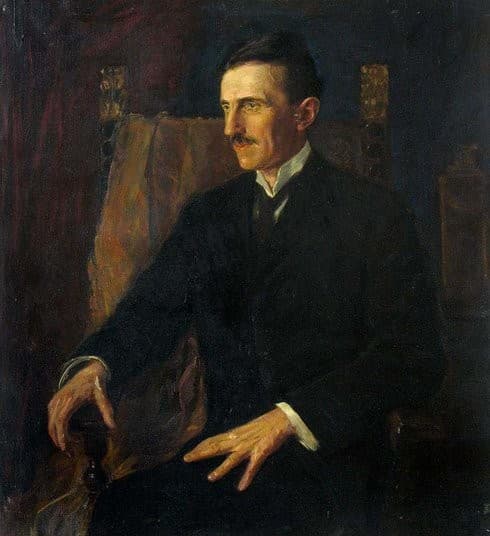
Winter 1942. On the thirty-third floor of the New Yorker Hotel, a modest room numbered 3327, where an old man in a dark suit feeds pigeons on the windowsill. At eighty-six, Nikola Tesla agrees to receive a visitor and trace the thread of a life spent taming electricity.
—How did your inventions come to you? They say you almost never drew plans.
That's correct. When a machine came to me, I saw it running before me, complete, with its coils and shafts, as clear as an object on a table. I could run it for weeks in my mind, stop it, open it, look for where a part would wear out, before a single piece of copper was cast. I once wrote this simple and true thing: “My discoveries came to me intuitively. The experiments I performed in my dreams were as real to me as those I carried out in my laboratory.” Paper was only for notaries and the lawyers of patents. My real workshop, you see, never had walls.
My real workshop, you see, never had walls.
—Your close ones told of strange habits — the number three, pearls. What do you say to that?
People have laughed at me a lot, and I sometimes laugh too. Yes, I walk three times around a building before entering, yes I count my steps and the volume of my soup, yes I demand eighteen clean napkins every day. And I cannot stand a woman wearing pearls at my dinner; it makes me shiver deep in my stomach. These are not affectations. They are the downside of a mind that perceives everything with fierce intensity: a flash of light pierces my skull, distant thunder makes me jump in pain. The same hypersensitivity that lets me visualize an entire motor makes me a slave to these small rules. Genius and torment, sir, share the same room.
Genius and torment, sir, share the same room.
—You first worked for Edison. Why did that split become a war?
I had landed in New York in 1884, with few coins in my pocket, to serve Edison. He was a hard worker, but a man of direct current, unable to see beyond. My dynamos would have saved him fortunes; he had promised me a sum, but he mocked me, calling it American humor. I left. When Westinghouse bought my patents on the polyphase system, the battle was on: he and I on one side, Edison on the other. And that man, to frighten the public, electrocuted dogs and horses on platforms, screaming that my alternating current killed. He even lent a hand to the first electric chair. Fear was his last argument. Physics was mine.
Fear was his last argument. Physics was mine.
—When did you feel that this war was won?
1893, the World's Columbian Exposition in Chicago. We had been entrusted with lighting the White City, and one evening, before hundreds of thousands of visitors, I saw two hundred thousand lamps suddenly lit, powered by my polyphase system. Edison had bid, but Westinghouse and I were chosen because we were cheaper and safer. People walked open-mouthed under those garlands of cold fire, they who had grown up with candles. Two years later, the alternators at Niagara Falls sent their energy all the way to Buffalo, over thirty kilometers away. The demonstration was made: power could be transmitted over miles. Edison's direct current had just lost the world.
They had grown up with candles, and walked open-mouthed under garlands of cold fire.
—In 1899, you isolated yourself in the Colorado mountains. What were you looking for?
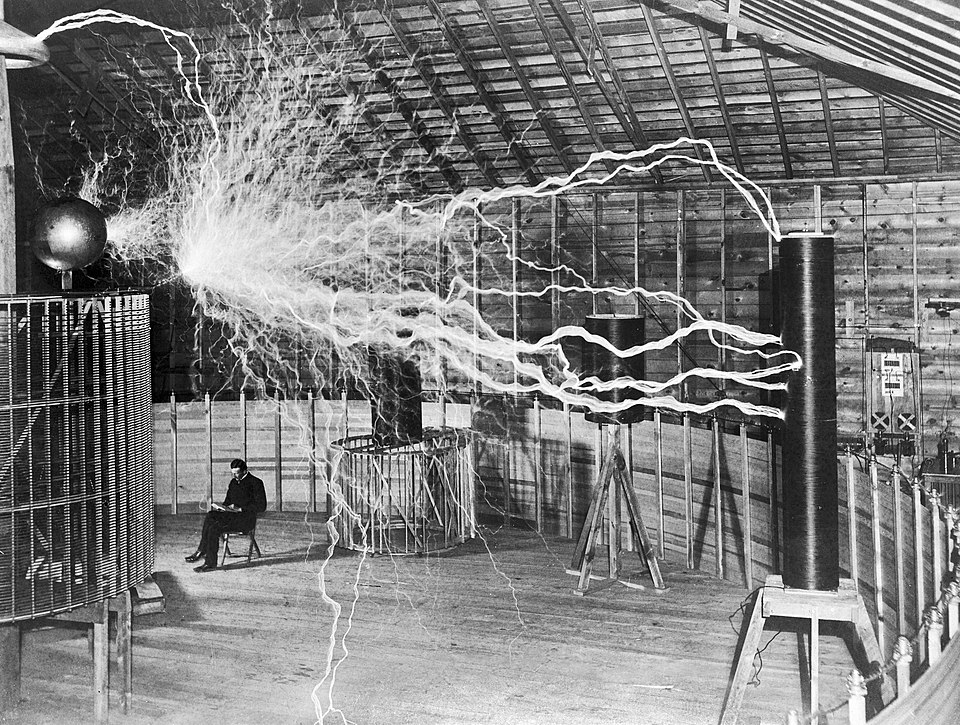
Silence and space. In Colorado Springs, the dry air carries electricity like nowhere else, and I built a laboratory there with a giant coil piercing the roof. One night, I unleashed my oscillating transmitter at full power. Artificial lightning bolts over thirty meters long shot from the tower, the roar was heard twenty-four kilometers away, and the smell of ozone filled the valley. I burned out the dynamo of the city power company and plunged Colorado Springs into darkness — they resented me, naturally. But that night, I had struck the Earth like a bell, and I heard it resonate. I had proof that the globe itself could conduct my energy.
I had struck the Earth like a bell, and I heard it resonate.
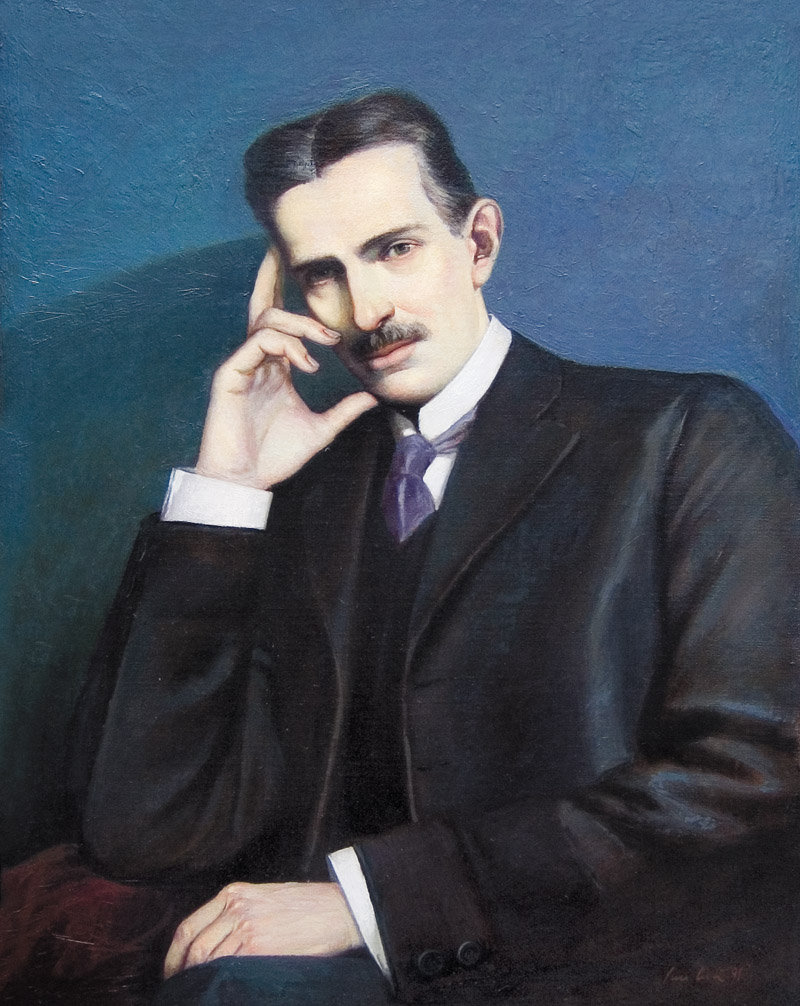
—They say you lit lamps at a distance, without any cable. Is that true?
Perfectly true, and it is the moment I am most proud of. Still in Colorado, I planted two hundred incandescent bulbs in the ground forty kilometers from my laboratory, without any wire connecting them. I activated my magnifying transmitter, and they all lit up together, shining in the prairie like a field of fallen stars. My assistants trembled. Understand what this means: energy had traveled through the earth and air, invisible, without a single copper conductor guiding it. Where others saw a circus trick, I saw the dawn of a world freed from poles and cables. The resonant transformer I had designed in 1891 had just kept its wildest promise.
They lit up like a field of fallen stars in the prairie.
—Wardenclyffe was to crown that dream. What did this titanic project consist of?
A tower fifty-seven meters tall erected on Long Island, at Shoreham, with a copper mushroom on top and roots plunging deep into the ground. My idea went beyond simple radio: I wanted to gird the planet with a network, where one could both exchange messages and draw power at any point on the globe. I had written to my backer J.P. Morgan in 1901 that I was “able to transmit messages wirelessly to any point on the globe, to supply electrical energy to any place on Earth without using wires.” The ether was for me an ocean that bathed the whole Earth. Imagine: a peasant in Asia lighting his lamp from the same source as a bourgeois in New York.
I wanted to gird the planet with a network where everyone could draw power at any point on the globe.
—And yet the tower was abandoned, then demolished. How did you experience that failure?
Like a slow strangulation. Morgan closed his purse as soon as he understood that I wanted to offer energy to the world rather than sell it by the meter — a man who lends money does not like giving away light for free. Funds dried up around 1905, the tower stood there, mute, rusting in the Atlantic wind. In 1917, they dynamited it to settle my hotel debts, and I learned the news like the death of a child. That same year, those very engineers who had abandoned me gave me the Edison Medal — what cruel irony, to decorate the man whose masterpiece they had just blown up. I was right too early; that is the one sin never forgiven.
I was right too early; that is the one sin never forgiven.
—The question of radio long pitted your name against Marconi's. What do you think of that?
Marconi received the honors, the medals, even the Nobel Prize, for a wireless transmission built on seventeen of my patents — I counted them, you know. My high-frequency work dated back to 1891, and I had told the engineers: “Working with high-frequency alternating currents, I discovered phenomena of an entirely new nature, opening a vast field of investigation for engineers and physicists.” I was overtaken while I dreamed of something greater than radio. I do not beg for recognition; time is a more honest judge than academies. Let it decide one day, even long after me, and my priority will appear on its own.
Time is a more honest judge than academies.
—Today, in this room, you devote your days to pigeons. What do they mean to you?
They are, in the end, my only faithful company. Every day I go down to the park, or I let them in here, at the New Yorker Hotel, and I nurse them when they are hurt. There was a white dove, a female, that I loved as one loves a human being; the day she died in my hands, I felt that something also died in my work. I live on little — warm milk, vegetable juices, never meat, for I have always thought that frugality keeps the mind clear. The powerful of this world have forgotten me in this room, but these birds, they come back. A man who wanted to electrify the Earth now content himself with warming feathers.
A man who wanted to electrify the Earth now content himself with warming feathers.
—If you could imagine being read a century from now, what would you want to be remembered?
Not the ruined inventor in this room, but the idea that guided me all my life. I wrote in 1900, in Century Magazine, this conviction: “All the energy available to man comes from the sun. Our existence depends on our food resources and on how we use the natural forces around us.” That is my testament. Let us stop burning coal like barbarians, let us capture the force of waterfalls, wind, and light. The induction motor I designed as a young man already turns in your factories; it will still turn when my name has faded. I did not work for glory, but so that one day light would be as free and abundant as the air we breathe.
Let light one day be as free and abundant as the air we breathe.
This imaginary interview was generated by artificial intelligence from sources documented in Nikola Tesla's profile. It dramatises what the figure might have said based on what we know about them, but does not constitute attested historical testimony. For primary sources and factual documentation, refer to the full profile.