Kids interview Nikola Tesla
by Charactorium · Nikola Tesla (1856 — 1943) · Sciences · 5 min read
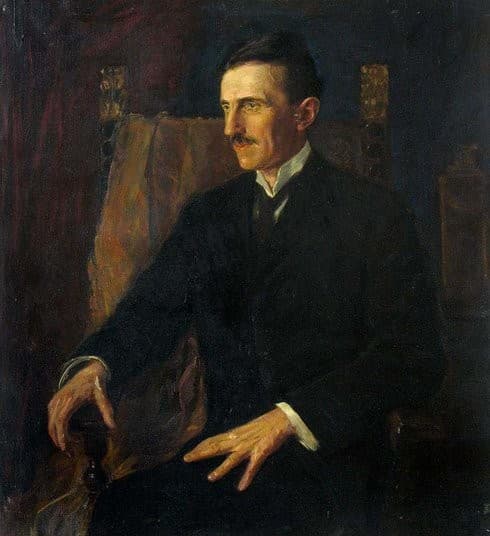
Two young visitors, aged 12, push open the door of a New York hotel room. A very elegant old gentleman in a dark suit waits for them by the window, surrounded by pigeons. His name is Nikola Tesla, and he has agreed to answer all their questions.
—Is it true that you invented your machines in your head, without drawing?
Yes, my child, it's true. Imagine closing your eyes and seeing your motor run, with every part, every wheel, as if it were right before you. I could run it for days in my head, and even spot the part that would wear out. I didn't need paper. In my book My Inventions, I wrote that the experiments done in my dreams were as real as those in my laboratory. When I finally built the machine for real, it worked on the first try. It was like copying a finished drawing neatly.
My dreams were a workshop where my machines were already running.
—What did you eat in the morning before going to work?
Very little, you know. I woke up early, did some exercises, then drank warm milk with a little honey. That's all. I didn't like red meat; I found it tired the body. I preferred vegetables, fruits, simple things. After that, I'd rush to my laboratory in New York at dawn, to enjoy the silence. In the morning, no one speaks, no machines hum. It's the best time to think. Imagine a large empty room, quiet, with just the rising light: that's where my best ideas came.
—Who was your great rival? Why did you argue?
His name was Thomas Edison. At first, I even worked for him! But we disagreed about electricity. He championed direct current; I championed alternating current, which changes direction many times per second and travels far without losing power. They called it the War of Currents. Edison wanted to scare people: he said my current was dangerous. But in 1893, my system lit up the entire great Chicago World's Fair, before amazed crowds. Then everyone understood. Imagine thousands of lamps turning on at once, like a sky of stars inside a building.
You don't win an argument with fear, but with light.
—Were you afraid people would think your invention was dangerous?
A little, yes. It's hard when false things are said about your work. To frighten the public, my rival gave cruel demonstrations with my current. Many people were afraid of electricity, as one fears a storm. So with my partner Westinghouse, we had to show, patiently, that alternating current could be safe and useful. When I assigned my patents to Westinghouse in 1888, it was a gamble. But look: today, that current still enters homes. Imagine planting a seed and being told it's bad. You wait, you water, and one day the tree proves you were right.
—Is it true that you made giant lightning? What was it like?
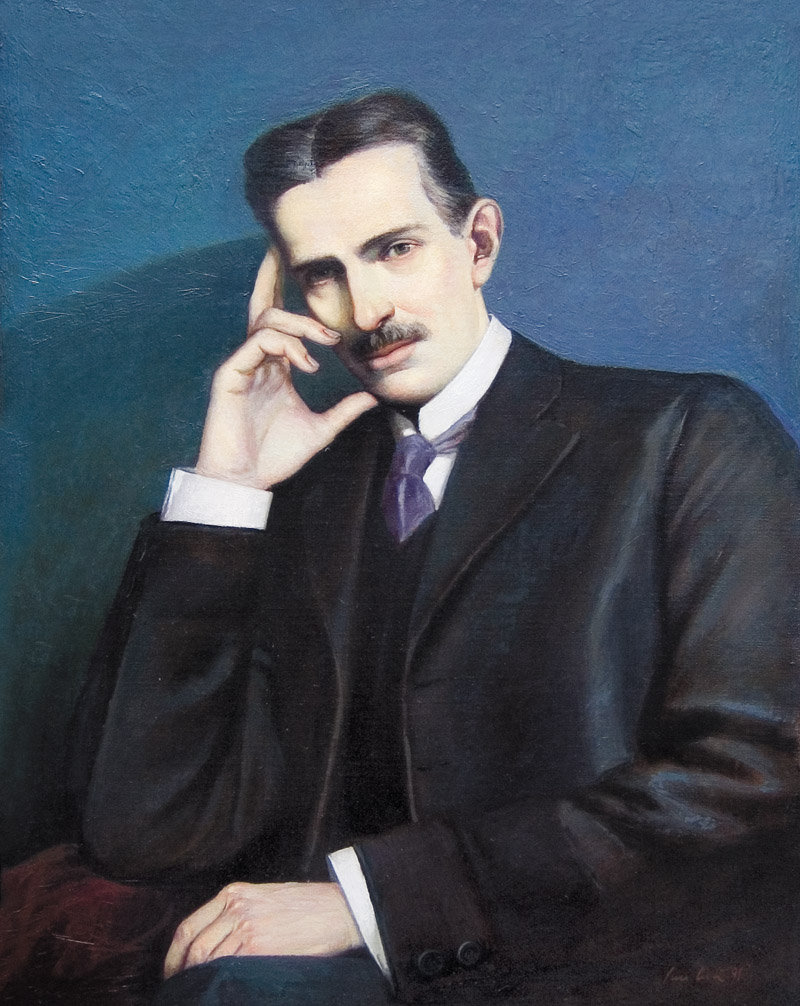
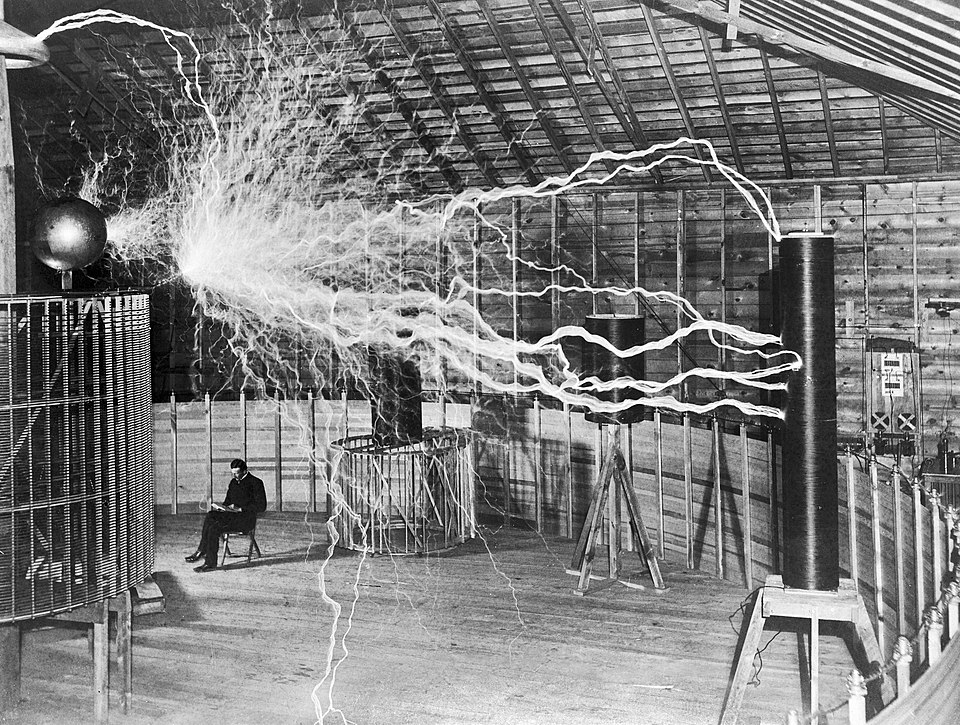
Oh, you should have seen it! In 1899, I had a laboratory in Colorado Springs, in the mountains. I built a huge machine there, my Magnifying Transmitter. With it, I made artificial lightning bolts over thirty meters long. The thunder could be heard twenty-four kilometers away! Imagine a storm you control yourself, with a switch. The locals were impressed, sometimes worried. Once, I even caused a city-wide blackout. But what a spectacle: lightning obeyed my hand. It was probably the craziest moment of my inventor's life.
I learned to command lightning as one lights a candle.
—And is it true that you lit lamps without any wires?
Yes, and I was very proud of that! Still in Colorado Springs, I managed to light two hundred lamps located forty kilometers from my machine, without a single wire connecting them. The energy traveled all by itself, through the air and the ground. Imagine placing a lamp in the middle of a field, far from everything, and it lights up as if by magic. Except it wasn't magic: it was science, invisible waves. I dreamed of a world where electricity would be free and everywhere, like the air we breathe. For me, my transmitter was my greatest invention.
—What was your wildest dream? The one about the big tower?
Ah, you mean Wardenclyffe. That was my most immense dream. I wanted to build a giant tower on Long Island, capable of sending energy and messages anywhere on Earth, without any wires. In a letter to my financier, J.P. Morgan, I wrote that I could transmit messages to any point on the globe. Imagine: a child in America and a child in Asia, receiving the same light at the same instant. A single tower to connect the whole world. I believed in it with all my heart, between 1901 and 1905. It was too big, perhaps. But the most beautiful dreams are always a little too big.
The most beautiful dreams are always a little too big.
—Why did your tower never work? Were you sad?
Yes, I was very sad, I won't lie. Money ran out. Building such a tower cost a fortune, and my financier eventually stopped believing. In 1905, I had to abandon the project. And the worst came later: in 1917, they demolished my tower to repay my debts. Imagine building a castle with your own hands for years, and having it destroyed before your eyes. It hurts, right here. But you know, an idea never truly dies. The tower fell, but the dream of connecting the world remained standing in people's minds.
You can tear down a tower, but never the idea that gave it life.
—They say you had strange habits. Is that true?
Ha! Yes, it's true, and I own it. I loved the number three. Before entering a building, I would always walk around it three times. At the hotel, I asked for eighteen clean napkins every day, because eighteen is a multiple of three. And I hated pearl earrings; they made me uncomfortable, I don't even know why. Today, one might say my mind had its little quirks. Imagine someone who absolutely must count their steps. My brain loved order, numbers, regularity. That's also what helped me, I think, to design my machines with such precision.
—In the end, were you all alone? Why the pigeons?
Yes, my child. At the end of my life, I lived simply, here at the Hotel New Yorker, in room 3327. I didn't have much money left, and few visitors. So I fed the city pigeons. I cared for them, talked to them, and they came to perch on my windowsill. They were my most faithful friends. A man who made lightning strike ends up marveling at a bird's wing, you see. I gave the world the current that lights cities, and the world forgot me a little. But I wasn't bitter. I had my ideas, my birds, and the sky.
He who commanded lightning still marveled at a bird's wing.
This imaginary interview was generated by artificial intelligence from sources documented in Nikola Tesla's profile. It dramatises what the figure might have said based on what we know about them, but does not constitute attested historical testimony. For primary sources and factual documentation, refer to the full profile.