Kids interview Ovid
by Charactorium · Ovid (42 av. J.-C. — 17) · Literature · 5 min read
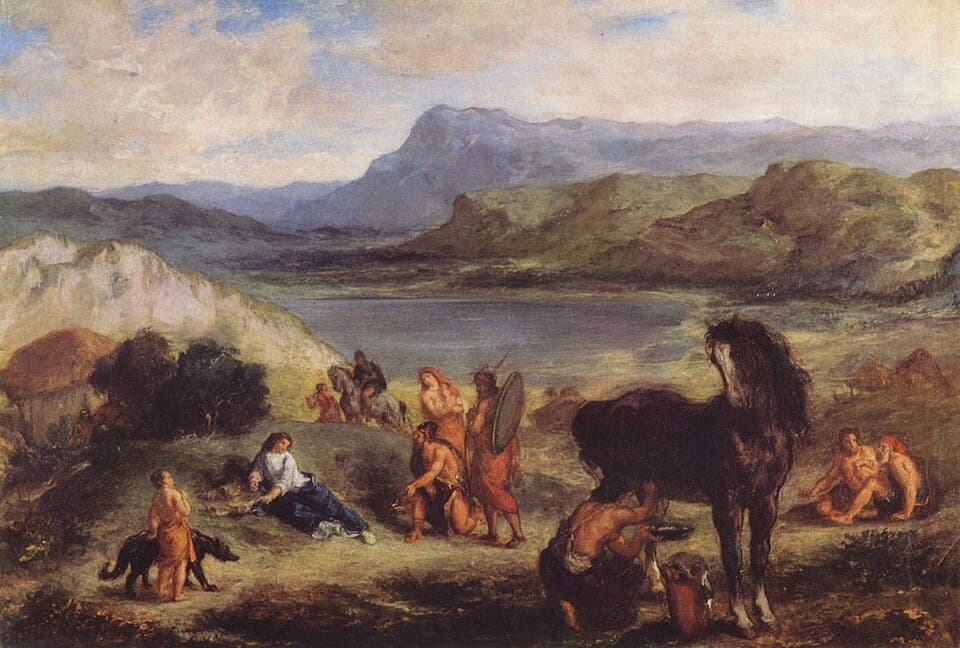
Two twelve-year-old students visit an exhibition on ancient Rome. In front of a mosaic, an old man in a toga smiles at them: it's Ovid, the poet. He sits down near them and agrees to answer all their questions.
—How old were you when you decided to become a poet?
You know, my child, I think I always knew. I was born in Sulmo, in the mountains of Abruzzo, on March 20, 43 BCE. It was a small, cool town, crossed by cold springs. Sulmo mihi patria est, I used to say: 'Sulmo is my homeland.' My father, though, wanted me to become a lawyer. He sent me to Rome to learn the art of speaking well, rhetoric. But imagine a boy trying to write a serious legal speech... and every sentence spontaneously starts singing in verse! My father scolded me. I couldn't help it. The words wanted to dance.
My father wanted a lawyer; the words wanted to dance.
—What did you write with when you were little?
With a stilus, a small pointed stick made of metal or bone. You scratched letters onto a wax tablet, a wooden frame filled with soft wax. When you made a mistake, you turned the stylus around: the other end was flat, and it erased everything by smoothing the wax. Magical, isn't it? From childhood, I carved my verses onto it, sometimes in secret. Later, I even went to Athens, in Greece, to finish my studies. That's where I learned by heart all the old stories of the Greek gods. I didn't know it yet, but that material would become, years later, my great work.
—What is your most famous book?
The Metamorphoses, my child! Metamorphosis is a Greek word meaning 'change of form.' Imagine a huge book, fifteen scrolls, that tells the whole world from its creation to my time. And everything changes: a girl becomes a tree, a man becomes a flower, a proud man becomes a stone. I gathered about two hundred and fifty of these transformation stories. It begins like this: In nova fert animus mutatas dicere formas corpora — 'My mind impels me to speak of forms changed into new bodies.' It's my way of saying that nothing ever stays quite the same. You too will not remain the child you are.
Nothing ever stays quite the same.
—How long did it take you to write such a big book?
Nearly ten years, my child! And I didn't write alone in a corner. In the morning, in my office called the tablinum, I paced back and forth and spoke my verses aloud. Very learned slaves, my scribes, wrote under my dictation on long papyrus rolls. More than twelve thousand lines in total! Imagine repeating a story for so long that it follows you into your dreams. Sometimes I would correct a single word for an entire day. A poem, you see, is like a garden: you prune, you wait, you start over. Patience makes beautiful things grow.
—Did you also write about women?
Yes, and I'm proud of it! In a book called the Heroides, I imagined letters written by the great women of the old myths. Penelope waiting for her husband gone to war. Dido, an abandoned queen. Medea, betrayed by the one she loved. You know, in ancient stories, it's almost always the heroes who speak. I wanted to listen to the heroines' hearts: their anger, their sadness, their courage. I wrote these poems in elegiac couplets, verses meant to express feelings. Imagine finally reading the letter that no one had ever wanted to write. Giving a voice to those who were silenced—that was my way.
I wanted to listen to the heart of those who were silenced.
—Is it true you wrote a book that angered the emperor?
Alas, yes, my child. I had written the Ars Amatoria, 'The Art of Love.' The word ars means a skill, a technique. I explained, with a bit of humor, how to seduce and please, as if love were a trade to be learned. I described where people met in Rome: under the porticoes, during grand banquets. It was light, mischievous. But Emperor Augustus wanted the Romans to be serious and well-behaved. My little joyful book displeased him greatly. Years later, he even used it as an official reason to punish me. You see, a poem that makes you smile can sometimes become as dangerous as a sword.
A poem that makes you smile can become as dangerous as a sword.
—What was a party like at rich Romans' houses?
Ah, the convivium! That was our grand evening dinner. We didn't eat sitting like you: we lay on couches around the table, leaning on one elbow. Imagine a room lit by small oil lamps, perfumed with herbs and garum, that fish sauce we put on everything. We drank wine from cups, listened to music, and above all, we recited poems. I would present my new verses to my friends there. It was also there, between courses, that people fell in love! I talked about it a lot in my books. The Roman night smelled of wine, hot oil, and poetry.
—Why did the emperor send you so far from home?
That is the great wound of my life, my child. In the year 8 CE, Augustus banished me to Tomis, a distant city on the Black Sea — far to the east, where the winter is terrible. Why? I said it myself: carmen et error, 'a poem and a mistake.' The poem was undoubtedly my Art of Love. But the mistake... I never wanted to reveal it. I had seen, or known, something I shouldn't have. Imagine being torn from your home, your friends, your language, overnight, without a trial. I never saw Rome again. Never.
A poem and a mistake: that is what cost me my homeland.
—What was your life like there, in the cold?
Very hard, my child. In Rome, I had a beautiful house with frescoes on the walls and a garden. In Tomis, I lived in a modest dwelling, probably wooden, battered by freezing winds. The worst was being alone among people whose words I couldn't understand! So, do you know what I did? I learned their language, Getic. I even composed verses for them. And I had to trade my fine toga for the sagum, a thick, coarse barbarian woolen cloak. To console myself, I wrote letters in verse to Rome, the Tristia, so that I wouldn't be forgotten.
—If you could say one thing to today's children, what would it be?
I would say: write, my children. They took everything from me — my city, my friends, my mild climate. They sent me to die at the edge of the world, and they even burned my verses, they say. But do you know why we are still talking, you and I, after so many centuries? Because copies of my Metamorphoses were already circulating among my friends. Words traveled where my body could no longer go. A very powerful emperor wanted to erase me. He failed. This I know: what you write with your heart can cross time. It is stronger than all empires.
Words traveled where my body could no longer go.
Read further
This imaginary interview was generated by artificial intelligence from sources documented in Ovid's profile. It dramatises what the figure might have said based on what we know about them, but does not constitute attested historical testimony. For primary sources and factual documentation, refer to the full profile.