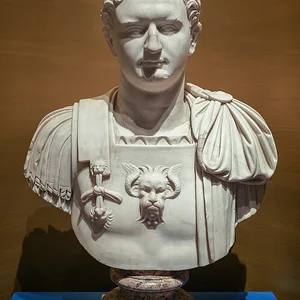

Ovid (43 BC – 17 AD) was a Roman poet of the Augustan age, author of the Metamorphoses, a landmark work of ancient literature. He transformed Greco-Roman mythology into narrative and musical poetry, profoundly influencing European culture.
Ovid(42 av. J.-C. — 17)
Ovid
Rome antique
8 min read
Frequently asked questions
Famous Quotes
« Video meliora proboque, deteriora sequor»
« Omnia mutantur, nihil interit»
Key Facts
- 43 BC: born in Sulmo in central Italy
- c. 8 AD: exiled by Emperor Augustus for reasons still debated, sent to Tomis (modern-day Romania)
- Composition of the Metamorphoses (c. 8–17 AD): 15 books in verse, around 12,000 lines tracing mythological transformations
- 17 AD: died in exile at Tomis
- Lasting influence: his works inspired the Renaissance, Baroque art, and European literature to this day
Works & Achievements
Ovid's first collection of elegiac poems, celebrating his fictional passion for a certain Corinna. These poems, often ironic and lighthearted, earned him immediate fame in Roman circles.
A satirical and poetic manual of seduction in three books, aimed first at men and then at Roman women. This provocative work was officially invoked by Augustus to justify Ovid's exile a decade later.
A collection of fictional poetic letters written by mythological heroines (Penelope, Dido, Medea...) to their absent lovers. A work of remarkable psychological modernity, it gives voice for the first time to the women of mythology.
Ovid's masterpiece in 15 books and 12,000 verses, recounting the history of the world from Creation to Julius Caesar through 250 tales of transformation. A foundational work of Western culture, it inspired Dante, Shakespeare, Botticelli, and generations of artists.
A Roman poetic calendar in 6 books (only the first 6 months have survived), explaining Roman religious festivals and rites. A precious work for understanding Roman religion and customs.
Five books of elegiac poems composed in exile at Tomis, blending laments about his condition, descriptions of barbarian life, and supplications to Augustus. A unique document on the psychology of a poet broken by political power.
Four books of poetic letters sent from Tomis to Roman friends and loved ones, in the hope of having them intercede on his behalf. Ovid describes with precision the peoples, climate, and geography of the shores of the Pontus Euxinus.
Anecdotes
Ovid was born in Sulmo, in the Abruzzi region, on March 20, 43 BC, the same day that the consul Hirtius died at the Battle of Mutina. His father, a man of the equestrian class, wanted him to become a lawyer and sent him to study rhetoric in Rome, but young Publius preferred composing verses in spite of himself.
In 8 AD, Emperor Augustus exiled Ovid to Tomis, a barbarian town on the shores of the Black Sea (present-day Constanța in Romania). The official reasons remain mysterious: Ovid himself speaks of a 'carmen et error', a poem and a mistake. Some historians believe he may have been caught up in the scandal surrounding Augustus's granddaughter, Julia.
From his exile, Ovid wrote pleading poetic letters to Augustus, then to Tiberius, seeking a pardon. He even learned Getic, the local language of the inhabitants of Tomis, in order to teach them the glory of Rome in verse. Despite all his efforts, he died in exile around 17 AD, never having seen Rome again.
The Metamorphoses, Ovid's masterpiece, contains more than 12,000 verses in dactylic hexameter and recounts approximately 250 myths of transformation. To compose this colossal work, Ovid is said to have spent around ten years on it, dictating it to scribes in his luxurious Roman home before his exile.
It is said that Ovid himself burned the manuscript of the Metamorphoses when Augustus pronounced his exile, out of despair. Fortunately, copies had already circulated among his friends and Roman admirers, which allowed the work to reach us intact.
Primary Sources
In nova fert animus mutatas dicere formas / corpora. Di, coeptis (nam vos mutastis et illas) / adspirate meis... — 'My mind leads me to speak of forms changed into new bodies. O gods, inspire my undertaking, for it is you who have brought about these transformations...'
Ille ego qui fuerim, tenerorum lusor amorum, / quem legis, ut noris, accipe posteritas. — 'I who was the poet of tender loves, learn who I am, O posterity who reads me.' Ovid retraces his own life in this poetic autobiography.
Da mihi Maecenatem... — Ovid implores the protection of the imperial circle from his exile in Tomis, describing the harshness of the barbarian climate and his longing for Rome.
Si quis in hoc artem populo non novit amandi, / hoc legat et lecto carmine doctus amet. — 'If anyone among this people does not know the art of love, let him read these verses and, taught by this poem, let him love.'
Key Places
Ovid's birthplace, nestled in the Abruzzo region 140 km from Rome. Ovid evokes it with nostalgia in his works: 'Sulmo mihi patria est' (Sulmona is my homeland), a fertile town crossed by cold springs.
Ovid lived and thrived in Rome, moving in literary circles around Messala Corvinus, a rival of Maecenas's circle. He describes the baths, porticoes, and spectacles of the Campus Martius as places of seduction in the Ars Amatoria.
A barbarian town on the Black Sea coast where Augustus exiled Ovid in 8 AD. Ovid suffered from the cold, the isolation, and the foreign culture, which he describes with despair in the Tristia and the Epistulae ex Ponto.
Ovid stayed in Athens in his youth to complete his rhetorical and philosophical education, following the custom of cultivated young Romans. It was there that he deepened his knowledge of Greek mythology, the raw material of his Metamorphoses.
Typical Objects

A common writing instrument in Rome, consisting of a wooden frame coated with wax on which texts were inscribed with a stylus. Ovid composed his early verses on such tablets, later dictating them to his scribes to be copied cleanly onto papyrus.

The format of the ancient book, made of glued papyrus sheets rolled around a rod. Ovid's Metamorphoses circulated in this form across several scrolls among educated Roman readers.

A fine-pointed metal or bone tool used for writing on wax tablets and for erasing by turning the stylus to its flat end. It was with this tool that Ovid, from childhood, practiced poetic composition despite his father's opposition.

The distinctive garment of the Roman equestrian class to which Ovid's family belonged, bordered with purple. Ovid wore it during his brief career in public office in Rome before devoting himself entirely to poetry.

Wine was the central drink at Roman banquets (convivia) where Ovid recited his poems before an aristocratic audience. The Ars Amatoria describes these feasts at length as places of romantic encounter.

In exile at Tomis, a cold and inhospitable land, Ovid had to adopt the thick garments of the local Getae population. In the Tristia he mentions the cultural shock of having to wear these rough clothes, so unlike the refined Roman toga.
School Curriculum
Vocabulary & Tags
Key Vocabulary
Tags
Daily Life
Morning
Ovid rose at dawn, like any Roman of good standing. After his ablutions, he received his clients and admirers during the morning salutatio, an unavoidable social ritual. He would then dictate his verses to one or more scribes, working on his poems in the relative calm of his tablinum (study).
Afternoon
In the afternoon, Ovid frequented the public baths, the porticoes (such as the Porticus Octaviae, which he mentions in the Ars Amatoria) and the gardens for walks and conversation. He sometimes attended public readings (recitationes) or organized them himself at his home to present his new compositions to a circle of learned friends.
Evening
The evening was devoted to banquets (convivia) at the homes of friends or patrons, where poetry, music and philosophical discussions held a prominent place. Ovid himself describes in his works these elegant dinners, accompanied by country wine, as the ideal setting for amorous games and poetic recitations.
Food
The Roman diet of the equestrian class was based on bread, legumes (lentils, chickpeas), fresh vegetables, and sea or freshwater fish. Meat, mostly reserved for banquets, was served with sauces made from garum (fermented fish sauce) and aromatic herbs. In exile at Tomis, Ovid complained about the coarseness of the local food and the poor wine.
Clothing
In public, Ovid wore the white toga of the equestrian class, a loose garment draped over the tunic and a mark of Roman respectability. In private, a simple tunic (tunica) sufficed. In exile in the cold Tomis, he adopted the sagum, a thick woolen cloak worn by barbarian peoples, which he evokes with bitterness as a symbol of his downfall.
Housing
In Rome, Ovid lived in a comfortable domus on the Capitoline or Palatine hill, featuring a central atrium with a pool, an interior garden (hortus) and rooms decorated with mythological frescoes. In exile at Tomis, he lived in a modest dwelling, probably wooden, battered by the icy winds of the Black Sea, which he describes as a true torment after the luxury of Rome.
Historical Timeline
Period Vocabulary
Visual Style
Esthétique de la Rome augustéenne — fresques chaudes, marbres blancs, représentations mythologiques aux formes fluides — contrastée avec la palette froide et austère de l'exil pontique.
Sound Ambience
Un contraste entre le brouhaha cultivé de Rome augustéenne — salles de récitation, banquets, fontaines — et la solitude glaciale de l'exil à Tomes, avec le vent du Pont-Euxin et les langues barbares.
Liens externes & ressources
Références
Œuvres
Les Amours (Amores)
Vers 16-1 av. J.-C.
L'Art d'aimer (Ars Amatoria)
Vers 1 av. J.-C.
Les Héroïdes (Heroides)
Vers 10-1 av. J.-C.
Les Métamorphoses (Metamorphoses)
8 ap. J.-C.
Les Fastes (Fasti)
Vers 1-8 ap. J.-C. (inachevés)
Tristes (Tristia)
9-12 ap. J.-C.
Lettres du Pont (Epistulae ex Ponto)
11-17 ap. J.-C.