Imaginary interview with Ovid
by Charactorium · Ovid (42 av. J.-C. — 17) · Literature · 7 min read
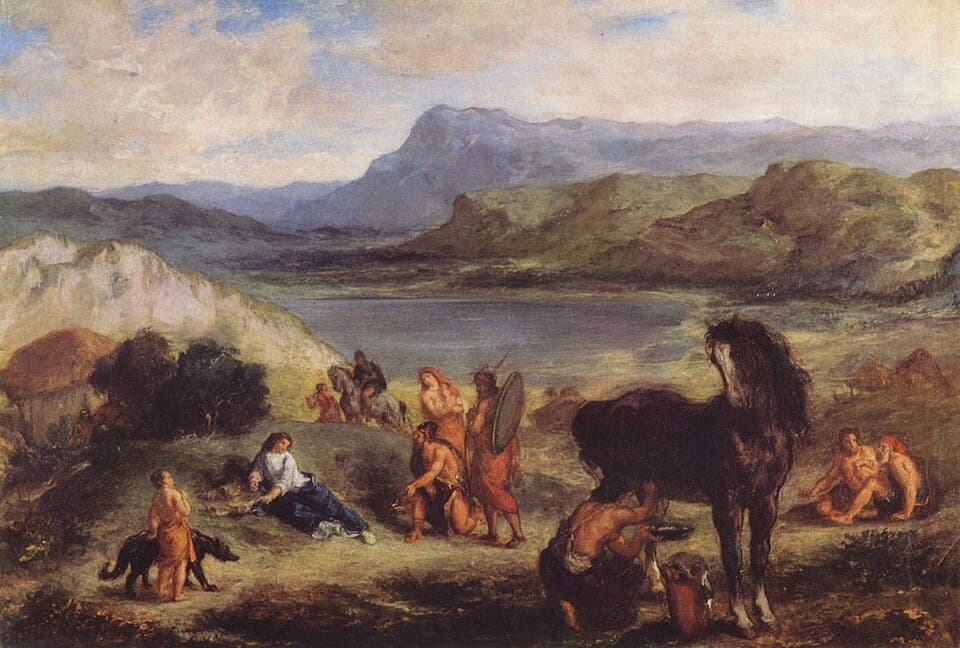
Tomis, on the shores of the Pontus Euxinus, a winter evening around the year 15. The Getic wind whistles against the shutters of a wooden house where an aging Roman fastens his cloak of thick wool. On his table, wax tablets and a letter begun for Rome, which he will never see again. He agrees to speak, on condition that it not be forgotten that he was, back there, the most read poet of the City.
—They say you were born on the day of a battle. What were you told about that day?
I came into the world at Sulmo, in the Abruzzi, on the twentieth day of March in the year 43 before the birth you reckon differently, the very day when the consul Hirtius fell before Modena. A bad omen, my nurse said; I saw in it above all that civil war rocked my cradle. Sulmo mihi patria est — Sulmo is my homeland, a fertile land cut by cold waters, and I sang of it all my life. My father, a man of equestrian rank, dreamed for me of the toga praetexta and the law courts: a son who was a lawyer, that was his pride. But from childhood, the stylus ran of its own accord over the wax, and what I wanted to say in prose turned into verse despite myself. Old Hirtius died in battle; I was already born a deserter from the bar.
Civil war rocked my cradle; I was already born a deserter from the bar.
—How did you go from the schools of rhetoric to the poetry that made your name?
My father sent me, like every young Roman of good family, to learn rhetoric in Rome, then to perfect my art all the way to Athens. There, under the Greek sky, I drank mythology at the source: those gods who change form, those nymphs who become trees or springs, all the material that, years later, would nourish my Metamorphoses. They wanted to make an orator of me; declamations bored me, except when I could pour them into couplets. My teachers reproached me for turning my pleadings into songs. When my brother died and my father ceased to hope for a magistrate, I laid aside for good the toga of public office and gave myself entirely to elegy. The rhetorician gave way to the poet, and I never regretted the case I never pleaded.
They wanted to make an orator of me; I turned my pleadings into songs.
—Your Art of Love made you famous and then ruined you. What was your intention in writing it?
The Ars Amatoria was a game, a handbook for laughter, where I taught seduction as one teaches a trade — for ars in our language is art, skill, and a touch of cunning. I walked my readers under the porticoes of the Campus Martius, in the shadow of the Portico of Octavia, among the banquets where wine loosens glances: there were my hunts, there my amorous ambushes. Si quis in hoc artem populo non novit amandi, hoc legat et lecto carmine doctus amet — let him who does not know the art of loving read me, and instructed by my poem, let him love. Rome laughed; Augustus, for his part, did not laugh. The prince dreamed of reformed morals, faithful wives, and severe laws, and here was a poet teaching adultery in elegant verse. That light book weighed heavier than I imagined.
I taught seduction as one teaches a trade; Augustus, for his part, did not laugh.
—You speak of a 'carmen et error' to explain your exile. What can you say about it?
Two words, and my entire downfall: carmen et error, a poem and a mistake. The poem, everyone guesses, is my Art of Love, which Augustus brandished to strike me. But the mistake, the other fault, I saw with my own eyes and must keep silent; heads higher than mine are at stake. They whisper the name of Julia, the prince's granddaughter, and the scandal that enveloped her the very year of my disgrace — I will say no more. In the year 8, the order fell: relegatio to Tomis, on the Black Sea. Note the word well: relegatio, not deportatio. I kept my property, my citizenship; I only lost Rome, that is, everything. An exiled poet without trial, by the sole edict of the master — that is what a carmen and a secret can cost.
I kept my property, my citizenship; I only lost Rome, that is, everything.
—What is life like for a Roman poet on the shores of the Pontus Euxinus?
The Pontus Euxinus, the sea called hospitable — what mockery! Here the cold splits stones, wine freezes in the cup and keeps the shape of the vessel. I had to trade my refined toga for the sagum, that cloak of coarse Getic wool, which smells of beast and sweat. Around me, barbarian horsemen with poisoned quivers, a harsh language that I ended up learning — to the point, by mockery of fate, of composing verses in Getic to tell them of Rome's glory. Far from the Forum, the baths, the recitationes where I read my new poems to learned friends, I have only my tablets and memory. From this end of the world I write my Tristia and my Letters from the Pontus, supplications hurled toward a City that does not reply.
The cold splits stones, wine freezes in the cup and keeps the shape of the vessel.
—What exactly do you ask for in these letters that you send tirelessly to Rome?
I ask what every exile asks: that they remember me, and that they plead my cause. Da mihi Maecenatem — give me a Maecenas, a protector who whispers my name in the prince's ear. I write to my friends, to my wife who remained in Rome, to anyone who approaches the palace. After the death of Augustus in the year 14, I hoped that Tiberius would open the cage; he did not. My Epistulae ex Ponto are outstretched hands that meet only the wind of the Pontus. I describe the climate, the tribes, the desolation, not out of a taste for painting, but so that in Rome they measure what they inflict on me. A poet begging for his pardon in verse: that is what my art still serves for, when it serves no longer to charm but to survive.
My letters are outstretched hands that meet only the wind of the Pontus.
—You learned the language of the Getae. What is it like to live among those whom Rome calls barbarians?
One lives badly, and then one gets used to it, which is worse. The first months, I heard only a noise of throats around me, and I was ashamed of my Latin mouth that no longer served anyone. So I listened, then spoke Getic, that rough language in which no verse seemed able to hold. What irony: I who made the dactylic hexameter dance, I found myself composing for these men in the sagum a poem in their idiom, to celebrate the house of Augustus. They listened, struck their quivers in approval — a barbarian triumph, my only audience now. At Tomis, I am no longer Ovid the poet of Roman ladies; I am the foreigner who knows how to speak, and who is tolerated because he has learned to say things in the language of the cold.
One lives badly, and then one gets used to it, which is worse.
—If you had to introduce yourself to those who will read you long after you, what would you tell them about yourself?
I have already told them, in my Tristia, looking back on my own life as one watches a receding shore: Ille ego qui fuerim, tenerorum lusor amorum, quem legis, ut noris, accipe posteritas — I who was the singer of tender loves, learn who I am, O posterity who reads me. That is my true testament: not the lawyer my father wanted, not the condemned man Augustus made, but the player, the lusor, he who took love as his material and elegy as his homeland. If, by some impossibility, I am still read in a century or ten, let them read me thus: a light man whom a prince found too heavy, and who, from the depths of Tomis, bets his survival on a few rolls of papyrus that left without him for the City.
A light man whom a prince found too heavy.
—Why did you, they say, throw the manuscript of your Metamorphoses into the fire at the moment of departure?
The day the edict drove me out, I took the rolls of the Metamorphoses, ten years of my work, and threw them into the flames of my own hearth. A gesture of despair, not of contempt: I was leaving Rome unfinished, the work seemed to me only a sketch that civil death was tearing from my hands. I burned the volumen as one burns a child one will not see grow. But fate was kinder than the prince: copies were already circulating among my friends, read aloud at recitationes, copied by faithful hands. What my fire wanted to destroy, their affection had saved. Today I rejoice in it; then, in my fury, I thought I was reducing to ashes all that remained of my glory. One does not so easily kill a poem that has already begun to live in other mouths.
I burned the roll as one burns a child one will not see grow.
—Speaking of the Metamorphoses: how does one build a work of fifteen books and twelve thousand verses?
One builds it slowly, word by word, in the quiet of the tablinum, at the hour when the clients of the salutatio have finally left the atrium. In the morning, after ablutions, I dictated to my scribes what I had first scratched with the stylus on wax; they copied it fair onto papyrus. For ten years, I stitched together nearly two hundred and fifty tales of transformation, from the first chaos to my own time, in dactylic hexameters. In nova fert animus mutatas dicere formas corpora — my mind impels me to speak of forms changed into new bodies: thus the work opens, and that is its whole program. The entire world is but a long metamorphosis, and I, modestly, have only kept its record in verse, from the god who separated the elements to the star of Caesar.
The entire world is but a long metamorphosis; I have only kept its record in verse.
—Do you regret writing that poem that scandalized the prince, or do you still claim its freedom?
I regret the misfortune it brought me, not the verses themselves. When I wrote the Ars Amatoria, I described pleasures that all Rome knew: trysts under the porticoes, glances over the wine cup in a convivium. I did not invent vice, I set it to music. Augustus wanted to restore ancient morals through his marriage laws; my poem seemed to him a public insolence, a sung contradiction to his reform. Perhaps he was right to be angry; a prince does not joke with what he builds. But to condemn a poet for a carmen written ten years earlier is to confuse the mirror with the face. I paid for a laugh. If I had to do it again, I would no doubt choose my jokes more prudently — but I would not disown the man who loved to laugh.
I did not invent vice, I set it to music.
Read further
This imaginary interview was generated by artificial intelligence from sources documented in Ovid's profile. It dramatises what the figure might have said based on what we know about them, but does not constitute attested historical testimony. For primary sources and factual documentation, refer to the full profile.