Imaginary dialogue between Horace (Quintus Horatius Flaccus) and Ovid
by Charactorium · Ovid (42 av. J.-C. — 17) · Literature · 6 min read
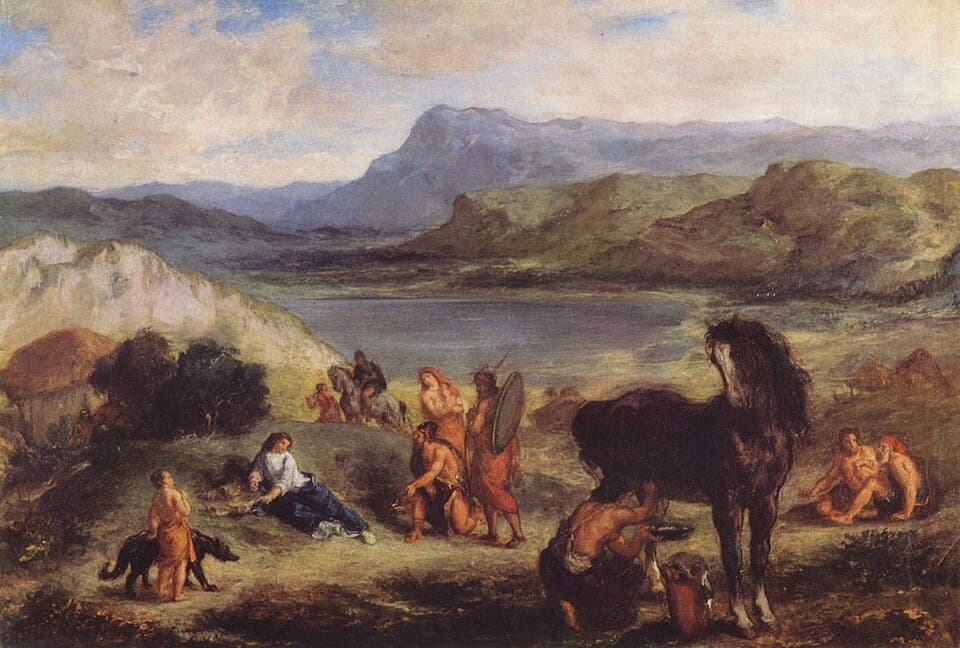
It is under the portico of a house on the Palatine, an autumn evening around 9 BC, that Horace meets the young Ovid after a recitatio well-watered with Campanian wine. Oil lamps smoke softly, and in the distance, the last guests of a convivium can still be heard winding down. The two men are not from the same circle — the elder belongs to Maecenas, the younger to Messalla Corvinus — but they respect and tease each other. Horace, an aging Epicurean, comes to pressure this poet, too brilliant, too self-assured, to justify his audacities.
—I am told, young Publius, that your father wanted you to be a lawyer at the Forum, back in Sulmo. How did the stylus defeat the pleader's toga?
My father was a man of the equestrian order, prudent, who counted sesterces and despised the Muses: they don't feed a man, he kept telling me. He sent me to Rome to learn rhetoric from the best teachers, dreaming of seeing me plead. But you see, Horace, every time I tried to write in prose, the words would arrange themselves into verse, as if obeying a secret meter. I was born on the very day when the consul Hirtius fell at Modena — perhaps the gods brought me into the world amid the din so that I might sing of something other than war. I yielded. Poetry was not my choice: it was my nature.
Poetry was not my choice: it was my nature.
—And Athens? You went there to complete your education, like any well-born young Roman. What did you bring back on your wax tablets?
I went there to listen to rhetoricians and philosophers, yes, but what I really brought back was the Greece of fables. On my tablets, between exercises, I was already scratching with my stylus the names of heroes and gods turned into beasts, rivers, stars. All that mythology the Greeks bequeathed to us, I felt it bubbling, ready to pass into our language. I also traveled to Asia, Sicily — a poet must see the world he claims to sing. You, who served under Brutus before laying down arms, know that one writes well only what one has lived a little. I have lived only loves and travels; that will be enough for a life of verse.
—Describe your days to me, you the socialite. When mine begins in the calm of my Sabine farm, yours seems entirely spent in Rome...
My mornings are like those of all well-born Romans: the salutatio, the clients filing in, then I retire to my tablinum to dictate my verses to scribes. In the afternoon, I walk under the porticoes — especially that of Octavia —, I stroll at the baths, I watch the crowd on the Campus Martius. For you see, Horace, I don't like your country solitude: my material is faces, glances, the games of the city. In the evening, it's the convivium, wine, recitations among friends. You preach retreat and the aurea mediocritas; I learn nothing except in the hustle and bustle of Rome. It is there, between two cups, that my best couplets are born.
You preach retreat; I learn nothing except in the hustle and bustle of Rome.
—Do you remember, last year, you came to hear me read at Maecenas'? You are not one of us, yet you were there. What were you looking for in our circle?
I remember perfectly, and I would come back without ceremony. Messalla is my patron, and our two circles are said to be rivals — but among poets, rivalry is a game, not a war. I came to listen to you because one always learns from an elder who holds his audience suspended on his meters. You chiseled your Odes like a goldsmith; I go faster, lighter, I admit. The recitatio is our true arena, Horace: it is there that a work lives or dies, even before the copyist rolls it into a volumen. I love that moment when you watch faces for the silence that is worth all applause. You and I do not sing the same thing, but we serve the same goddess.
—Let's talk about this Corinna who runs through your Loves. All Rome looks for her. Does she exist, or is she just a meter dressed in flesh?
Ah, everyone asks me that, and it is proof that my verses have succeeded! Corinna is everywhere and nowhere: she is the face that every lover lends to his desire. If I named a real woman, I would lose my freedom and she her reputation. In my Amores, I wanted to paint love not as a serious lament in the manner of Tibullus or Propertius, but as a game, a comedy where the lover laughs at himself. I am the tenerorum lusor amorum, the trifler of tender loves — that is how I want to be read. I leave grave passion to others; I prefer to smile while loving.
Corinna is everywhere and nowhere: she is the face that every lover lends to his desire.
—It is whispered that you are preparing an art of love, a proper seduction manual. Aren't you afraid, in the age of moral laws, to play with fire?
An art, yes, just as there is the art of war or eloquence! Why should love, which governs so many lives, not have its technique, its rules, its master? I want to teach men — and why not women — where to find the beloved, how to conquer her, how to keep her: the portico, the theater, the convivium are my classrooms. You frown, Horace, and I know what you think of Augustus' new laws on adultery. But I do not write for matrons! I address freedwomen, courtesans, those not covered by the law. Laughter and lightness have never overthrown a throne. At least, I believe so.
—You spoke to me earlier of those gods turned into beasts and rivers. What is this great design that itches you, behind your amorous trifles?
Here it is, my secret, Horace: I dream of an immense work that would sing of only one thing — transformation. Everything in the world is metamorphosed: Daphne becomes laurel, Io becomes heifer, chaos becomes the order of the stars. I want to go back from the birth of the world to our own day and string together these hundreds of stories like the pearls of a single necklace, in hexameters this time, no longer in light couplets. It will be a continuous poem, a river of fables that flows without breaking. Metamorphosis, the Greeks say: the change of forms. It is the only subject, really, because nothing remains. You who sing that everything passes, you should approve: I make passage itself the matter of an entire song.
Everything is metamorphosed: I want to make passage itself the matter of an entire song.
—Leaving the light meter of elegy for the hexameter of epic is to put on the buskins of Virgil. Isn't that bold, for a poet of the boudoirs?
Bold, no doubt — but he who dares nothing does not deserve the Muses. Virgil, may he rest in peace, sang of arms and a man; I will sing of bodies and their metamorphoses, which is no less. The dactylic hexameter is a demanding instrument, I know: six feet that must be conducted without ever tiring the ear. But I have turned enough couplets to know how to bend the language to my will. I do not want to remake the Aeneid: I want a poem without a single hero, where the only constant is change. It will take me years — ten perhaps — dictating each day in my tablinum. When it is done, I hope they will no longer say that Naso only knew how to laugh.
—Listen to an old friend, Naso: you mock the Princeps, his laws, his morals. Beware — he has a long memory and an arm that exiles far from Rome.
I know, Horace, I know you speak out of affection, you who have known, better than anyone, how to keep measure with the powerful. But what do you want Caesar Augustus to reproach a poet who only smiles? I do not conspire, I do not bear arms, I write only feigned loves and Greek fables. The carmen, the song, has never earned anyone exile. You speak to me of relegatio, of those barbarian shores where they send troublemakers to rot — but I am not a troublemaker, I am the ornament of Rome's banquets! And yet... I confess that sometimes, at night, I feel a chill pass. You have known proscriptions; I have known only peace. Perhaps I am too confident.
The song has never earned anyone exile. And yet... sometimes, at night, I feel a chill pass.
—Imagine for a moment that he banishes you to the ends of the Black Sea, among the Getae. What would remain of the brilliant Ovid, far from Rome and its porticoes?
What a grim idea you throw at me, like a bad omen at the end of a feast! If I were torn from Rome, from its baths, its convivia, from this crowd I live on, I think half of me would die. Far from the city, what would I write? Complaints, letters begging for pardon, shivering under a barbarian sagum instead of my toga. It would be worse than death: to be alive and already cut off from the world. But I want to believe that the Muses protect me, and that my verses will win me friends even in the palace. Come, Horace, let's open another amphora instead — you have chilled my blood, and it is up to you, the Epicurean, to give me back the taste of the moment. Carpe diem, isn't it, as you like to say?
Read further
This imaginary interview was generated by artificial intelligence from sources documented in Ovid's profile. It dramatises what the figure might have said based on what we know about them, but does not constitute attested historical testimony. For primary sources and factual documentation, refer to the full profile.