Imaginary dialogue between Charlemagne and Pepin the Short
by Charactorium · Pepin the Short (714 — 768) · Politics · 6 min read
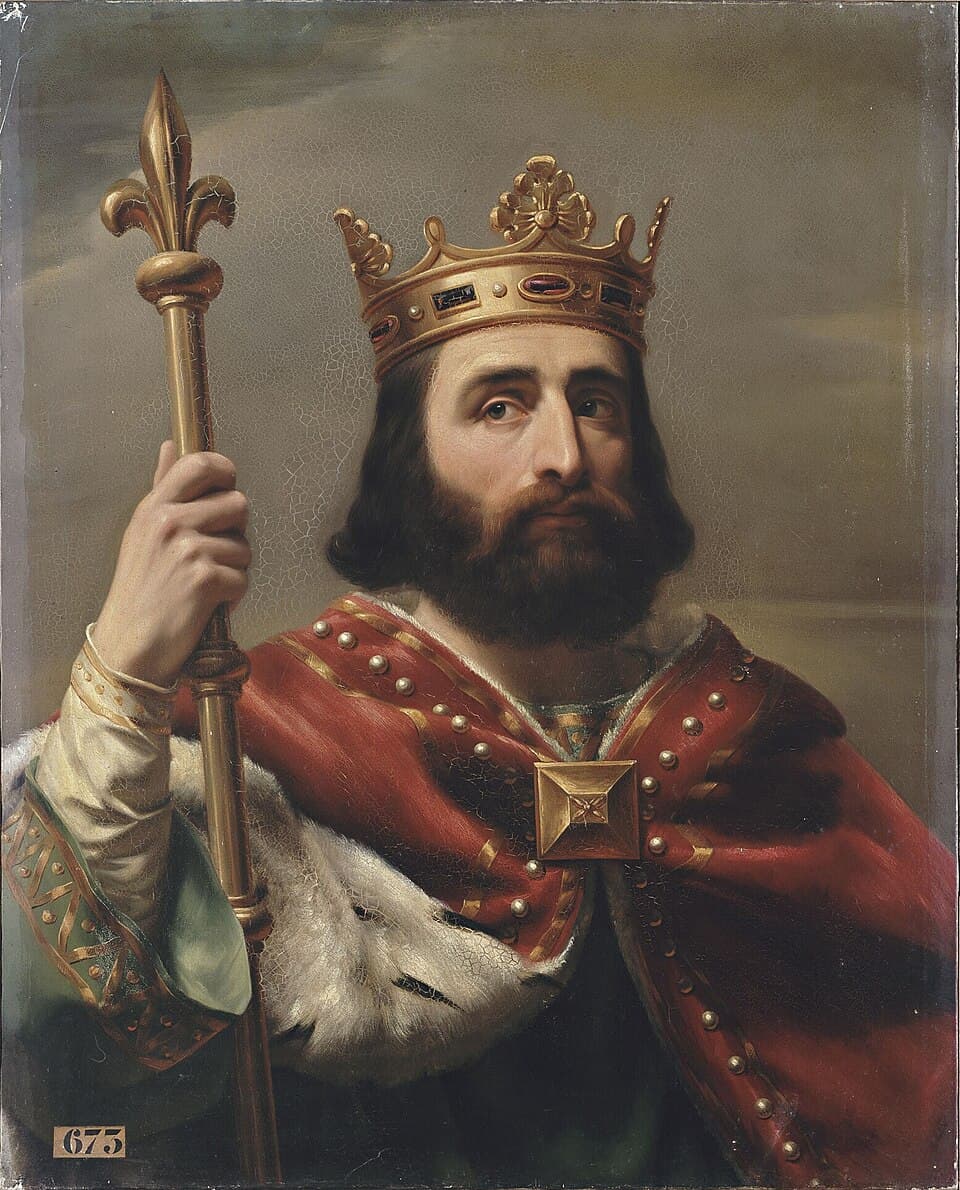
It is at the palace of Quierzy, on the banks of the Oise, that at the end of the year 767 the young Charles comes to sit beside his father. The old king rests between two campaigns in Aquitaine; in the great wooden hall, the fire crackles and the smell of candle wax mingles with that of the parchment of diplomas spread on the table. Father and son know each other better than anyone: it was together that they were anointed by the pope at Saint-Denis, thirteen years earlier. Charles wants to understand, before it is too late, how a mayor of the palace became the anointed king of the Franks.
—Father, before I was born you were only mayor of the palace, just as grandfather Charles Martel had been. How did you dare take another man's crown?
I took nothing that I did not already hold, my son. Since your grandfather, it was we who led the armies, dispensed justice, held the plaids — while Childeric possessed nothing of the king but the empty title. I wanted the name to finally match the power. So I sent messengers to Pope Zachary to ask him the only question that mattered: was it right that the one who exercised no power should wear the crown, while the one who governed had no name? His answer opened the way for me. Childeric was shorn and sent to the monastery — not out of cruelty, but because a deposed king cannot be allowed to live in freedom. Remember this when your turn comes: a title without strength is worth nothing, but strength without legitimacy does not last.
A title without strength is worth nothing, but strength without legitimacy does not last.
—At Soissons, in 751, the nobles raised you on the shield. But what did you fear, that day, as you placed your hand on that scepter?
I feared the blood of the Merovingians, Charles. For three centuries, the Franks had known only that long-haired lineage; it was said to come from a mystery, almost sacred. And I, son of a mayor, was about to sit in their place. The nobles had acclaimed me, yes, but an acclamation can be withdrawn as quickly as it is given. What I held in my hand was only a wooden staff; what I needed was an authority that no jealous warrior could challenge. Boniface anointed me according to the custom of the ancients, and that was not enough in my eyes. I understood that day that a crown is won by the sword, but it is kept only by something higher than men.
—You speak of what is higher than men. You and I were anointed by Pope Stephen at Saint-Denis; I was only six. What did you want, that day, to seal on our foreheads?
I wanted, my son, that no one could ever again take from us what men alone had given. The oil that the pope poured on your forehead and mine is the same that was used to anoint the kings of Scripture, David and Saul. A king elected by the nobles can be deposed; a king anointed by God — who would dare touch him? This rite did not exist in the West before us — I brought it for our house. When you felt the bishop's thumb trace the cross of oil on your child's skin, you became more than an heir: you became a chosen one. Treasure that. It is not the golden crown that makes the king of the Franks, from now on — it is that anointing.
A king elected by the nobles can be deposed; a king anointed by God — who would dare touch him?
—Many among our warriors have murmured that a Frankish king was made king by the sword, not by the oil of a Roman priest. What did you tell them, father?
I told them that the sword and the oil do not fight each other, Charles: they support each other. My leudes believed that kingship was won in battle — and they were not wrong, for without victories I would never have reigned. But a victory does not bind hearts beyond the shared loot. Boniface taught me that the Church could give what no army gives: the feeling that disobeying the king is disobeying God. Those who murmured against the Roman priest would have loved to see another mayor in my place. The anointing silenced them. I did not humiliate the Frankish sword, my son; I blessed it, and in so doing I made it unassailable.
—Pope Stephen crossed the Alps to beg you at Ponthion. Why did you lead your Franks to war in Italy for a bishop from beyond the mountains?
Because he came to me, Charles, and not to the emperor of Constantinople. Understand what that meant: the successor of Peter left Rome, crossed the snows, and it was the protection of a Frankish king that he implored against the Lombards who were strangling him. To refuse would have been to abandon Christendom to the emperor of the Greeks and the Lombard kings. So I crossed the Alps twice, besieged Pavia, forced their king to surrender the cities. And those lands I tore away, I did not keep for myself — I gave them to the Church of Rome. They may call it a gift; I see it as an alliance. The king of the Franks protects the pope, the pope anoints the king of the Franks. That balance, my son, will carry you further than all my battles.
The king of the Franks protects the pope, the pope anoints the king of the Franks.
—Those lands you gave to the pope, many of your counts would have wanted them for themselves. Did you ever regret such a gift, father?
Never, Charles, and I will tell you why. A count dreams of the land he sees; a king must see the land he does not yet possess. By giving those provinces of central Italy to the successor of Peter, I did not lose a domain — I bought a loyalty that neither gold nor armies can buy. The pope now owed me his freedom; and who else but he could pour the holy oil on our house? My counts counted in acres; I counted in generations. When you reign, remember that the papacy will recall what your father did for it at Pavia. This gift did not impoverish the Franks: it made them indispensable to all Christendom.
—Since childhood I have followed you on the roads, from Verberie to Compiègne, never two seasons in the same place. Why does such a powerful king have no capital, father?
Because a king who is not seen ceases to be king, my son. The kingdom of the Franks is too vast to be governed while sitting. I go from estate to estate — Verberie, Quierzy, Compiègne — not out of a love for travel, but because my presence is my best government. Where I pass, I hold the plaid, I dispense justice, I remind the counts that the king can appear. And we eat the reserves of each domain on the spot: it is easier for the court to go to the grain than for the grain to come to the court. My missi travel through the provinces where I cannot be in person, my eyes and ears. A fixed throne, Charles, is a king forgotten at the edge of the kingdom.
A king who is not seen ceases to be king.
—You have always pitched your tent near the fire of your warriors, never apart. Why does an anointed king share the hardship of the camp?
Because the anointing did not change my legs or my back, Charles. Under the campaign tent, facing the rain of Aquitaine or the passes of Italy, I am the same man who marches with his leudes. A chief who is carried in a litter while his warriors slog — they follow him out of duty; a chief who suffers the cold with them — they follow him out of love. It is under the tent, in the evening, that one learns the mood of an army, that one hears grievances before they erupt. My chapel also follows in my baggage, for I never miss lauds or compline. King and soldier, prayer and mud: such is the life I have bequeathed to you. Never believe that the crown exempts you from the fatigue of your men.
—You have been nicknamed the Short, because of your small stature, and you know that some have laughed behind your back. Did that ever hurt you, father?
Laughed behind my back, yes — never to my face twice, my son. A man's height is measured from the ground to the head; authority, however, is not measured. I wore the scramasax at my belt and the hauberk on my shoulders like the tallest of my warriors, and in battle no one remembered my missing thumbs. You know the story of the lion that was released at court, and the furious buffalo beside it: I walked up to the beast and struck it down before the eyes of my leudes who dared not move. I wanted them to understand once and for all what a king must embody. A man's greatness is not in his stature, Charles — it is in what he dares when others retreat.
A man's greatness is not in his stature — it is in what he dares when others retreat.
—Your missi, your plaids, your army — you built everything so that one man could govern so many peoples. What do you fear for what you will leave me, father?
I fear, Charles, that you will forget at what cost all this holds together. I took Narbonne from the Arabs, subdued Aquitaine year after year, bound the papacy to our house, had our blood anointed: none of this is acquired forever. A kingdom is like an estate — if you stop traveling it, watching over it, feeding it, it returns to wasteland. My missi are only worth as much as the king listens to them; my plaids, only as much as the king attends them. You will inherit my crown with your brother, and that is my concern: a divided kingdom is a kingdom tempted to split. Keep the Church as an ally, the sword as a servant, and the Franks united under one hand. The rest, my son, will depend on you.


This imaginary interview was generated by artificial intelligence from sources documented in Pepin the Short's profile. It dramatises what the figure might have said based on what we know about them, but does not constitute attested historical testimony. For primary sources and factual documentation, refer to the full profile.