Imaginary interview with Pepin the Short
by Charactorium · Pepin the Short (714 — 768) · Politics · 6 min read
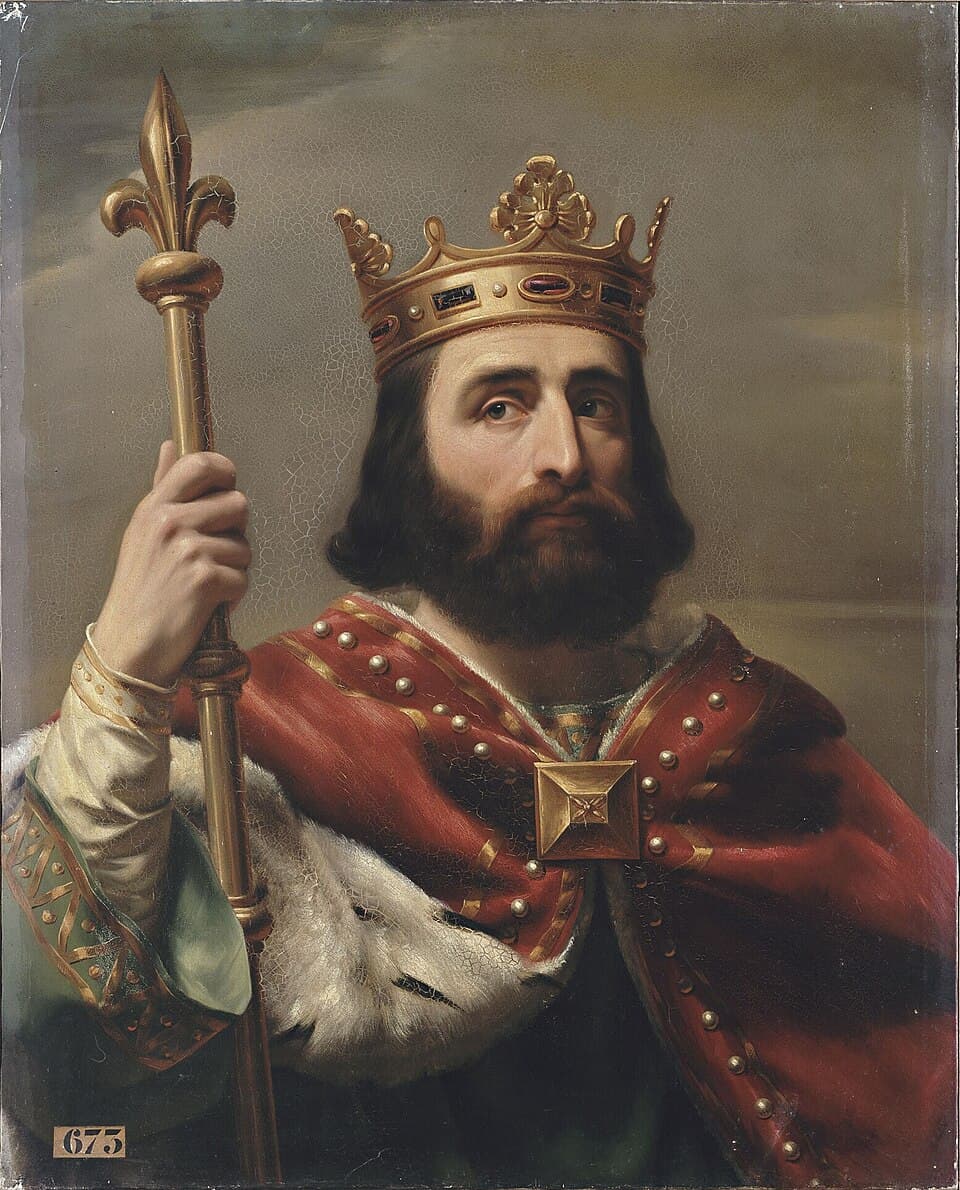
Verberie, on the banks of the Oise, a winter evening when the great wooden hall still smells of the banquet's smoke. The King of the Franks, short but sharp-eyed, agrees to linger by the fire while his leudes fall asleep on the benches. Here, gathered by the glow of the embers, are the words he deigned to share.
—You have been given the nickname 'the Short.' What do you say to those who focus on your height?
Short in the leg, not in the arm. God made me short of stature, but He gave me a grip that my warriors know. One day at court, a lion was let loose before the assembly to test the courage of the great; no one dared move. I stepped down, felled the beast with my own hands, and then sent word to my leudes that a valiant man weighs more than a tall man. My father Charles Martel had stopped the Saracens at Poitiers; I was not about to tremble before a wild beast. A king's greatness is not measured by height, but by the fear he inspires and the justice he dispenses. Let the gossips laugh at my name: they bow when I appear.
—Before seizing the crown, you consulted Rome. Why first seek the Pope's opinion?
Because a throne seized without the Church's blessing is mere theft. I was mayor of the palace, as my father before me — the one who raised armies, dispensed justice, held the kingdom — while the Merovingian let himself be paraded in an ox-cart, king in name only. So I sent my messengers to Rome, to Pope Zachary, to submit a grave question: according to righteousness, who should wear the crown, he who bears the burden or he who keeps only the empty title? The Holy Father replied that it was more just that power and name rest in the same hand. That word was worth more than an army: it removed from the Frankish people any scruple in following me.
A throne seized without the Church's blessing is mere theft.
—And the last of the Merovingians, Childeric — what became of him once the crown passed to you?
His hair was cut — that long mane his lineage believed sacred — and he was led to the cloister, where he ended his days as a monk. The chroniclers noted it bluntly: King Childeric was shorn and sent to a monastery, and thus ended the rule of the Merovingians. Then at Soissons, in the year 751, the Franks raised me up and Archbishop Boniface consecrated me with his own hands; I received the scepter as the emblem of my office. It was no revolt: a line that no longer ruled gave way before one that already ruled. Einhard wrote long after me — these kings had nothing royal left but the empty title. Cutting that hair was cutting a lie.
—You were the first Frankish king anointed with holy oil. What did this anointing change for you?
Everything, and more than everything. Before me, a Frankish king ascended the throne by blood and arms; I was anointed like David and the kings of Scripture, the holy oil poured on my brow by the bishop's hand. The monk Willibald recorded it thus: I was consecrated king of the Franks according to the custom of the ancients, by anointing me with holy oil. That vessel of oil, that ampulla, turned my kingship into something other than force: a charge received from God, no longer just from men. Henceforth, to raise a hand against the king was to raise a hand against the Lord's anointed. My sons would inherit it, and their sons after them. The sword makes a chief; the anointing makes a king.
The sword makes a chief; the anointing makes a king.
—In 754, the Pope himself consecrated you again at Saint-Denis. Why this second coronation?
Because the first made me king, but the second bound me to Rome itself. Pope Stephen II had crossed the Alps in the depths of winter, old and weary, to come to us — never had a pontiff traveled thus to a Frankish king. At the abbey of Saint-Denis, in 754, he anointed me anew, and with me my two sons, Charles and Carloman, so that the crown might remain in my house. It was no longer a bishop of my kingdom, but the successor of Peter who sealed my lineage. I wished one day to rest in that same basilica, under the protection of the saints. When the head of the Church crosses mountains to bless you, you no longer measure your throne by anything but Heaven.
—Pope Stephen II begged you to defend him. What exactly did he expect from you?
The Lombards pressed Rome from all sides, and their king Aistulf thought he could swallow the city of Peter. The Holy Father wrote me letter after letter — they are still kept — begging me, O most excellent son, to take up the defense of the holy Roman Church so that the Lombards may no longer oppress her. I received him in person at Ponthion, in January of the year 754, and there, before my court, the alliance was forged: the King of the Franks would henceforth be the arm of Rome, where the emperor of Byzantium could no longer be. He asked me not for gold, but for a Christian sword. How could a king anointed by the Church turn a deaf ear to the cry of the Church?
—Your two campaigns in Italy resulted in a famous donation. What was it about?
Twice I led my armies across the Alps, and twice I besieged Pavia, the Lombard capital, until Aistulf yielded. But I did not keep for myself the lands retaken in central Italy: I gave them to the Church, to the successor of Peter. This is called the Donatio Pippini, the Donation of Pepin. Other kings conquer to enlarge themselves; I conquered to give. From these territories was born the patrimony that the Pope governs in his own right — what your clerics will call the States of the Church. A Frankish king thus restored to Rome what no emperor any longer assured her. I judged it better for my soul to build a domain for Saint Peter than to add a province to my crown.
Other kings conquer to enlarge themselves; I conquered to give.
—They say your court is constantly on the move. How does a king with no capital live?
A Frankish king does not shut himself up in a single city: he goes where his fiscs are, those great estates that feed him and his retinue. I go from Verberie to Quierzy, from Compiègne to Ponthion, and when an estate has given its grain, its wine, and its game, the court breaks camp to go eat elsewhere. In the morning, I hear lauds in my chapel, then I receive my envoys and my bishops. In the evening, in the great wooden hall, warriors, clergy, and nobles break bread together, and storytellers keep us awake very late. Before sleep, compline. To reign is not to sit: it is to ride from one estate to another, so that everywhere the face of the king may be seen.
—How do you ensure your will is followed to the far reaches of the kingdom?
Twice a year, I convoke the plaid — the assembly of the great, bishops, counts, abbots, and warriors — to decide on war and justice; no one governs such a vast people alone. But a decision taken at the palace is worthless if it gets lost on the way. That is why I send trusted men, the missi dominici, to check the counts in the provinces and enforce my word where I cannot ride myself. I also dispense justice in person, surrounded by my faithful leudes. My son Charles will take up this practice and extend it far beyond what I dared. A king who never sees his counts ends up governed by them.
—If you could imagine that people would still speak of you centuries from now, what would you want them to remember?
If God allowed that I be read a hundred years hence or more, I would not want my height or my nickname to be remembered. Let them say rather that a mayor of the palace became king without shedding his predecessor's blood, by the advice of Rome and the oil of anointing; that he protected the Church and built her a domain; that he left a kingdom more solid than he received it. The rest belongs to my sons. My Charles already carries within him enough to make me forgotten — and I would be proud of that, for a father lives on in the arm of his child. The consecration I received, other Frankish kings will receive after me, generation after generation. For the rest, I leave it to the judgment of God, who weighs kings more justly than men.
A mayor of the palace became king without shedding his predecessor's blood.


This imaginary interview was generated by artificial intelligence from sources documented in Pepin the Short's profile. It dramatises what the figure might have said based on what we know about them, but does not constitute attested historical testimony. For primary sources and factual documentation, refer to the full profile.