Kids interview Pepin the Short
by Charactorium · Pepin the Short (714 — 768) · Politics · 4 min read
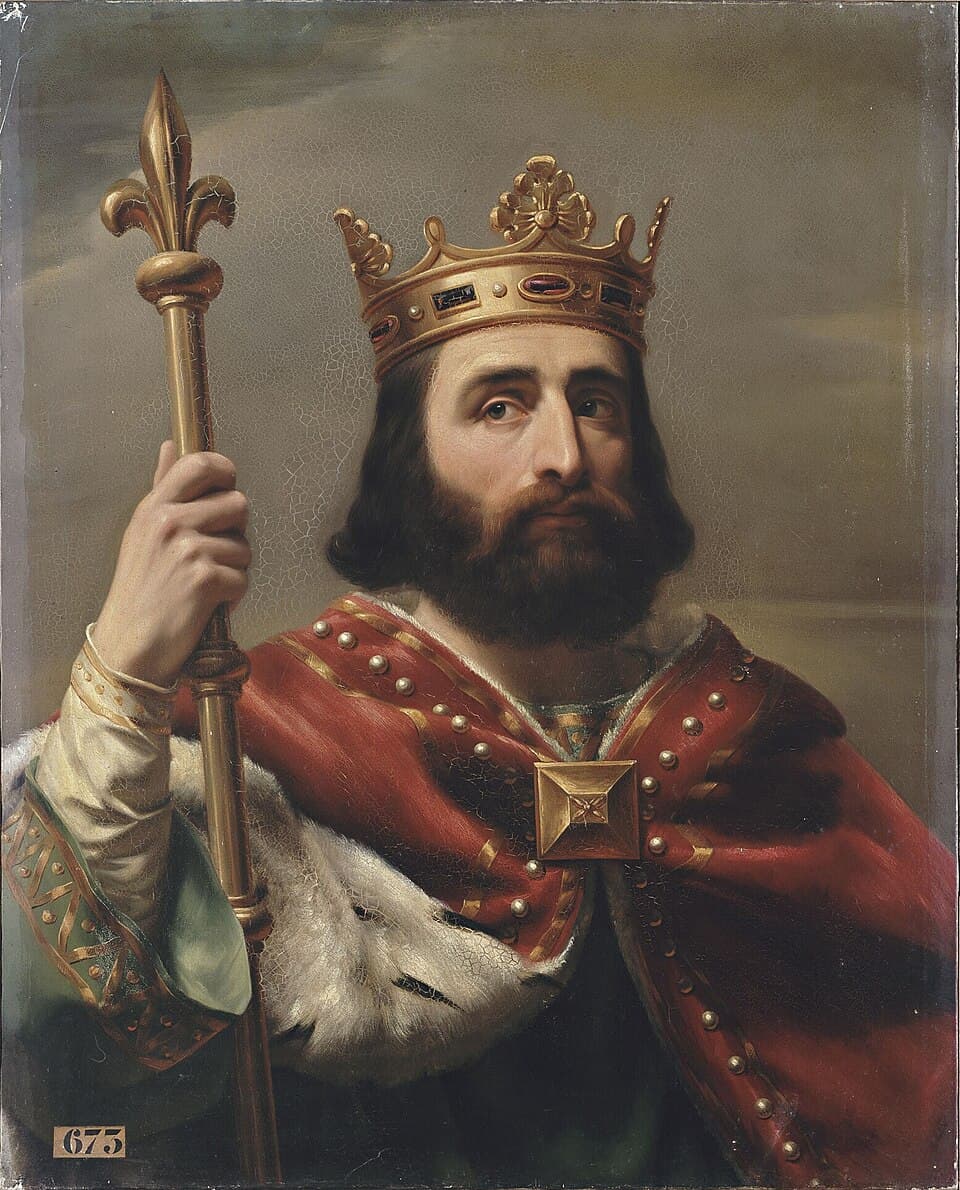
Two twelve-year-old students are visiting an old abbey this morning on a school trip. In the light of a large stone hall, a short but sturdy man awaits them with a warm smile. It is Pepin the Short, first king of the Carolingians, who agrees to answer their questions.
—Why are you called “The Short”? Isn’t that a bit of a mocking nickname?
You know, my child, it’s true: I am short. “The Short” means the small one. Many people used to laugh about it under their breath. But listen to me carefully: a man’s height is not measured by his legs. I was born in 714, son of Charles Martel, the warrior who stopped the Arabs at Poitiers. My father taught me a simple thing. A leader is not the tallest body, but the strongest will. Imagine a small rock in the middle of a river: the water flows around it, but the rock does not move. I was that rock. And my warriors knew it.
A man’s height is not measured by his legs.
—Is it true that you really fought a lion?
That story is told, yes, and I like that people remember it. One day, at court, my warriors were still murmuring about my small stature. So I had a huge beast brought in, a roaring lion, in front of everyone. Imagine the silence, the smell of the wild animal, the men stepping back. I stepped forward, my combat knife at my belt, that long scramasax with a single edge. And I faced it alone. Why? To show them a truth. A courageous man is worth far more than a tall man. After that day, no one smiled at my height anymore.
A courageous man is worth far more than a tall man.
—How do you become king when you are not born one? How did you do it?
Good question, and a delicate one. In my time, there were already kings, the Merovingians. But they no longer governed anything. I was “mayor of the palace”: the one who truly rules in place of the king, like a captain who steers the ship while the prince sleeps. It was awkward. So in 751, I sent messengers to Pope Zachary with a question. Who should be king: the one who bears the title, or the one who exercises power? The pope replied: power and title must go together. That answer opened the path to the throne for me.
Who should be king: the one who bears the title, or the one who exercises power?
—And what happened to the old king? Did you put him in prison?
No, not prison, but it was almost worse for him. The last Merovingian king was named Childeric III. In my time, kings wore long hair: it was the sign of their royal blood, their pride. So they cut his hair, they shaved him like a monk, and they sent him to live in a monastery, far from the world. Imagine: a king who is shaved, and all his power falls with his locks onto the ground. That day, at Soissons, I was raised to the throne by the Franks. One dynasty died, mine began.
All his power fell with his hair onto the ground.
—What exactly was the moment when they poured oil on your head?
Ah, that moment, I will never forget it. It is called the anointing. A bishop takes blessed oil, kept in a small sacred ampulla, and marks your forehead with it. Do you know where this idea comes from? From the kings of the Bible, those of ancient times, who were anointed to show they were chosen by God. At Soissons, it was Archbishop Boniface who anointed me. Before me, no Frankish king had received this gesture. Imagine: it was no longer just men who made me king, but heaven itself. That drop of oil was worth more than an army.
That drop of oil was worth more than an army.
—The pope came to anoint you a second time? Why twice?
Yes, and it was a great honor. The first time was enough, but in 754, Pope Stephen II himself crossed the Alps, those high icy mountains, to come to me. At the abbey of Saint-Denis, near Paris, he anointed me again, me and my two sons. Can you imagine? The head of the entire Church crossing snowy passes to bless a small Frankish king. That day, my whole family received the seal of the sacred anointing. My sons, one of whom would become Charlemagne, were already marked to reign. A sacred lineage had just been born.
The head of the entire Church crossed the icy Alps to bless a small king.
—Why did the pope need you? Couldn’t he defend himself?
The pope was a man of prayer, not a man of war. And a people threatened him: the Lombards, settled in Italy for a long time, whose kings wanted to take Rome. The pope wrote me urgent letters. He begged me to take up the defense of the holy Roman Church, so that the Lombards would stop oppressing him. Imagine receiving a plea for help from the holiest man in the world. Could I refuse? So I gathered my army and crossed the mountains. I besieged their capital, Pavia, until their king yielded. I protected Rome like a shield.
The pope was a man of prayer, not a man of war.
—And after you won, did you keep the lands for yourself?
No, and that is the most surprising part. I could have kept those rich Italian lands. But in 756, I gave them to the pope. This gesture is called the “Donation of Pepin.” Imagine giving an entire country to a man who has no army: I gave him the means to be a true prince, not just a priest. Those lands became the Papal States, and they lasted over a thousand years. Why this gift? Because a king who protects the Church gains something more precious than gold: an alliance that makes him just in the eyes of all.
I gave him the means to be a true prince, not just a priest.
—Did you live in a big castle? What were your days like?
Not just one castle, no: I had several, and I traveled constantly between them. Verberie, Quierzy, Compiègne... I went from one estate to another. Why? Because a king had to consume the reserves on site, where they were. My days? At daybreak, prayer with my clerics. Then the council for the affairs of the kingdom. In the afternoon, hunting boar or deer in the forests, to feed the court and train my warriors. In the evening, a great banquet in the hall, with meats, wheat bread, and storytellers. Imagine a house that never sleeps in the same place.
My kingdom was a house that never slept in the same place.
—But how did you know what was happening everywhere if you were constantly moving?
Excellent question: a kingdom is vast, and a king has only two eyes. So I had an idea. I sent trusted men to the provinces, called the missi dominici, the “envoys of the master.” Imagine messengers traveling the roads to oversee the counts, those lords who governed the regions in my name. They checked that my orders were followed, that justice was done. My son Charlemagne took up this idea and expanded it further. You see, ruling is not being everywhere: it is having faithful eyes everywhere that see for you.
Ruling is not being everywhere: it is having faithful eyes everywhere.

This imaginary interview was generated by artificial intelligence from sources documented in Pepin the Short's profile. It dramatises what the figure might have said based on what we know about them, but does not constitute attested historical testimony. For primary sources and factual documentation, refer to the full profile.