Imaginary interview with Rābiʿa al-ʿAdawiyya
by Charactorium · Rābiʿa al-ʿAdawiyya (vers 717 — 801) · Spirituality · 6 min read

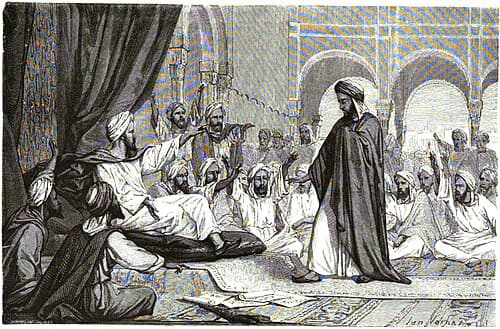
In the dimness of a humble dwelling in Basra, on a spring night in the year 160 of the Hijra, Ḥasan al-Baṣrī once again comes to sit beside Rābiʿa al-ʿAdawiyya. A single oil lamp lights the prayer mat spread on the beaten earth; outside, the bustling city has fallen silent. The scholar and the ascetic have known each other for a long time — he has often left his study circles to come listen to her, and confesses to have learned more here than in years of books. Tonight, he comes with his usual questions and the desire to understand where this light comes from.
—Rābiʿa, it is whispered in Basra that you were born in poverty and sold as a child. What remains in you of those years?
You know as well as I, Ḥasan, what poverty is in this city where the silks of India are displayed. I was born the fourth daughter of a family that had nothing, and I was sold as one sells a jug. But I tell you: this stripping away was my first grace. Having nothing to lose, I had nothing to fear losing. The rich who come to consult you tremble for their storehouses; I have never had a storehouse. The servitude of men taught me very early that there is only one Master to whom one truly owes obedience. The rest — the chains, the hunger, the contempt — was but a light veil over that certainty.
Having nothing to lose, I had nothing to fear losing.
—It is said that your master freed you after seeing you one night surrounded by an inexplicable brightness. What happened that night?
I could not describe to you what my master thought he saw, Ḥasan, for I was in prayer and the world had left me. I only know that that night, like the others, I begged God to deliver me not from men, but from myself. In the morning, my master, deeply moved, gave me my freedom and dared no longer look at me as a servant. I then withdrew to the desert on the outskirts of the city, where there are no more walls or faces, only sand and sky. Men saw a light; I saw only my own destitution before Him. If there was a brightness, it did not come from me — I am but a lamp, and the oil is not the flame.
I am but a lamp, and the oil is not the flame.
—You know that for years I have been leaving my disciples to come listen to you. What can a scholar like me learn from a woman without schooling?
Do not belittle yourself, Ḥasan: you know the Book better than anyone in Basra, and your lessons nourish the whole city. But allow me to tell you, since it is you: the knowledge you teach is a light that illuminates the path, and that is a great good. Only one can know all the stations of the road without ever setting out toward Him who waits at the end. You describe love; I have yet to burn. That is all you find here, and it is not much: not more knowledge, but the reminder that knowledge is nothing if it does not become thirst. You are well placed to know this, you who sometimes weep in the midst of your own sermons.
You describe love; I have yet to burn.
—You were seen in broad daylight running through our streets with a torch in one hand and a bucket of water in the other. Basra still talks about it — explain it to me.
I wanted, Ḥasan, to set fire to Paradise and drown Hell with my bucket. Let men finally open their eyes! As long as there is a Garden to hope for, they serve God like merchants calculating their profit; as long as there is a Fire to fear, they serve Him like slaves fearing the whip. Burn one, quench the other, and what remains? Him alone, naked, without reward or punishment. Only then will we know who truly loves Him. My torch was not the madness of the street, as passersby thought: it was my prayer made visible, for those who only hear what they see. You who preach fear of Judgment, understand that I do not deny the Fire — I only want them to stop loving for anything other than Him.
As long as there is a Garden to hope for, they serve God like merchants calculating their profit.
—Just tonight you were praying before I entered. What words do you address to God in these vigils where you weep until dawn?
The same words every night, Ḥasan, for my heart has no others. I say to Him: O God, if I worship You for fear of Hell, burn me in Hell. If I worship You for Paradise, deprive me of it. But if I worship You for Your own sake, do not deprive me of Your eternal beauty. That is my whole theology, briefer than your treatises. By day, I receive those who come, I speak, I teach; but the night belongs to me, or rather it belongs to Him. When silence falls on Basra and the merchants sleep, I have no veil between Him and me. And I weep, not from sadness, but because I sense Him so near and my narrow soul cannot contain Him entirely.
The day belongs to men; but the night, or rather it belongs to Him.
—The governor himself asked for your hand, and many other notables. Why did you turn away all suitors, you who could live in abundance?
What would I do with a husband, Ḥasan? I already belong, entirely, to another. To the governor and the others I set one condition: that they promise me never to die, and that they tell me what my fate will be on Judgment Day. None could answer, of course — so by what right would they claim what no longer belongs to me? Marriage binds two beings who share each other; but there is nothing left of me to share, all has been given. People think me deprived because I am alone. On the contrary, I am the most fulfilled woman in Basra: my heart has only one occupant, and no rival will come to distract me from Him. Celibacy for me is not a renunciation — it is a fidelity.
Celibacy for me is not a renunciation — it is a fidelity.
—I look around me: a mat, this lamp, a jug, and nothing else. And you refuse, they say, gifts from the rich. How do you live?
You see everything, Ḥasan, there is nothing more to see, and that is precisely what I wanted. My garment is of coarse wool, like that of the first who renounced the world — it is from this ṣūf that people are beginning to name us. I eat barley bread, a few dates, I drink the water from this jug. Wealthy men send me dishes and fabrics; I send them back, for whoever accepts a gift from the rich becomes dependent on him, and soon flatters him. But I want to depend only on God. This poverty is not a suffering I inflict on myself: it is a lightness. The less I possess, the fewer obstacles between Him and me. Destitution is my wealth, and an empty stomach makes the soul attentive.
Whoever accepts a gift from the rich becomes dependent on him, and soon flatters him.
—You keep vigil every night until fajr, in tears, hardly sleeping or eating. Does your body never claim its due, Rābiʿa?
My body claims, of course — it is hungry, it is sleepy, it grows old like yours, Ḥasan. But who should command, the rider or the mount? I sleep little because the night is too precious to lose in oblivion; I eat little because a full body grows heavy and the soul falls asleep with it. When I kneel on this mat at sunset, I no longer feel the cold of the earth nor the fatigue of the days. The tears are not sorrow: they flow as water flows downward, naturally, toward Him who draws me. People pity me for this austere life. But tell me, you who have tasted the moment when He lets Himself be sensed: who would want to sleep when the Beloved keeps watch at your door?
Who would want to sleep when the Beloved keeps watch at your door?
—When I question you about the knowledge of God, the maʿrifa I seek in my books, you often smile. Why that smile, tell me frankly?
I smile, Ḥasan, because you seek outside what is within, like a man who would roam the markets of Basra to buy water when a spring gushes in his own courtyard. The knowledge you speak of is not read, it is received. It does not come at the end of a reasoning but at the end of a love. Your books will tell you everything about the attributes of God; they will not give you the trembling of His presence. Yet do not think I despise your study: without it, how many would go astray. But study is the lamp, and love is the traveler. What use is the lamp if no one rises to walk? That is why I smile: not at you, but out of tenderness for your thirst, which I know well.
You seek outside what is within.
—Before I return to my disciples, Rābiʿa: what must be made to fall to finally see Him, this veil you always speak of?
The veil, Ḥasan, is not something He stretches — it is we. He is never absent; it is we who are elsewhere, occupied with our fears and hopes, our storehouses and our terrors. The veil has a single name, and that name is our own self. As long as I say 'I', 'my prayer', 'my piety', I remain before the veil. The day when there is nothing left of me to name, there will be nothing left to screen Him either. That is my sole work, night after night on this mat: not to gain something, but to erase myself. Go back to your disciples and teach them the path — but remember that at the end of the path, one must still forget the walker.
The veil has a single name, and that name is our own self.

This imaginary interview was generated by artificial intelligence from sources documented in Rābiʿa al-ʿAdawiyya's profile. It dramatises what the figure might have said based on what we know about them, but does not constitute attested historical testimony. For primary sources and factual documentation, refer to the full profile.