Kids interview Ranavalona III
by Charactorium · Ranavalona III (1861 — 1917) · Politics · 5 min read
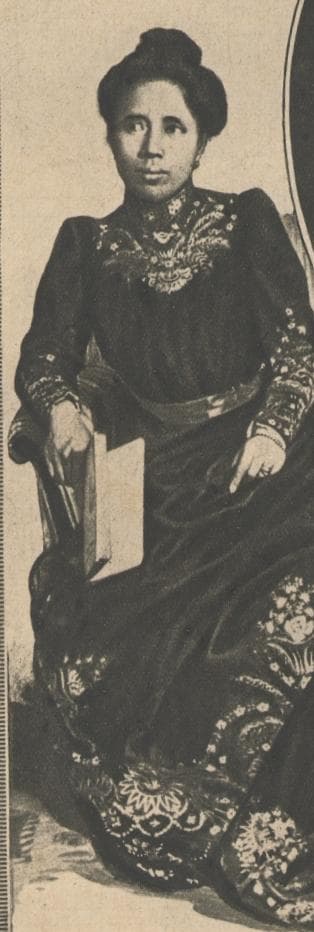
Two young visitors of twelve push open the door of a large silent room. At the far end, sitting very upright in a silk lamba, an old queen from Madagascar awaits them. She smiles: 'Come closer, my children. Ask your questions.'
—How old were you when you became queen?
I was twenty-two years old, my child. Imagine: one morning you're still playing with your cousins, and that evening they place a crown on your head. In 1883, I was chosen to ascend the throne in Antananarivo, my capital, perched on its great hill. I was afraid, you know. An entire kingdom, the Merina kingdom of the highlands, suddenly rested on my shoulders. But I wasn't alone in deciding. A very powerful man, the Prime Minister, already held the real power in his hands. I was the face of Madagascar. He was its arm. It's strange to reign without commanding everything, believe me.
They place a crown on your head, and an entire kingdom rests on your shoulders.
—Is it true you had to marry the Prime Minister?
Yes, it's true. And the most astonishing thing is that I was already the third queen to marry him! His name was Rainilaiarivony. Imagine an older man, very shrewd, who remained in power while the queens succeeded one another. He came from the Hova, a class of free people who were not nobles but who governed and waged war. This marriage wasn't a love story like in fairy tales. It was a custom, a fomba, to unite the throne and the government. I carried the dignity, he carried the decisions. We walked together, without always choosing each other.
I carried the dignity, he carried the decisions.
—What were your days like at the palace?
I rose early, before the great sun of the highlands. In the morning, I prayed with my court: I was Christian, Protestant, like the queen before me. Then I received my ministers who brought me news of the kingdom. In the afternoon, there were audiences and ceremonies. In the evening, we shared a large meal of rice, the vary, with zebu in broth. We listened to music and the tantara, the old tales of the ancestors. For even as a Christian, I never forgot the razana, our departed forebears whose spirit watches over the living, they say. Two beliefs in one heart, my child. That didn't bother me.
Two beliefs in one heart, that didn't bother me.
—What did you wear when receiving important people?
My finest garment was the lamba of silk, red and gold. It's a large cloth draped around the body, and among us its color indicated your rank. Red and gold were for the Merina royalty, only for the queen. Sometimes I added a long dress, in the English style, because the missionaries had brought us their fabrics and their books. On my table always rested a Bible in Malagasy, translated into my language. Imagine the work: taking the words of a foreign book and pouring them into the language of my people. That book, I held it like a treasure.
—When the French soldiers arrived, were you afraid?
Of course I was afraid, my child. But fear can be hidden under a crown. In 1895, the French army of General Duchesne was approaching my city. Everyone told me to flee the Rova, my palace on the hill. I refused. I dressed in my royal robes and waited, seated, without moving. When the officers entered, I demanded to be treated according to my rank. Later, the general wrote that I had received him 'with perfect dignity.' You see, I had no army left. But I still had my calm. And calm, sometimes, is a weapon.
Fear can be hidden under a crown.
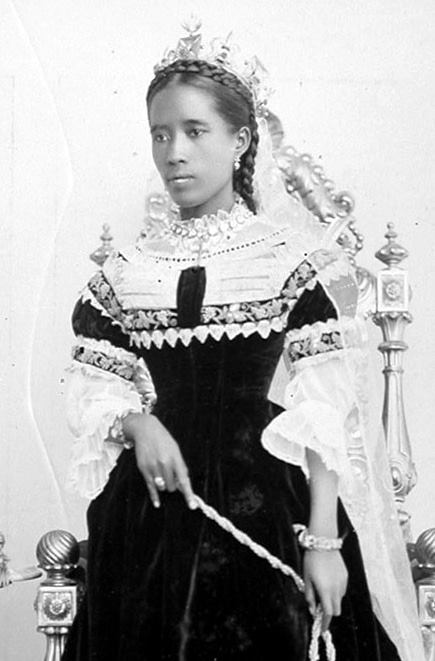
—How did you try to save your country?
Not with cannons, I had almost none. I tried with words and journeys. I sent trusted men all the way to Paris and London, in 1895, to speak to governments and newspapers. Imagine a long voyage by boat, weeks at sea, just to go and say: 'Madagascar exists, leave it free.' That was my way of fighting: diplomacy. It means convincing instead of fighting, speaking instead of shooting. I believed that by making myself heard by the great powers, my little kingdom of the highlands could survive. I was wrong. But I do not regret having spoken.
I fought with words, not with cannons.
—Did you write to the French to say no?
Yes. In 1896, when France declared that Madagascar belonged to it, I did not bow my head in silence. I wrote to the French president, Félix Faure, a solemn letter. In it, I protested: my people had never agreed to become French subjects, and I could not accept the erasure of our sovereignty. Our right to govern ourselves, you understand. A queen without an army can still hold a pen. That letter did not stop the soldiers. But it remained in the archives, as a trace. Years later, one can still read it and know that I had said no.
A queen without an army can still hold a pen.
—What happened afterward, when you lost the throne?
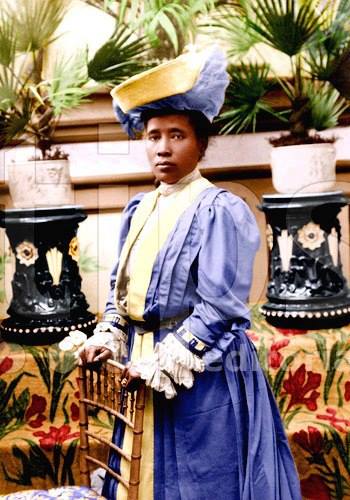
They drove me from my home, my child. In 1897, I was declared deposed and taken to the island of Réunion, far from my highlands. Two years later, they took me even farther, to Algiers, across the seas, in a hot city I did not know. Imagine leaving your home, your hill, the smell of cooking rice, and waking up each morning under a foreign sky. I lived there for eighteen years. Modestly, without a palace. But I never stopped holding myself like a queen. They can take my kingdom. They cannot take my way of standing straight.
They can take my kingdom, not my way of standing straight.
—There, in exile, did people still come to see you?
Yes, and it warmed my heart! From time to time, Malagasy people made the long journey to Algiers to greet me. They came to show their loyalty, as if I were still their queen. This greatly embarrassed the French authorities, you know — they would have preferred me forgotten. But one is not so easily forgotten. I received them with the courtesies of a court, even in my small house. For them, I was the living memory of a free country. As long as a single child of Madagascar came to bow before me, my kingdom was not entirely dead.
As long as one came to bow, my kingdom was not dead.
—And after your death, did you return to Madagascar?
I died in Algiers in 1917, at fifty-five, far from my hill. I was first buried there, in foreign soil. But my people did not leave me alone forever. For years, the Malagasy demanded my return. And in 1938, twenty-one years after my death, my remains were finally brought home. I was placed in the Rova of Antananarivo, the palace where I had reigned, on the hill I loved. You see, my child: a queen can be exiled alive, and return home after her death. The country always remembers its own.
A queen can leave in exile alive and return home after her death.
This imaginary interview was generated by artificial intelligence from sources documented in Ranavalona III's profile. It dramatises what the figure might have said based on what we know about them, but does not constitute attested historical testimony. For primary sources and factual documentation, refer to the full profile.