Imaginary interview with Renart
by Charactorium · Renart · Mythology · 6 min read
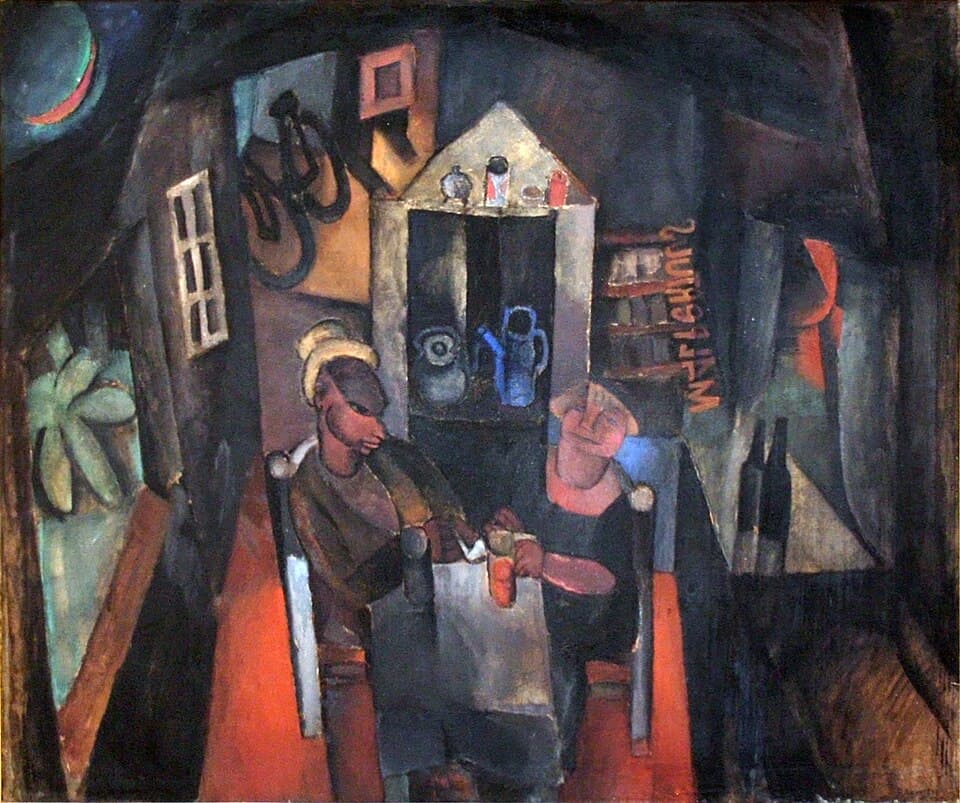
It is at Maupertuis, in the maze of galleries dug beneath a motte in Flanders, that the fox agrees to receive us. He makes us sit on a stolen bale of straw, keeps an eye on the exit — an old habit — and, with a grin from ear to ear, invites us to begin. Outside, you could swear you hear Isengrin scratching at the door.
—Let's start at the beginning: where does this name Renart come from, which everyone uses today?
Ah, that's my most lasting trick, and I didn't even plan it! In my father's time, the red beast with slanted eyes was called the goupil — an honest word, from the clerics' Latin. Then the jongleurs carried my tales from court to court, from castle to castle, and people began to say 'he pulled a Renart' for 'he tricked his people.' So much so that by being named so often, I ended up swallowing the old word entirely, like I swallow a hen: today my own proper name is given to my whole race. What other rogue has stolen into the dictionary itself? One is born a goupil, but one becomes Renart — and it is I, the liar, who had the last word on language itself.
One is born a goupil, but one becomes Renart — and it is I, the liar, who had the last word on language.
—Let's talk about Isengrin the wolf. The story of fishing in the ice, how did you pull it off?
It was winter, and my comrade Isengrin had, as always, more hunger than brains. I showed him the frozen pond, the hole a peasant had made for his bucket, and I swore to him that eels bite at the tail dipped in it: you just had to wait, sitting in the cold, until the weight pulled and you hauled up a feast. The fool plunged his fine tail into the black water. The frost did its work — I didn't even have to lie twice. In the morning, his tail was caught in the ice like a trap, and the dogs were coming. That's the whole art of the Roman: the strongest has the fangs, but it's the craftiest who dines. Isengrin left his tail in the hole; he still thinks about it.
The strongest has the fangs, but it's the craftiest who dines.
—You never seem to let go of this wolf. Why this relentless pursuit of Isengrin?
Because he is big, stupid, and believes his strength owes him everything. Another time, I dug a pit for him under the leaves, where the path narrows, and with fine words I led him straight into it: he chose to fall all by himself, convinced it was his idea. You see, I don't hate Isengrin — I need him. Without a wolf to act proud and strong, my tricks would be mere thefts; with him, they become a lesson. Every time he falls into my pit, the whole order of the mighty trembles a little, the lord tripping over his own feet before his peasant. They call me cruel. I only say that I give stupidity what it deserves, and that the wolf pays me back when he can.
—You were dragged to King Noble's court to be judged. What happened there?
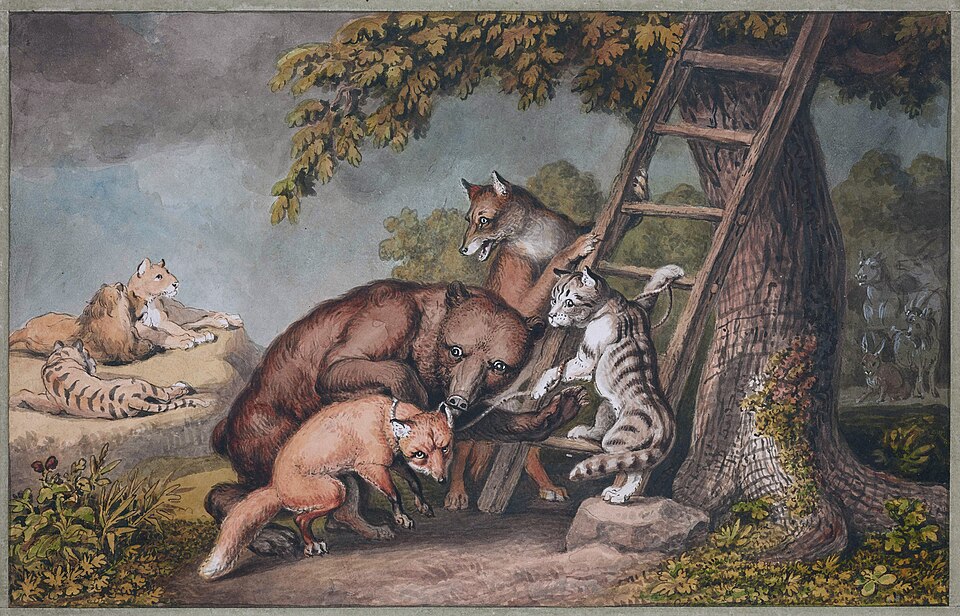
The whole menagerie had banded together! Isengrin bellowing his grievances, Chantecler weeping over his hens, Tibert the cat eyeing me sideways, and in the middle King Noble the lion, on his throne, wanting my hide to enforce his fine justice. I was accused of a thousand crimes — and the worst part is, they were almost all true. But do you think a court is a place of truth? It's a theater, where the one who speaks best wins. I saw there, better than anywhere else, what the great are worth: a king flattered with a gift, barons howling with the pack, oaths sworn in the morning only to be betrayed by evening. That court that pretended to judge me was more deceitful than I — the only difference is that they did it in ceremonial robes.
A court is not a place of truth: it's a theater, where the one who speaks best wins.
—And how do you defend yourself when you are guilty of everything you were accused of?
With the only weapon I have ever carried: the tongue. Before King Noble, I deny almost nothing — I tell stories. I turn my misdeeds into mishaps, I paint myself as a poor persecuted fox, I remind the lion of services rendered, I promise penance, I talk of going on a pilgrimage to redeem my soul. And while I spin my fine words, I see the king's anger turn to doubt, doubt to pity, pity to a smile. The clerics who put my branches into parchment noted it well: I am molt cortois et molt sage, et molt deceveor et molt traïtres — courteous and wise as much as deceitful and treacherous, all in the same mouth. A guilty man who knows how to speak is never fully condemned; he always has one sentence left in advance.
A guilty man who knows how to speak is never fully condemned: he always has one sentence left in advance.
—You are also known for your disguises. Which one served you best?
All of them, for no face is truly mine! Once I made myself a pilgrim — satchel, staff, the contrite look of a penitent heading to holy places — and they opened doors that are closed to a fox, they fed me, they confessed to me while I was already eyeing the henhouse. Another time, having fallen by accident into a dyer's vat, I came out all such a strange color that no one recognized me: there I was, a foreign jongleur, babbling in a language of my own making, singing for my supper at the very homes I had come to plunder. That's the beauty of it: under the jongleur's costume or the pilgrim's robe, one does not suspect the saint or the fool. The cloak makes the honest man far better than the man ever does himself.
One suspects neither the saint nor the fool: the cloak makes the honest man far better than the man.
—Your tricks sometimes go as far as forged documents. How do you deceive churchmen and robe-wearers?
With a piece of parchment well scraped and a wax seal! The powerful do not believe their eyes or their common sense — they believe the written word. Show a baron a letter hanging from a seal, and he bows; the clerics themselves, who can read, bend before a charter if it looks genuine. So I forge them: a dispensation, a safe-conduct, a false message from the king, and I am covered. Understand me well: I only imitate those above, for the real factory of false papers is the chanceries of the great. I, at least, deceive for a hen or for my skin; they deceive entire kingdoms and call it governing. My pen is but a small mirror held up to their great hypocrisies.
—Let's return to Maupertuis. Why do you hold this den so dear?
Because it is my fortress, and it is worth all the dungeons in the world! Lords build their castles of stone, high, proud, visible for ten leagues — and that is precisely their weakness: one always knows where to strike a great man. Maupertuis, on the other hand, is just a hole in a motte, but a hole with a thousand corridors: you enter through ten mouths, you leave through ten others, and no siege can conquer it. When King Noble himself came to besiege me with his entire court, they scraped the earth for days while I slept in the deepest part. There is my fox lesson: the stone you see, you knock down; the burrow you don't understand, you never take. The weak saves himself where the strong does not think to look.
The stone you see, you knock down; the burrow you don't understand, you never take.
—What does an ordinary day look like for you?
It begins before dawn, nose to the wind, sniffing toward the farms to see which one forgot to close its henhouse. In the morning I watch, in the afternoon I strike — a fat hen seduced by sweet words, a slab of bacon lifted from a lord's kitchen, and always that poor Isengrin led by the nose. In the evening, I return to Maupertuis with my loot under my paw, and I sit down like a baron at my own stolen feast, near Hermeline and my cubs. I hardly hunt by running, you see — running is for the wolf. I prefer that the prey come of its own accord, convinced it had a good idea. Cunning is a meal prepared in the morning and savored in the evening; there is no better cooking.
—Your stories have traveled far beyond Flanders. What do you think people like so much about you?
They recite me, it seems, in the lands of the Empire, among the Flemish, among those across the Channel — everywhere a little guy has had enough of bowing to a big one. For what do my branches tell, deep down? That a fox without an army or domain trips up the wolf, the lion, the clergy, and the king, just with his wits. The peasant who listens to me in the evening by the fireside recognizes himself in me: he too would like, just once, to roll his lord. I am not a hero — I steal, I lie, I betray, and people laugh anyway. There is my secret: under the red fur of the beast, I parade all the foolishness of men. As long as there are powerful people to mock, we will need a Renart to stick out his tongue at them.
As long as there are powerful people to mock, we will need a Renart to stick out his tongue at them.
Read further

This imaginary interview was generated by artificial intelligence from sources documented in Renart's profile. It dramatises what the figure might have said based on what we know about them, but does not constitute attested historical testimony. For primary sources and factual documentation, refer to the full profile.