Imaginary dialogue between Le Roi Noble (le lion) and Renart
by Charactorium · Renart · Mythology · 6 min read
It is in the great hall of King Noble's Court that the lion receives the fox, this spring when the barons still murmur the complaints of Isengrin. Light falls from the high windows onto the cold flagstones, and in the distance the royal pack can be heard yapping. The sovereign and his vassal have known each other for a long time — too long, perhaps — and Noble wants to hear, from the cunning one's own mouth, the confession of his tricks. Renart bows low, but his eye already gleams with a retort.
—Renart, Isengrin has come weeping under my throne for his tail lost in the ice. Tell me then of this fishing that brings him such great shame.
Sire, my comrade the wolf was very hungry for fish, and I had a great desire to teach him how to get them. I led him to the frozen pond one winter evening, and told him that he only had to dip his tail in the hole and wait for the fish to hang onto it in a bunch. The harder he pulled, I said, the finer the catch. The fool stayed there all night while the water froze around him. In the morning, his tail was sealed as if in iron, and the peasants were already coming with their sticks. He had to tear off his tail to flee. I did not lie a single word, Sire — I only let him believe what he wanted to believe. Hunger and stupidity did the rest.
I did not lie a single word — I only let him believe what he wanted to believe.
—You speak of him as a comrade, yet you delivered him to the peasants. Does a fox have neither pity nor restraint toward his own kind?
Pity, Sire? Isengrin is twice my size, and his fangs are worth ten of mine. When the strong bends over the weak, it is for the weak to invent his weapons, and mine lies entirely in my brain. The wolf would have devoured me without remorse if he had caught me off guard; I only forestalled him. And besides, see the justice of the matter: he wanted to fish without effort, to gain without labor, like so many great ones of your court who want to harvest without sowing. The ice only took from him what his greed had already taken. I am not cruel, Sire — I am the mirror in which everyone comes to bump into their own folly. Why blame me if the reflection is ugly?
When the strong bends over the weak, it is for the weak to invent his weapons.
—You have been seen as a pilgrim on the roads, then as a dyer in his vat. Tell me, fox, how many men do you house under your single fox skin?
As many as the roads require, Sire. One day I took the staff and the scarf of the pilgrim, eyes downcast and prayer on my lips, and no one thought to search a holy man going to the relics. Another time, fallen by bad luck into a dyer's vat, I came out all yellow, unrecognizable, and passed myself off as a minstrel from overseas with a strange speech. I even forged sealed parchments so that the doors of abbeys would open by themselves. Disguise is not a lie, Sire: it is an art. The world only believes in appearances — so I offer it fine ones, tailored to its credulity. Under every robe I borrow, it is always the same fox laughing.
The world only believes in appearances — so I offer it fine ones.
—So you laugh at abbots and merchants. But to deceive even the clerks of the Church, is that not to tempt God himself, Renart?
Sire, I only tempt men, and churchmen resist a fine parchment and an even finer promise less than anyone. Do you think I force the doors? No — it is their own greed that opens them for me. The monk who believes I am a pilgrim hopes for my blessing; the merchant who buys my dye hopes to double his gold. I only dangle before each the bait he already has in his belly. If God wanted less greedy fools, He would have made them otherwise. As for me, I gladly confess — provided the confessor does not count his hens after I leave. Heaven will judge, Sire; in the meantime, I live off your land, and off the folly that grows there thicker than wheat.
I only dangle before each the bait he already has in his belly.
—Remember, Renart: you appeared before me, here, accused of a thousand crimes. How did you dare to turn my barons around with your mere words?
I remember it as if yesterday, Sire, for it was my finest joust — and you were the judge. Your barons cried for my death, Isengrin showed his wounds, the rooster wept for his hens. I could have denied; I did better. I spoke. I reminded each of his own debts, his own tricks, the stolen cheeses and broken oaths. When the wolf demanded justice, I asked aloud who in that court had clean paws. Silence defended me better than ten lawyers. You see, Sire, one does not win a trial by proving one's innocence — one wins it by troubling the conscience of the judges. You yourself smiled, I saw it. Fine words are worth more than good right when the audience has something to hide.
One does not win a trial by proving one's innocence — but by troubling the conscience of the judges.
—You claim that my entire court was guilty. Beware, fox: would you dare say that your king himself did not have clean paws?
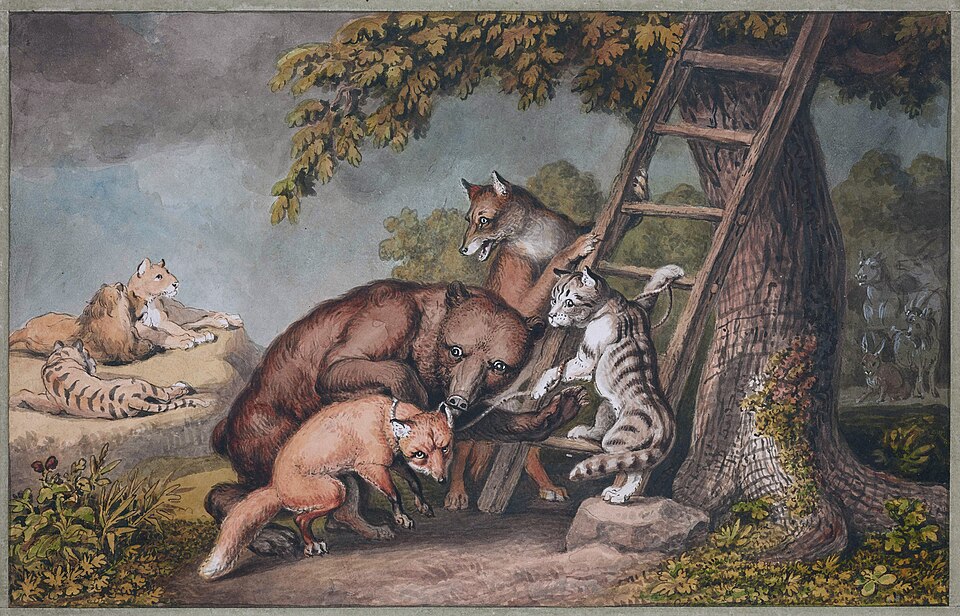
Sire, I would refrain from such presumptuousness — a fox knows how far to bite. But since you press me, and we are between ourselves, I will say this: a king who condemned me too quickly would deprive himself of the most useful of his vassals. Who else at your court reports to you what the barons plot in the shadows? Who unmasks flatterers by imitating them? You pardoned me not out of weakness, Sire, but out of wisdom: the sovereign who keeps a fox at his door sleeps more peacefully than he who surrounds himself with hungry wolves. I do not say you were complicit — I say you knew how to count. And a king who knows how to count forgives the fox what he would hang in another.
The sovereign who keeps a fox at his door sleeps more peacefully than he who surrounds himself with hungry wolves.
—They say your fortress of Maupertuis is impregnable. What does a fox's den have that my stone castles do not, tell me?
Cunning in its very walls, Sire. Your castles show their strength in broad daylight: high towers, drawbridges, banners in the wind. They are seen from afar, besieged, starved. Maupertuis does not show itself. Its galleries plunge underground, cross and recross, and whoever ventures in no longer knows if he is going up or down. I have a hundred secret exits and not one through which the enemy can enter at will. In the evening, I bring my loot back by paths that no one knows, and I sleep with a full belly while Isengrin scratches in vain at the clod above my head. A stone castle says: I am strong. My den says: you will not find me. And the second always prevails over the first.
A stone castle says: I am strong. My den says: you will not find me.
—When you return in the evening to Maupertuis, loot under your paw, are you never afraid that one day a cleverer one than you awaits you there?
Always, Sire — and that is what keeps me alive. The fox who thinks he is the smartest in the woods is already half caught in a trap. So I return by a new path each evening, I sniff the wind before going down, I listen to the earth. My father died in a snare for following the same trail twice; I do not forget the lesson. Fear is not my shame, Sire, it is my servant: it is she who wakes me before the dogs. The day I fear nothing, that day my skin will be stretched to dry on a peasant's barn. As long as I tremble a little when returning home, I know I am still better at cunning than at sleeping.
The fox who thinks he is the smartest in the woods is already half caught in a trap.
—Your name travels from mouth to mouth as far as foreign courts, they say. How did a simple fox of my woods come to such fame?
Through the minstrels, Sire, my best unwitting accomplices. They go from castle to castle, from fair to fair, and wherever people laugh at my tricks, they ask for my name again. The downtrodden peasant loves to hear how a weakling outwitted a strong man; he recognizes himself, he takes revenge in thought. That is why my branches cross rivers and mountains, and they are told, I am told, even among the Flemish and the Germans. Soon, Sire, people will no longer say of a fox that he is a fox — they will say he is being a Renart. My name will stick to the whole race like the dye to my skin. What king can boast of having given his name to an entire animal? Not even you, Sire — with all due respect.
The downtrodden peasant loves to hear how a weakling outwitted a strong man; he takes revenge in thought.
—You mock nobles and clerics without respite. Do you not fear that one day satire, by dint of biting, will end up destroying you?
Satire will not destroy me, Sire, for it only says aloud what everyone thinks in silence. I slander no one: I describe. If the lord is miserly, I show a miserly lord; if the monk is gluttonous, I paint a monk with a full belly. People laugh, and laughter is stronger than any army. A baron may chase me from his lands, but he will not chase away the laughter he had at himself. That is my true fortress, Sire — better even than Maupertuis. One enters it through the mouth and never leaves. As long as men laugh at the powerful, the fox will have his place by the fireside, and no pyre will extinguish that flame. It is the only trick, Sire, that I did not invent: it preceded me, and it will survive me.
A baron may chase me from his lands, but he will not chase away the laughter he had at himself.
Read further

This imaginary interview was generated by artificial intelligence from sources documented in Renart's profile. It dramatises what the figure might have said based on what we know about them, but does not constitute attested historical testimony. For primary sources and factual documentation, refer to the full profile.