Kids interview René Descartes
by Charactorium · René Descartes (1596 — 1650) · Philosophy · Sciences · 5 min read
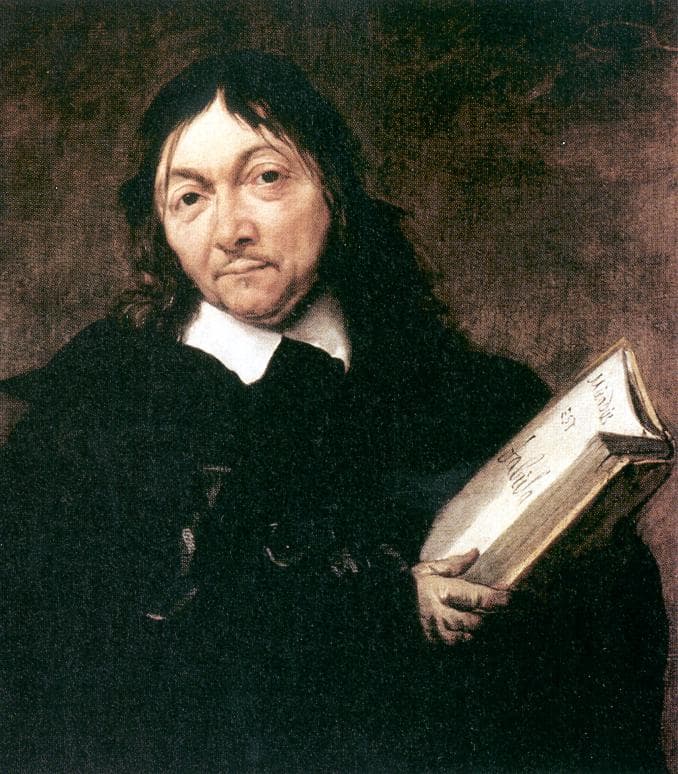
Two 12-year-old students visit an old Dutch castle with their school trip. In a small room heated by a stove, a gentleman in lace collar awaits them, looking gentle. It's René Descartes, and he has agreed to answer all their questions.
—Is it true you stayed in bed until noon? Were you lazy?
Ah, I've often been reproached for that! But listen to me, my child. For me, the bed was not laziness. It was my workshop. Imagine a silent room, warm blankets, and the day slowly dawning behind the window. No noise, just my thoughts. That is where, in the quiet, my best ideas came to find me. I could think for hours about a mathematics problem without moving a finger. People worked hard from dawn and it shocked them. I believed a rested mind thinks better than a tired body.
A rested mind thinks better than a tired body.
—And then you went to live with a queen? Did it go well?
Alas, no. In 1649, Queen Christina of Sweden invited me to Stockholm, far north, where the winter is terrible. She loved philosophy, but she wanted her lessons at five in the morning! Imagine: me, the man of long mornings, up in the dark, in an icy palace where the wind blew under the doors. My body couldn't take it. I caught a severe lung illness and died in February 1650, just months after arriving. You see, perhaps I should have stayed under my covers.
—We were told you doubted everything. Even that the sky is blue?
Yes! And I'll explain why, because it sounds crazy. Imagine building a house on sand. It collapses, doesn't it? Well, our ideas are the same. I decided to shake everything: what if my eyes were deceiving me? What if I were dreaming right now? I put everything into doubt, on purpose, to see what would remain standing. It wasn't to become sad or suspicious. It was a tool, like a hammer to test a wall. This is called methodical doubt. I wanted to keep only things that were truly, truly certain.
Nothing solid is built on sand.
—And what remained certain, after doubting everything?
Only one thing, but what a thing! Listen. Even if I doubt everything, even if everything around me is false, there is someone who doubts. And that someone is me, who thinks. So, if I think, then I exist! I wrote this phrase in my Discourse on the Method, in 1637: "I think, therefore I am." For me, it was like a rock in the middle of the sea. The greatest storms of doubt could not overthrow it. From that little solid rock, I could rebuild, stone by stone, everything I thought I knew.
I doubt, therefore I think; I think, therefore I am.
—Were you also a mathematician? Did you like math?
I loved it! And I even invented a new way of doing it. In my time, geometry was about figures drawn with a compass and ruler: circles, triangles, curves. And algebra was about calculations with letters and numbers. Two separate worlds. I had an idea: what if we wrote shapes with equations? Imagine a curve on your paper becoming a little sentence of numbers and letters. I published that in La Géométrie, in 1637. When you one day plot points with an x and a y, remember: those coordinates are called "Cartesian," after my name, Descartes.
A curve can be written as a sentence of numbers.
—How do you solve a difficult problem, in your opinion?
Good question, my child! I have a little trick I used all the time. When a problem seemed too hard, I pretended it was already solved. Yes, you heard right! Imagine you're looking for treasure: you start from the idea that it's found, and you trace the path backward to see how to get there. Then I gave a name to each little line, each piece of the problem, even those I didn't know yet. By cutting big difficulties into tiny easy bits, you always end up moving forward. That's my famous method.
Cut a big problem into small easy bits.
—Were you afraid of the Church? Why did you hide your books?
I had prepared a big book, The World, where I explained that the Earth moves. But in 1633, I learned news that chilled me: Galileo, a scholar I admired, had just been condemned for saying the same thing. Imagine your fright if someone were punished just for telling the truth! So I put my book in a drawer and didn't publish it. It wasn't courage, I admit. I was afraid of suffering the same fate. It was only published after my death. Sometimes, keeping quiet for a moment is the only way to keep thinking.
Sometimes staying quiet for a moment means being able to think for a long time.
—So where did you go to live in peace?
To Holland, my child! I lived there for more than twenty years. There, I was left to think and write in peace, which was rare in my time. But I was so concerned with my tranquility that I moved constantly, more than twenty times! I even kept my address secret so that nosy people wouldn't knock on my door. Imagine a man who changes houses like hiding places. It was in that calm that I wrote almost all my work, near a good warm stove, my goose-feather pen in hand.
—Did you have friends to talk about all this? Weren't you too lonely?
I wasn't alone, thanks to letters! In the evening, by candlelight, I wrote to scholars all over Europe. But my most precious friend was a princess, Elisabeth of Bohemia. She was one of the few women of my time recognized for her intelligence. She asked me such clever questions that sometimes I didn't know what to answer! She wanted to understand how our mind, which thinks, can command our body, which moves. Imagine two friends writing letters as long as books, just to solve a riddle together. Those exchanges are among the finest of my life.
—And what will remain of you when we grow up, deep down?
What a lovely question to end with. Thanks to Princess Elisabeth, I wrote my last book, The Passions of the Soul, in 1649. In it I speak of joy, sadness, love, fear — those emotions that run through you when your heart beats fast. But what I'd like you to remember is simpler. Don't believe something just because an adult tells you it's true. Examine it yourself, gently, with your own reason. Ask questions, as you have today. That is my true gift: teaching you to think for yourself. It's the most beautiful treasure one can keep for a lifetime.
Don't believe something just because an adult tells you it's true.
This imaginary interview was generated by artificial intelligence from sources documented in René Descartes's profile. It dramatises what the figure might have said based on what we know about them, but does not constitute attested historical testimony. For primary sources and factual documentation, refer to the full profile.