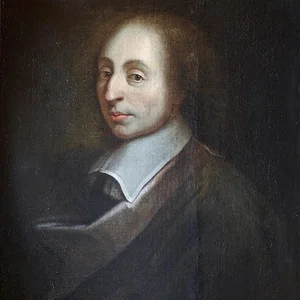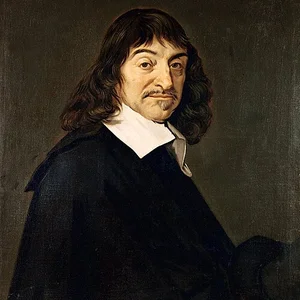

French philosopher and mathematician of the 17th century, founder of modern philosophy and rationalism. Known for his method of systematic doubt and his famous principle "I think, therefore I am." He revolutionized mathematics by creating analytic geometry.
René Descartes(1596 — 1650)
René Descartes
France
8 min read
Frequently asked questions
Famous Quotes
« I think, therefore I am»
« Common sense is the most widely shared commodity in the world»
« Divide each difficulty into as many parts as it is feasible»
Key Facts
- 1596: Born in La Haye-Descartes, Touraine
- 1630–1640: Development of his method of systematic doubt
- 1637: Publication of the Discourse on the Method
- 1641: Publication of the Meditations on First Philosophy
- 1650: Died in Stockholm, Sweden, where he had been teaching
Works & Achievements
A founding work of modern rationalism, in which Descartes sets out his method in four rules for reasoning well and arriving at certain truths. It is here that the famous cogito appears: "I think, therefore I am."
An appendix to the Discourse on the Method, this work revolutionized mathematics by creating analytic geometry, which makes it possible to represent geometric curves using algebraic equations. The Cartesian coordinate system is its direct legacy.
A masterpiece of Western philosophy, this work presents radical methodological doubt as the starting point for rebuilding certain knowledge. Descartes demonstrates the existence of the thinking subject, of God, and of the external world.
An ambitious synthesis of Cartesian metaphysics and physics, presented in four parts. Descartes develops his vortex theory to explain the motion of celestial bodies and the structure of the universe.
The last work published during Descartes' lifetime, written partly in response to questions from Princess Elisabeth of Bohemia. He analyzes human emotions as phenomena that are both physical and mental, laying the groundwork for modern psychology.
A treatise on physics and cosmology in which Descartes defends a mechanistic view of the universe. He abandoned plans to publish it upon learning of Galileo's condemnation, fearing he might suffer the same fate.
Anecdotes
Descartes had a habit of staying in bed until noon to think, a practice he considered essential to his reasoning. It was precisely during these long, restful mornings that he reportedly had his greatest philosophical and mathematical insights. This habit shocked some of his contemporaries, who were accustomed to austere working days.
On November 10, 1619, while serving as a soldier stationed in Ulm, Germany, on a cold night, Descartes had three consecutive dreams that he interpreted as a divine sign revealing his mission: to unify all the sciences through rational method. He carefully recorded these dreams and regarded them as the starting point of his entire life's work.
Descartes spent much of his life in Holland to escape the religious constraints of France. He changed address more than twenty times to protect his peace and quiet and to prevent visitors from disrupting his work, often keeping his exact whereabouts secret.
In 1649, Queen Christina of Sweden, an avid philosophy enthusiast, summoned him to Stockholm. She demanded lessons at five o'clock in the morning in an ice-cold palace. Accustomed to his cozy mornings, Descartes struggled badly with the Nordic cold and died of pneumonia in February 1650, just a few months after his arrival.
Descartes maintained an intense correspondence with Princess Elisabeth of Bohemia, one of the few women of her era recognized for her philosophical intellect. Their exchange of letters, covering the passions of the soul and the relationship between mind and body, is considered among the richest in the history of philosophy.
Primary Sources
I think, therefore I am. This truth was so firm and so assured that all the most extravagant suppositions of the skeptics were incapable of shaking it.
I suppose therefore that all the things I see are false; I persuade myself that nothing has ever existed of all that my memory, filled with lies, represents to me.
Thus, wishing to solve any problem, one must first consider it as already done, and give names to all the lines that seem necessary to construct it.
I distinguish two things in the human soul, upon which all the knowledge we can have of its nature depends: one is that it thinks, the other is that, being united to the body, it can act and be acted upon together with it.
Wonder is a sudden surprise of the soul which causes it to consider with attention the objects that seem to it rare and extraordinary.
Key Places
Birthplace of René Descartes on March 31, 1596. The town was renamed in his honor in 1967 and preserves his childhood home, now a museum.
Descartes lived in Holland for more than twenty years, taking advantage of the intellectual tolerance of the Dutch Republic to write the bulk of his philosophical and scientific work.
It was in Ulm, in November 1619, that Descartes experienced the night of three founding dreams that revealed to him his philosophical calling and his project to unify all sciences through reason.
Descartes traveled there in 1649 at the invitation of Queen Christina. The harsh climate and early-morning lessons took a toll on his health; he died there on February 11, 1650.
Descartes studied at the Royal Jesuit College of La Flèche from 1607 to 1615, one of the finest schools in Europe. It was there that he received a thorough grounding in philosophy, mathematics, and science.
Typical Objects

Descartes wrote prolifically with a quill pen, maintaining correspondence with the greatest minds in Europe. His letters form an essential part of his philosophical work.

It was beside a warm stove, on a winter's night in Bavaria in 1619, that Descartes is said to have developed his foundational insights. The stove symbolizes the inner retreat conducive to philosophical reflection.

As a traveler and soldier, Descartes used maps and globes to navigate his journeys across Europe. These instruments also reflected his interest in geometry applied to real space.

Descartes took a keen interest in optics and the refraction of light, devoting his Dioptrics to the study of lenses and vision. He sought to improve the observational instruments of his time.

The analytic geometry invented by Descartes was based on the algebraic representation of geometric shapes. The compass and straightedge were the everyday tools of his mathematical demonstrations.

Descartes kept a carefully curated library, preferring to reason for himself rather than accumulate readings. His books served as starting points for questioning established knowledge.
School Curriculum
Vocabulary & Tags
Key Vocabulary
Daily Life
Morning
Descartes spent his mornings in bed, refusing to rise before noon. He meditated, read, and reflected beneath his warm covers, considering this time the most conducive to pure thought. This habit, maintained for decades, earned him a reputation as a contemplative mind with little regard for social conventions.
Afternoon
His afternoons were devoted to writing, optical experiments, and mathematical demonstrations in his study. He would sometimes dissect animals to understand how the human body worked, following the anatomical tradition of his era. He also received the occasional visit from a carefully selected handful of correspondents and disciples.
Evening
His evenings were dedicated to the extensive correspondence he maintained with philosophers, mathematicians, and scientists across Europe. By candlelight, he wrote long and precise letters, addressing objections and refining his theories. He went to bed early, keen to preserve the quality of his nights of reflection.
Food
Descartes followed a sober and balanced diet, in keeping with Dutch habits of his time: bread, fish, vegetables, cheese, and light beer. He took a keen interest in medicine and healthy living, hoping to reach the age of one hundred through reasoned bodily hygiene. He avoided overindulgence at the table, which he believed clouded the mind.
Clothing
Descartes wore the restrained bourgeois dress of the educated gentleman of the 17th century: a dark doublet, a wide white lace collar (falling band), a black wool cloth coat, and a broad-brimmed hat. Without ostentation, his attire reflected his status as a cultivated gentleman rather than a courtier. In Holland, he adopted the understated dress of Protestant merchant circles.
Housing
Descartes lived in comfortable, well-heated Dutch bourgeois houses, which he rented while frequently changing cities to preserve his anonymity. His lodgings were simply furnished: a writing table, a carefully chosen library, measuring instruments, and a good stove. He favored functionality and quiet over any showy luxury.
Historical Timeline
Period Vocabulary
Visual Style
Esthétique du Siècle d'or hollandais, clair-obscur à la Rembrandt, intérieur savant baigné d'une lumière dorée révélant livres, compas et diagrammes géométriques sur fond de ténèbres baroque.
Sound Ambience
Atmosphère de studieuse retraite dans une maison hollandaise du XVIIe siècle : crépitement du feu, plume sur le parchemin, cloches d'église et rumeurs feutrées du canal.
Liens externes & ressources
Références
Œuvres
Discours de la méthode
1637
La Géométrie
1637
Méditations métaphysiques
1641
Principes de la philosophie
1644
Les Passions de l'âme
1649
Le Monde et le Traité de l'homme
1633 (publication posthume 1664)