Imaginary dialogue between Konrad Adenauer and Robert Schuman
by Charactorium · Robert Schuman (1886 — 1963) · Politics · 7 min read
It is in the gray stone garden of Scy-Chazelles, on a spring morning in 1958, that Konrad Adenauer comes to visit his friend Robert Schuman. The chancellor knows this Lorraine home well, where the scent of trimmed hedges mingles with the smell of ink on files. The two men have exchanged countless telegrams over eight years, patiently coordinating the reconciliation of their two peoples. Today, Adenauer sets down his briefcase and comes to listen, as a friend more than a chancellor, to the man behind the work.
—Robert, my friend, you were born in Luxembourg when Lorraine was German. How did this child of the borders become a French citizen at thirty-two?
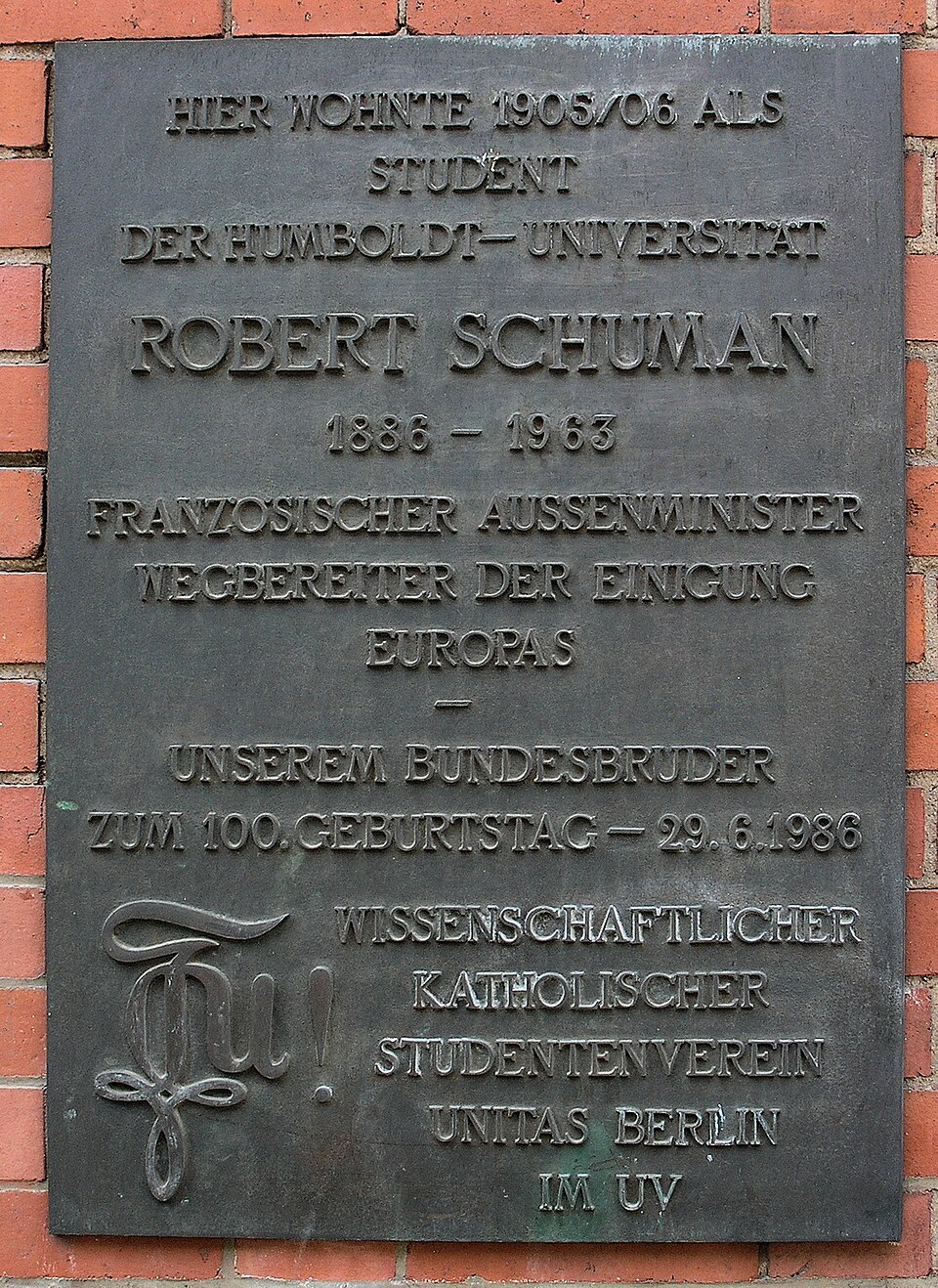
You touch there, Konrad, on what made me who I am. I was born in 1886 in a Grand Duchy wedged between your lands and ours, to a Lorraine family under German administration. I studied law at your universities, in Bonn, Munich, Berlin — and you know I still speak your language better than many of my colleagues at the Quai d'Orsay. When Lorraine returned to France in 1918, I became French without ceasing to be what I had always been: a man of both banks. Some saw this as a weakness, almost a suspicion. I saw it as my opportunity. How could one hate Germany when one had learned to think through its books? This dual belonging was not a tearing apart: it was already, in embryo, the whole Europe we are building together.
How could one hate Germany when one had learned to think through its books?
—Before our joint work, the Gestapo arrested you in 1940. You never speak to me about it. What did those years in hiding teach you?
It's true I speak little of it, and you understand why. In September 1940, they came for me because of my opposition to the regime. I was held prisoner in Neustadt, then I managed to escape in 1942. I lived hidden, from monastery to monastery, in the free zone, under false names, knowing that a denunciation could end everything. I do not tell you this to complain — others suffered a thousand times more. But in those silent convents, I had time to meditate on what had produced, since 1870, this succession of wars between our peoples. I understood that treaties, borders, victors and vanquished settled nothing. Something else was needed, a bond so concrete that no hatred could ever break it again. My European conviction was not born in an office: it was born in a cell.
My European conviction was not born in an office: it was born in a cell.
—Let us talk about May 9, 1950. You had me informed only a few hours before the announcement. Why so much secrecy between the two of us?
Forgive me again for that silence, Konrad — it was not mistrust of you, but fear of leaks. With Jean Monnet, we had drafted the text almost clandestinely, without informing most of my own ministers. The slightest indiscretion, and the chancelleries, the industrialists, the jealous would have strangled the idea before its birth. I sent you an emissary that very morning because it was unthinkable to extend such a hand to Germany without your heartfelt agreement. When I was told of your reaction, I knew we would succeed. That afternoon, in the Salon de l'Horloge of the Quai d'Orsay, before the international press, I read that declaration, trembling a little. I have never forgotten what I said that day: Europe will not be made all at once, nor according to a single overall plan, but through concrete achievements which first create a de facto solidarity.
It was unthinkable to extend a hand to Germany without your heartfelt agreement.
—Many in Bonn, as in Paris, considered your method too modest. Why coal and steel, and not immediately the great political Europe?
Because the great political Europe all at once, my friend, is a dream that collapses at the first obstacle. We saw it after every war: fine principles are signed, and everything falls apart. I preferred the method of small steps that Monnet called so aptly. Coal and steel are the sinews of war — the very materials from which cannons were made. Placing them under a common High Authority, above our two governments, made a new war not only unthinkable but materially impossible. That is the meaning of supranationality: we both cede a share of sovereignty, in equal parts. I said before the Assembly that we asked Germany for a limitation, but that France accepted exactly the same. A de facto solidarity, concrete, before grand speeches. You build peace as you build a cathedral: stone by stone.
You build peace as you build a cathedral: stone by stone.
—The Treaty of Paris of 1951 bound six countries. When you signed, did you already think of what would come after, beyond coal?
Of course I did, and you too. On April 18, 1951, when our six nations — France, your Germany, De Gasperi's Italy, Belgium, the Netherlands, Luxembourg — signed that treaty, we all knew we were not merely creating a coal market. We were creating a laboratory. The first supranational institution in history, with its High Authority independent of governments. If it worked for steel, why not tomorrow for trade, for energy, for many other things? I confess, Konrad, I refrain from prophesying. I only know that once peoples are accustomed to deciding together, to sharing a common authority, the path does not turn back. Each concrete achievement calls for the next. We have planted a seed; neither you nor I may see the full tree.
We have planted a seed; neither you nor I may see the full tree.
—Here, in this stone house where I visit you, you are nicknamed the "monk of politics." This faith, what weight does it carry in your actions?
The nickname makes me smile, but I do not deny it. You know I never married, that I live alone here, in Scy-Chazelles, surrounded by my books in several languages. Every morning, before dawn, wherever I am, I go to Mass; in the evening, I pace this garden reciting my rosary. This is not a show of piety. For me, democracy must be fraternal or it will not be: a politics of fraternity, otherwise it becomes tyranny or anarchy. The Europe we are building is not just a matter of tons of steel and customs tariffs. It is a moral work, a duty towards the dead of the three wars that pitted us against each other. You who share this faith, Konrad, understand that I do not separate the statesman from the Christian. My sobriety is not a displayed virtue — it is simply that pomp seems to me a waste of time.
Europe is not just a matter of steel: it is a moral work.
—You refuse official residences, you eat alone a soup and Lorraine cheese. Is this austerity not a burden at your age?
A burden? No, Konrad, it is quite the opposite: it is my rest. When I return from the Quai d'Orsay or Strasbourg, I come back to this fifteenth-century gray stone home, my vegetable garden, my library, my breviary annotated in my hand. I dine on soup, a little cheese, a glass of Moselle wine, and that is quite enough. In Paris, I always lived in modest apartments, refusing the splendor to which my position entitled me. My colleagues frequent salons and dinners; I retire early with a text on law or philosophy. You see, a man burdened with possessions and honors becomes cautious, afraid of losing everything. He who possesses almost nothing is free to serve a great idea to the end. My frugality is not a sacrifice: it is my freedom.
He who possesses almost nothing is free to serve a great idea to the end.
—At the Strasbourg Assembly you preside over, you switch from French to German, then to Luxembourgish. Why do you insist so much on this mix of languages?
Because a Europe that imposed a single language would betray its own principle. When I preside over this parliamentary Assembly, I insist that no language be privileged, and I set the example: I speak in turn in yours, in mine, in that of my Luxembourg childhood. This is not a performance, Konrad — it is my way of saying that diversity is not the enemy of unity. We do not want to melt our peoples into a single mold; we want them to decide together while remaining themselves. Strasbourg is the perfect symbol of this: so often disputed between our two nations, it becomes the heart of a reconciliation. When I sit there, I think of all those who died to move this border a few kilometers. From now on, we move only ideas and votes. It is a silent victory, but immense.
We no longer move borders: only ideas and votes.
—May 9 has become a date already commemorated. Do you measure, Robert, what your gesture that morning triggered?
I distrust grand words about myself, you know. That morning of May 9, I was only a voice that read a text matured by several. Without Monnet for the method, without you for the German response, without De Gasperi and the others, this paper would have remained a dead letter. What moves me is not the date remembered, but what happened in a few hours: a Frenchman extended his hand to Germany without ulterior motive, and Germany grasped it. After what our peoples had inflicted on each other, it was almost a miracle of trust. I believe the true audacity that day was not in the technical plan for coal and steel. It was in the wager on the good faith of yesterday's adversary. You made, that morning, half the journey. Without that, I would have read just one more speech.
A Frenchman extended his hand to Germany without ulterior motive, and Germany grasped it.
—One last question as a friend, Robert. After prison, flight, ordeal, what keeps you going and still believing that all this will last?
What keeps me going, Konrad, is precisely having touched bottom. When you have known the cell in Neustadt, the fear of denunciation, the silence of the monasteries where I hid, you no longer pay yourself with words about peace. You know the cost of war, in its very flesh. I do not believe our work is safe; nothing human is. Men after us may damage it, slow it down, doubt it. But we will have created bonds so concrete, so daily, that undoing them would cost more than keeping them. That is the whole wisdom of de facto solidarity: it does not rest on good feelings, which pass, but on shared interests, which endure. What we unite today is stronger than what divided us. And that, my friend, no Gestapo will ever be able to stop again.
What we unite today is stronger than what divided us.
This imaginary interview was generated by artificial intelligence from sources documented in Robert Schuman's profile. It dramatises what the figure might have said based on what we know about them, but does not constitute attested historical testimony. For primary sources and factual documentation, refer to the full profile.