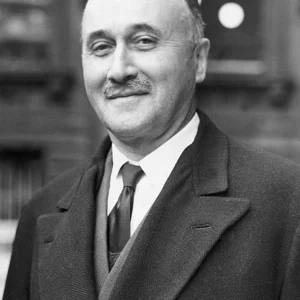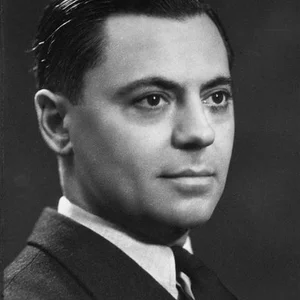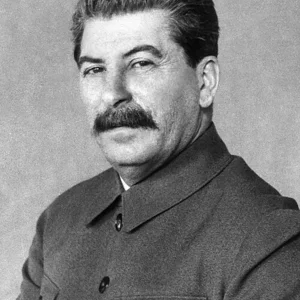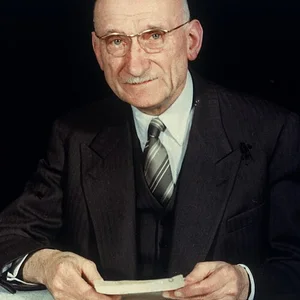

French statesman (1886-1963), Robert Schuman is one of the principal founding fathers of the European Union. As Foreign Minister, he proposed in 1950 the plan to create the European Coal and Steel Community (ECSC), laying the foundations for European integration.
Robert Schuman(1886 — 1963)
Robert Schuman
France, Allemagne
8 min read
Frequently asked questions
Famous Quotes
« World peace cannot be safeguarded without the making of creative efforts proportionate to the dangers which threaten it.»
« Europe will not be made all at once, or according to a single plan. It will be built through concrete achievements which first create a de facto solidarity.»
Key Facts
- 1950: Presentation of the Schuman Declaration proposing the creation of the ECSC (European Coal and Steel Community)
- 1951: Signing of the Treaty of Paris establishing the ECSC, the foundation of the future European Union
- 1948-1952: French Foreign Minister and key figure in Franco-German reconciliation
- 1955-1956: President of the Common Assembly of the ECSC
- 1958: International recognition of his role as a founding father of Europe
Works & Achievements
A founding speech proposing to pool French and German coal and steel production under a supranational High Authority. Regarded as the birth certificate of the European Union, this date is celebrated every year as Europe Day.
Treaty signed by six countries (France, Germany, Italy, Belgium, the Netherlands, Luxembourg) creating the European Coal and Steel Community. The first supranational institution in history, it served as the testing ground for all subsequent European integration.
Schuman's testament work, published in the year of his death, in which he sets out his vision of a Europe built on Christian values, democracy, and solidarity among peoples. An essential text for understanding the ideals of the Founding Fathers.
Schuman was the first president of the European Parliamentary Assembly (the future European Parliament), lending democratic legitimacy to the fledgling institutions of the European community.
Although not a direct signatory, Schuman laid the diplomatic groundwork for the Treaties of Rome establishing the EEC and Euratom — a logical extension of the ECSC he had founded seven years earlier.
Anecdotes
Robert Schuman was born in Luxembourg in 1886, at a time when Lorraine was under German rule. He studied in Germany and always spoke French with a slight German accent. Far from being a handicap, this dual cultural background gave him a unique understanding of the two rival nations, which proved decisive in shaping his vision of Franco-German reconciliation.
On May 9, 1950, Schuman read his declaration before the international press in the Salon de l'Horloge at the Quai d'Orsay. The text had been drafted in secret with Jean Monnet to avoid diplomatic leaks. Konrad Adenauer, the German Chancellor, learned of the announcement a few hours before it was made public and reportedly declared it was the first sincere act by a Frenchman toward Germany since the war.
During the Occupation, the Gestapo arrested Schuman in September 1940 because of his opposition to the Nazi regime. Imprisoned in Neustadt, he managed to escape in 1942 and took refuge in monasteries in the unoccupied zone, living in hiding until the Liberation. This experience of persecution deepened his conviction that only European unity could prevent future wars.
A man of deep piety, Schuman never married and led a life of great simplicity in his home in Scy-Chazelles in Moselle. He rose each morning at dawn to attend Mass before beginning his days as a minister, earning him the affectionate nickname 'the monk of European politics.' In 2004, Pope John Paul II opened his cause for beatification.
During his presidency of the European Parliamentary Assembly (1958–1960), Schuman insisted that debates be held in several languages with none given preference. He himself would speak in succession in French, German, and Luxembourgish, concretely embodying the multilingual ideal he championed for the building of Europe.
Primary Sources
Europe will not be made all at once, or according to a single plan. It will be built through concrete achievements which first create a de facto solidarity.
Democracy must be fraternal, or it will not be at all. It must be a politics of brotherhood, otherwise it will become a tyranny or an anarchy.
We ask Germany to accept limited sovereignty over its coal and steel resources, but we accept exactly the same limitations for France. It is an equality of rights and duties.
What unites us is stronger than what has divided us. The future of our peoples will be built together, or it will not be built at all.
Key Places
The Schuman family home in Lorraine, where Robert returned to live and where he died in 1963. Now a museum, it preserves his study and library exactly as he left them.
It was in this room of the French Foreign Ministry that Schuman delivered his historic declaration on 9 May 1950 before the international press, launching the process of European integration.
Robert Schuman's birthplace, then a neutral Grand Duchy between France and Germany. His borderland identity shaped his deep sensitivity to questions of reconciliation between European peoples.
A symbol of Franco-German reconciliation, Strasbourg was the city where Schuman helped establish the Council of Europe (1949) and the European Parliament. It became the institutional heart of the Europe he had envisioned.
Schuman served as a Member of Parliament for the Moselle département for over forty years, delivering many landmark speeches on French foreign policy from the floor of the National Assembly.
Typical Objects

Schuman carried his diplomatic files in a plain leather briefcase, a symbol of the tireless work of a statesman who preferred discretion over grandeur. It often contained draft diplomatic notes written in several languages.

A man of deep faith, Schuman always kept a rosary with him and recited it daily. His Catholic devotion shaped his vision of European fraternity as a moral duty as much as a political one.

Trained as a lawyer, Schuman wrote his speeches and diplomatic notes by hand in several languages. The pen with which he signed the founding European texts has become a symbolic object of European memory.

In the 1940s and 1950s, international communication relied on coded telegrams. Schuman used these messages daily to coordinate French positions with Adenauer, De Gasperi, and other European partners.

Schuman read his breviary each evening at his home in Scy-Chazelles. This prayer book, annotated in his own hand, bears witness to the spiritual dimension inseparable from his political commitment to peace.

The borders redrawn by the treaties of 1919 and 1945 were central to all diplomatic negotiations. Schuman used these maps to illustrate the need to transcend national borders through gradual economic integration.
School Curriculum
Vocabulary & Tags
Key Vocabulary
Tags
Concept
Daily Life
Morning
Schuman invariably rose before dawn to attend Mass at a nearby church, whatever city he happened to be in. Back home or at his ministerial residence, he read diplomatic dispatches and the press before sitting down to a simple breakfast: coffee and toast.
Afternoon
Afternoons were devoted to diplomatic negotiations, audiences, and sessions at the National Assembly. Schuman drafted his own speeches in several languages, copying out his notes in his small, tight handwriting. He received ambassadors and foreign counterparts with scrupulous courtesy but without unnecessary ceremony.
Evening
In the evenings, Schuman retired early, reading legal, philosophical, or religious texts. At Scy-Chazelles, he would walk through his garden reciting the rosary before dining alone or with a few close friends. He almost never attended the social gatherings that every other politician of his standing regularly frequented.
Food
His eating habits were marked by great frugality: soup, vegetables from the kitchen garden, bread, Lorraine cheese, and a glass of Moselle wine. A lifelong bachelor, he often ate alone and attached little importance to gastronomy — quite unlike the French political culture of his day.
Clothing
Schuman invariably wore dark suits (charcoal grey or black), starched white collars, and understated ties. His sober, austere appearance stood in sharp contrast to the studied elegance of some of his political contemporaries. He was never seen in casual dress in public.
Housing
His house in Scy-Chazelles — a small, grey-stone Lorraine dwelling dating from the 15th century — was his true home. A library overflowing with books in several languages, simple furniture, no ostentatious decoration. In Paris, he lived for many years in modest apartments, refusing the grand official residences to which his rank entitled him.
Historical Timeline
Period Vocabulary
Visual Style
Le style visuel oscille entre la solennité des palais diplomatiques parisiens des années 1950, avec leurs dorures et leurs tapisseries, et la sobriété austère de la Lorraine rurale où vécut Schuman, traduisant visuellement son caractère à la fois institutionnel et humble.
Sound Ambience
L'ambiance sonore évoque les couloirs feutrés de la diplomatie française des années 1950, mêlant le grattement des plumes sur le papier officiel aux cloches des églises lorraines et aux murmures multilingues des premières assemblées européennes.
Liens externes & ressources
Références
Œuvres
Déclaration Schuman
9 mai 1950
Traité de Paris instituant la CECA
18 avril 1951
Pour l'Europe
1963
Présidence de l'Assemblée parlementaire européenne
1958-1960
Contribution au Traité de Rome
25 mars 1957