Kids interview Romulus and Remus
by Charactorium · Romulus and Remus · Mythology · 5 min read
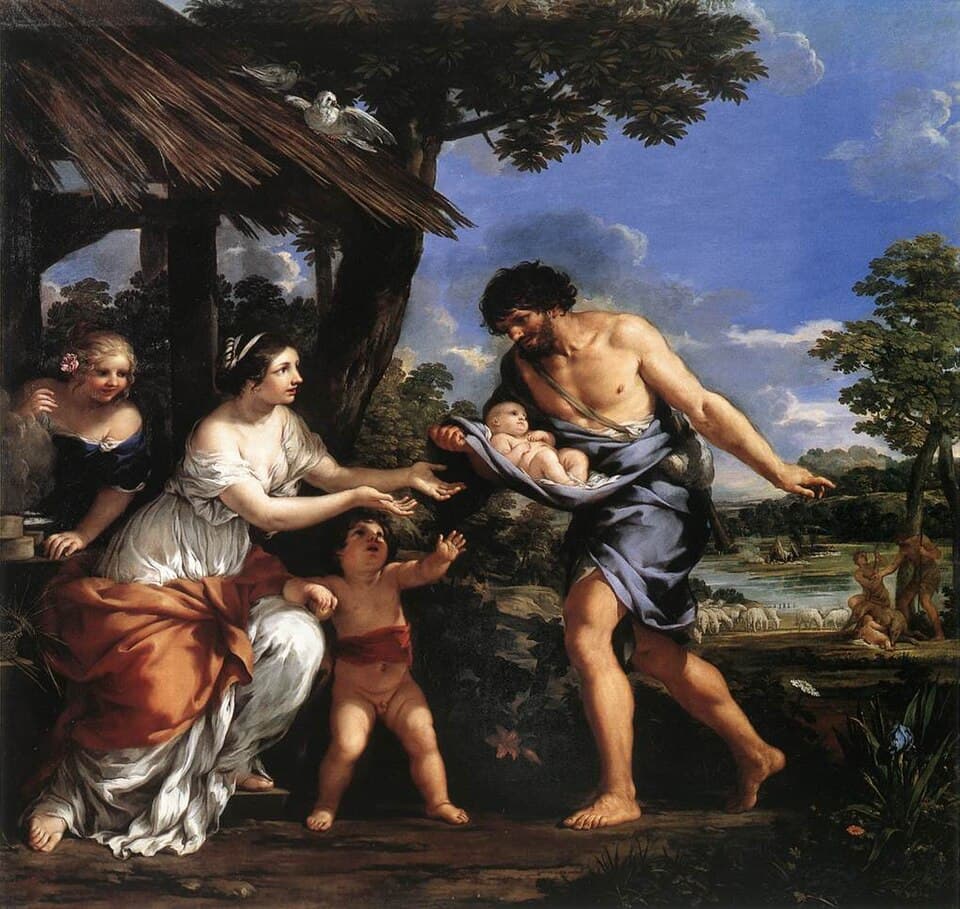
Two young visitors, each twelve years old, got off their bus this morning and climbed a hill in Rome. At the top, near an old cave, a man in a red cloak is waiting. He is Romulus, the founder — he smiles, pleased that people are still interested in him.
—Is it true that a she-wolf nursed you when you were babies?
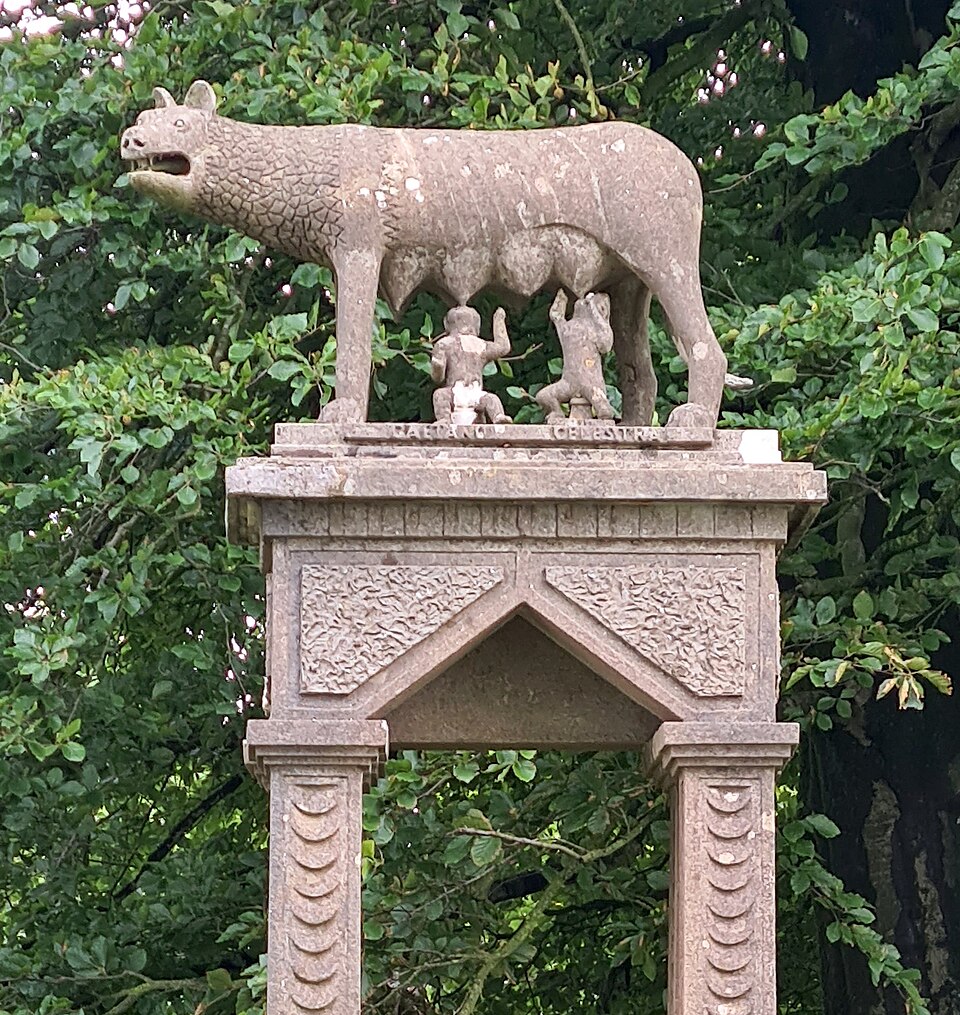
Yes, my child, and it's the most beautiful part of my story. You see, my brother Remus and I were abandoned as tiny babies, set down near the river, the Tiber. Imagine two newborns alone in the reeds, night falling, the cold. And then a wild she-wolf came. A beast that should have devoured us! But she lay down and gave us her milk, right there in a cave under this hill — they call it the Lupercal. Shepherds found us afterwards and raised us. That's why the she-wolf is everywhere in Rome today.
A beast that should have devoured us gave us her milk.
—Do you remember that cave? What was it like?
I was too much of a baby to really remember, but the shepherds told me about it so often! The Lupercal was a dark, damp hole dug under the Palatine, the hill where you're standing. Imagine a cave that smells of wet earth and animal fur. Outside, the Tiber flowed, wide and muddy. Later, when I became king, that place became sacred. The Romans held festivals there every year to never forget the she-wolf. A tiny place, and yet all of Rome was born inside it.
A tiny place, and yet all of Rome was born inside it.
—Why did you decide to build a city at that spot?
Because the Palatine was perfect, my child! A high hill, easy to defend, with the river right below for trade and water. In my time, around 753 BC, there was no great city here — just scattered huts of wood and thatch, shepherds like those who had raised me. I wanted a real fortified city, a civitas with its walls and laws. So I traced its boundaries and said: here will be Rome. Imagine planting a flag on an empty hill and promising that one day, the whole world will talk about it.
Here will be Rome — I planted that name on an empty hill.
—We were told you killed your brother. Is that true?
Yes... and it still weighs on me, my child. I won't lie to you. When I founded the city, I traced a sacred boundary all around — it's called the pomerium, a furrow dug in the earth with a plow, the ard (araire). That furrow was like an invisible wall: no one had the right to cross it. My brother Remus, to mock me, jumped over it. In anger, I struck him. They say I cried out: “Thus perish whoever shall leap over my walls.” A fratricide — killing one's own brother. That is the terrible price of that boundary.
The furrow I had traced became my brother's grave.
—Why was a simple line on the ground so important to you?
Because that line wasn't just a drawing, my child. The pomerium was the sacred boundary of the city, blessed by the gods. Imagine you draw a circle and say: inside, it's protected, it's holy; outside, it's danger. If anyone could jump over it laughing, then the city was worth nothing, it was no longer sacred. I had dug that furrow with the ard (araire), two oxen pulling the plow. When Remus scorned it, he scorned Rome itself. It was terrible, but a city without a respected boundary is a city already dead.
A city without a respected boundary is a city already dead.
—At first, there was almost no one in Rome. How did you manage?
Ah, that was my big problem, my child! A city without inhabitants is just empty walls. I mostly had men — shepherds, warriors, adventurers who came to join me. But without women and families, my city would die out in one generation. So I organized a festival and invited our neighbors, the Sabines, with their daughters. And then we kidnapped the young women to become our wives. Yes, I know, it sounds brutal — and it sparked a war. But Rome needed families to live. The beginnings of a city are never gentle.
A city without inhabitants is just empty walls.
—When you became king, what did you do first?
I understood one thing, my child: a king alone cannot decide everything. So I chose the wisest and oldest men and made them a council. They were called the patres, the 'fathers'. That council was the Senate — a word that comes from senex, old man. Imagine a hundred gray beards gathered to advise me before every major decision. I also divided the people into three groups, three tribes, to organize them better. You see, founding a city isn't just walls. It's inventing rules to make people live together.
Founding a city isn't just walls — it's making people live together.
—What's that story about a shield that fell from the sky?
Ah, you already know about that! Yes, they say one day a shield fell from the sky, right into my hands. It was called the ancile. For the Romans, it was a sign: as long as this shield stayed in Rome, the city would be protected by the gods. But I was afraid someone would steal it! So, king's trick: I had many identical copies made, so a thief would never know which was the real one. Those sacred shields were kept carefully. You see, in my time, an object could be worth more than an entire army.
As long as this shield stayed in Rome, the city would be protected.
—What kind of clothes did you wear when you were king?
Nothing very golden, my child, you'd be disappointed! In my time, we were rough warriors. I wore a simple woven wool tunic, and over it a large red cloak fastened at the shoulder with a bronze brooch — they called it the paludamentum, the commander's cloak. On my head, sometimes, a sign of my royal power. But don't imagine a shiny palace! I lived in a hut of wood and earth, with a thatched roof. The king of Rome slept in a shack. That's how it all began — in poverty.
The king of Rome slept in a shack of wood and thatch.
—They say you didn't die like everyone else. What happened?
A strange story, my child... One day, toward the end of my life, the sky grew dark. A huge storm rose up, with lightning and a cloud so thick you couldn't see anything. And when the sky cleared, I had vanished. Gone! The Romans said the gods had taken me to make me one of their own. They worshipped me under a new name, Quirinus, a protector god of Rome. After me, a wise king, Numa Pompilius, continued my work. Imagine: I was abandoned as a baby, and I left for the sky as a god.
I was abandoned as a baby, I left for the sky as a god.
This imaginary interview was generated by artificial intelligence from sources documented in Romulus and Remus's profile. It dramatises what the figure might have said based on what we know about them, but does not constitute attested historical testimony. For primary sources and factual documentation, refer to the full profile.