Imaginary interview with Romulus and Remus
by Charactorium · Romulus and Remus · Mythology · 6 min read
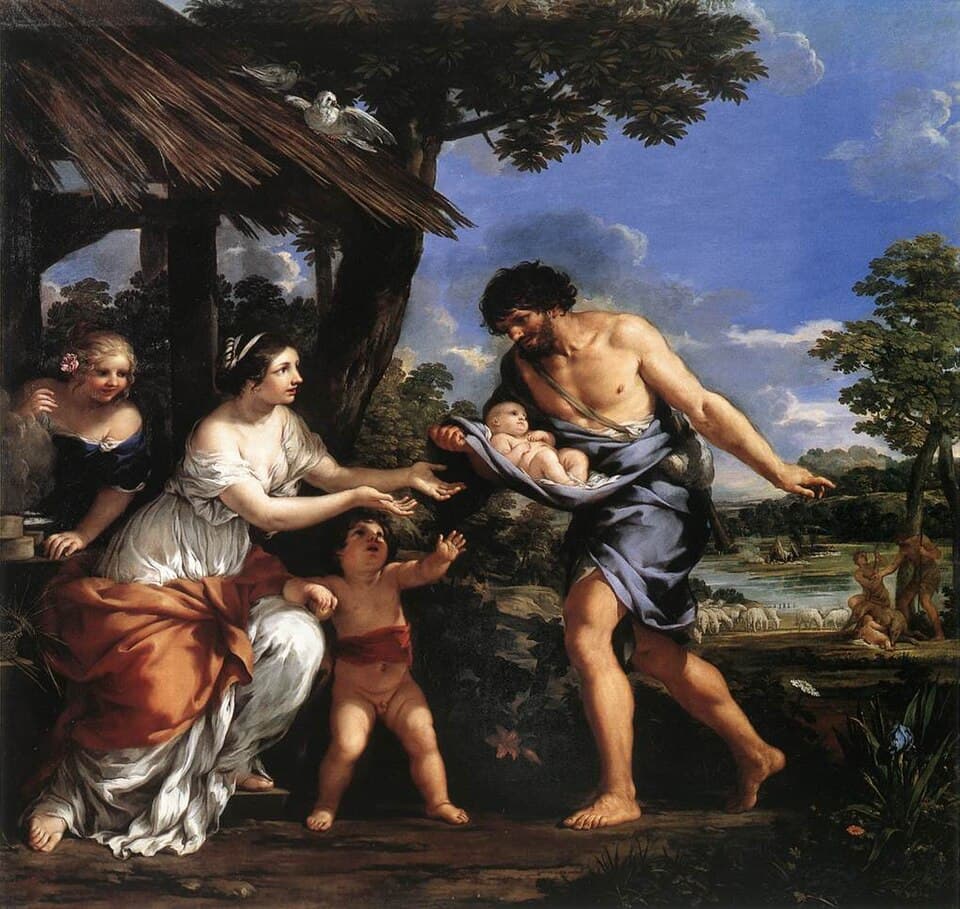
On the Palatine, as the sun sets over the freshly traced furrow, a rugged man, his cloak fastened with a bronze fibula, contemplates the nascent walls of his city. The earth still carries the scent of the she-wolf and the blood of a brother. Romulus agrees to tell, in the present tense of tradition, how Rome was born from his hands.
—Do you remember your very first days, on the banks of the Tiber?
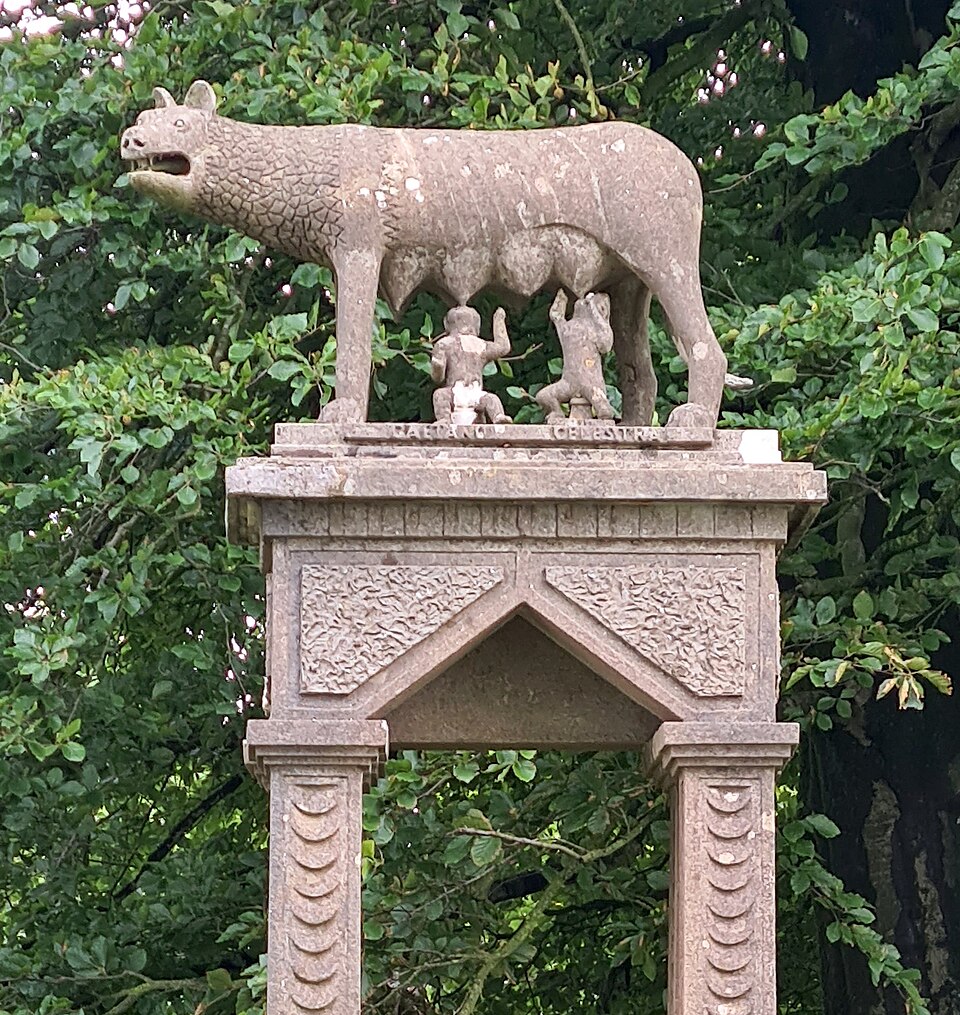
My brother Remus and I first knew only the cold of the water and the muddy slope of the Tiber. We had been exposed, two infants thrown into the river as one returns a burdensome gift to the gods. But the current deposited us at the foot of the hill, and that is where she came: the she-wolf, the Lupa, whose jaws were made for tearing. She lay us against her flank, in the Cave of the Lupercal, and offered us her teats like a mother. I cannot tell you why a wild beast became gentle that day. The shepherds who found us later could hardly believe it. It is this image — two children under the belly of a she-wolf — that Rome now carries even on its coins.
A beast made for tearing lay down to nurse us: that is where Rome comes from.
—How did those early years, raised by shepherds, forge the man you became?
I grew up in the wooden and thatch huts of Latium, among herds and weapons. My mornings I spent watching the flocks on the hills; my afternoons, toughening myself in combat against neighboring villages. Goat's milk, sheep's cheese, the game I brought back — that is what fed our evening meals, around the fire, with the elders. Nothing in that life said I would found a city. But the shepherd who took me in knew that we were not born from a hut. When I learned of my birth — son of Mars and a Vestal of Alba Longa — I understood that the she-wolf had not saved two shepherds, but two kings who did not yet know themselves.
—Let us speak of the day of the foundation. How did you trace the boundaries of Rome?
I yoked a heifer and a white bull to the plow, and I opened in the earth of the Palatine a deep furrow, lifting the plow at the places where the gates would be. It was not a simple ditch: it was the pomerium, the sacred boundary, the very skin of the city. Beyond the furrow, you are no longer in Rome — you are elsewhere, under other gods. I had consulted the augurs, observed the flight of birds; twelve vultures had answered me, and Remus had seen only six. The city would therefore be mine, and would bear my name. That morning, as I traced that line in the clay, I was not tracing a boundary: I was stitching together heaven and earth.
The furrow was not a ditch, but the very skin of the city.
—And yet that same day, you killed your brother. What happened?
Remus laughed at my wall. He judged it too low, pitiful, and with a leap he jumped over the enclosure I was building, trampling the sacred furrow I had just opened. Understand: crossing the pomerium without rite is to insult the gods who guard it. I struck him. And as he fell, I said that thus perish whoever shall cross my walls. They will judge me harsh, a fratricide — the word is just, and I do not flee it. But a city that lets its boundaries be mocked on the very day of its birth will not last a season. I preferred to mourn a brother than to bury a city. Livy, later, would say that this was the terrible price of Rome.
I preferred to mourn a brother than to bury a city.
—A new city, but populated only by men and fugitives. How to give it a future?
I had walls, warriors, an asylum open to exiles and the homeless — but no women, no children to be born. A city without cradles dies with its first generation. Our neighbors the Sabines refused to give us their daughters: who marries his daughter to a band of brigands? So I used cunning. I invited that people to a festival, games held in honor of a god, and at a signal my men abducted their young women. It was not a rape for pleasure, but for survival: I wanted wives, hearths, a Roman offspring. The war that followed nearly swallowed us — until those same Sabine women, now our wives, threw themselves between their fathers and their husbands to reconcile us.
A city without cradles dies with its first generation.
—How did you transform that assembled band into a true body politic?
A multitude is not a people; it needs a skeleton. So I divided the first Romans into three tribes, and each into curiae, so that every man knew his place, his rank, his duty. Then I chose a hundred elders — the patres — to advise me: this was the first Senate, the council of fathers. I wanted a king, yes, but a king who listens to the voice of the wisest, not a deaf tyrant. From that assembly of white-haired old men was born the institution that, centuries after me, would govern the world. I built stone walls on the Palatine; but the walls that truly held were those made of men and laws.
The walls that truly held were those made of men and laws.
—It is said that shields fell from heaven during your reign. What are those sacred objects?
A shield came down from heaven, an ancile, a pledge that the gods protected Rome as long as it remained within its walls. I knew the danger: a unique object can be stolen, lost, burned. So I had copies forged, indistinguishable from the original, so that no thief would ever know which was the true one. These shields became the heart of a cult, carried in procession by dancing priests. You see, governing a city is not only raising walls and armies: it is keeping its gods close, giving them a dwelling, rites, gestures repeated season after season. A city that loses its gods has already lost its walls, even if they still stand.
A city that loses its gods has already lost its walls, even if they still stand.
—Your very end is a prodigy. How would you describe your disappearance?
I was reviewing my troops on the Field of Mars when the sky suddenly darkened. A storm, a cloud so thick that no one could see his neighbor, a thunder like never before. When the cloud dissipated, my throne was empty. Men cried murder, accused the senators; but others swore they had seen me ascend among the gods. I was no longer called Romulus after that, but Quirinus, protector god of Rome, to whom a temple is raised. I will not tell you whether I was taken up to heaven or whether the earth drank my blood: tradition preserves both versions, and that is as it should be. A founder does not quite die; he becomes the threshold through which his city speaks to its gods.
A founder does not quite die; he becomes the threshold through which his city speaks to its gods.
—The Romans themselves seem to hesitate on the details of your story. Does that trouble you?
Why should it trouble me? Men tell my death in ten ways, doubt the name of my parents, argue over the path of the furrow. On the death of Remus, one says I struck him with my own hand, another that one of my companions cut him down in the fray. That is the nature of a legend: to breathe through many mouths. A dry fact has only one version; a myth has as many as there are hearths where it is retold at evening. What remains, under all the variants, is the furrow, the she-wolf, the walls, and the blood shed for them. That the details waver does not worry me: it is the sign that I still live in the mouths of the living.
A dry fact has only one version; a myth has as many as there are hearths where it is retold.
—If you could imagine what the Romans will do with your memory in the centuries to come, what would you hope for?
I would wish them to keep a day for me — to mark on the calendar the date when the first furrow was opened, and to call it the birthday of their city. To set the bronze she-wolf in their squares, to strike it on their coinage, so that no child forgets where he comes from. Not out of vanity: a people that no longer knows its birth is lost like a beast without a den. Let them doubt me, call me myth or fratricide, it matters little — as long as they remember that a city is dearly bought, that it is born in rite, cunning, and mourning. If in a thousand years a man still traces a boundary and calls it sacred, then Quirinus will still watch over them.
A people that no longer knows its birth is lost like a beast without a den.
This imaginary interview was generated by artificial intelligence from sources documented in Romulus and Remus's profile. It dramatises what the figure might have said based on what we know about them, but does not constitute attested historical testimony. For primary sources and factual documentation, refer to the full profile.