Imaginary interview with Sirimavo Bandaranaike
by Charactorium · Sirimavo Bandaranaike (1916 — 2000) · Politics · 5 min read
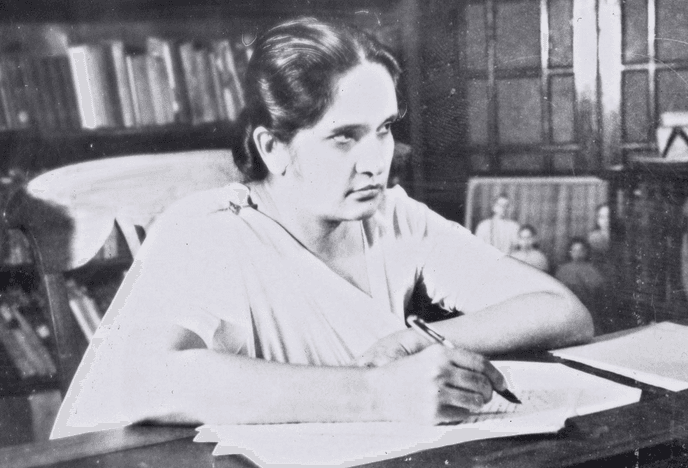
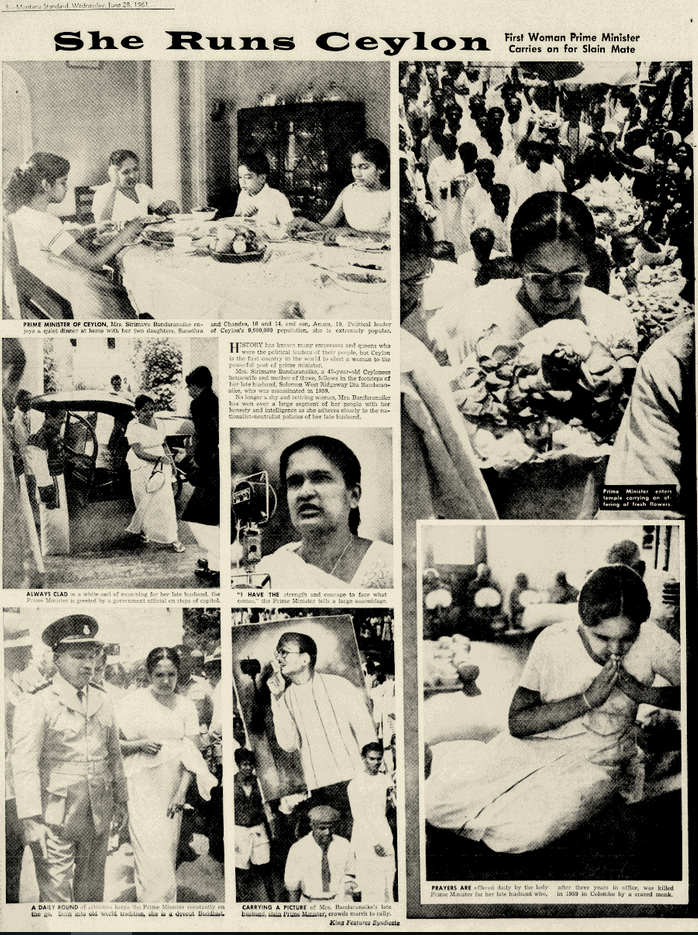
Colombo, early 1977. Under the ceiling fans of Temple Trees, between two files, Sirimavo Bandaranaike receives in a white sari edged with gold. The tea steams, the monsoon taps at the windows, and the first woman to have led a government agrees to look back on seventeen years of power won in mourning.
—How did you go from a widow's home to the Prime Minister's seat?
My husband, Solomon, fell under the bullets of a monk in 1959. At first I was seen as the weeping widow, the one they called the lady who cries. But the Sri Lanka Freedom Party was losing its center, and someone had to take the helm. In 1960, the people carried me to power, I who had never sat in Parliament. They thought me fragile, they thought me a convenient symbol. I replied, in my inaugural address, that I would serve this people with devotion and work for its unity. I was not my husband's shadow: I was the continuity of his struggle, become a full-fledged voice.
They called me the lady who cries; I chose to become the continuity of a struggle.
—Did you realize, that day, that the whole world had never seen this before?
They made me feel it before I understood it myself. Foreign dispatches repeated that no woman, anywhere, had led a government before me. That seemed as much a burden as an honor. For every mistake I would make would be attributed not to Sirimavo, but to all the women who would want to govern after me. In Colombo, in the provinces of Kandy, mothers pointed me out to their daughters. Universal suffrage had opened a door; it remained to prove that a woman could walk through it and hold her own. I never wanted this first place as a trophy. I wanted it to be useful.
Every mistake would be attributed not to Sirimavo, but to all the women coming after me.
—Why did you impose Sinhala as the sole official language?
Under the British, English was the language of masters and the privileged; the Sinhalese majority remained shut out of its own offices. As early as 1956, I supported my husband's policy to restore Sinhala its state dignity. We wanted the peasant to speak to his administration without an interpreter. But I will not lie to you: this decision hurt the Tamil minority, who felt relegated. The nationalism I thought reparative dug a rift between communities. One governs with intentions and reaps consequences. This one I saw grow, and I am not proud of it as a simple victory.
One governs with intentions and reaps consequences.
—What do you say to those who accuse you of having durably divided your island?
I do not shy away from this reproach. Restoring a language to a people humiliated by colonization seemed just to me; I did not weigh enough what those who spoke Tamil were losing. The Constitution of 1972, which turned Ceylon into the Democratic Socialist Republic of Sri Lanka, was meant to seal our complete sovereignty. For many Tamils, it sealed above all their marginalization. The history of a young nation is made of these fault lines one draws without always meaning to. If I am read in a hundred years, I hope they will judge the drive for emancipation as much as the clumsiness. But I know that the tensions I left did not die with me.
The history of a young nation is made of fault lines one draws without always meaning to.
—In a world split into two blocs, how did you hold your course?
I refused to trade a British master for a master in Washington or Moscow. Non-alignment was not a comfortable middle posture: it was the affirmation that a small country has the right to think for itself. In 1965, before the United Nations General Assembly, I reaffirmed our commitment to peace and the right of peoples to self-determination. I drew closer to India, to the Soviet Union, not out of allegiance but because those nations understood our language of independence. When you have neither fleet nor cannons, you have speech and dignity. I wanted Ceylon to speak as an equal with the giants.
I refused to trade a British master for a master in Washington or Moscow.
—What did non-alignment concretely bring to such a small country?
It gave us a voice without costing us our soul. By hosting and frequenting the Non-Aligned Movement, we became a rallying point for all nations emerging from empire and tired of having others choose for them. The world born of decolonization was seeking a third way; Colombo held its place. It allowed us to trade with some without breaking with others, to ask for help without signing allegiance. Of course, the two blocs suspected us in turn of leaning toward the adversary. But it was precisely this shared distrust that proved we remained free. A country that displeases no one is never truly independent.
A country that displeases no one is never truly independent.
—Why did you nationalize the great plantations inherited from colonization?
Tea and rubber made the island's wealth, but that wealth flowed back to British owners, over the heads of those who picked and tapped the trees. Between 1960 and 1965, my government took over these estates so that the country's resources would benefit everyone, not a privileged elite — I said so myself on the radio, which then carried my voice into the villages. Nationalizing was not confiscating out of ideology; it was finishing the work of 1948 independence, left incomplete as long as the economy remained colonial. One is not sovereign under one's flag if one remains a tenant on one's own land.
One is not sovereign under one's flag if one remains a tenant on one's own land.
—Of all your reforms, which do you think will leave the most lasting legacy?
Dams and nationalizations wear out; what lasts is what you put into a child's mind and body. We built free education and public healthcare, a democratic socialism that did not require the poor to deserve learning or healing. In South Asia, a welfare state was not a given; they told us we were too poor for such generosity. I believe on the contrary that a poor country cannot afford to waste a single one of its children. When I traveled through the provinces and saw little girls in uniform running to school, I knew that was where the future was being played out, more than in any of my speeches.
A poor country cannot afford to waste a single one of its children.
—Do you remember the moment when even your right to vote was taken away?
1980. My opponents, once in power, accused me of abuse and misconduct, and I was stripped of my civil rights for seven years. Imagine: she who had been three times head of government could no longer drop a ballot into the urn. It was a calculated humiliation, meant to erase a figure more than to punish a fault. I then knew the reverse of that power I had held so long — they took from me even the simplest gesture of a citizen. But I did not leave the stage begging. I waited. In politics, the patience of a woman thought finished is the most underestimated weapon there is.
The patience of a woman thought finished is the most underestimated weapon there is.
—How did you feel coming back to power so late in your life?
In 1994, when many thought me good only for memoirs and yellowed photographs, I returned as Prime Minister. The most moving thing was not my return, but seeing my daughter Chandrika become President: a mother and her child holding the head of state together. The wheel had turned since that widowhood of 1959 when they thought me lost. I do not come back out of thirst for a throne — at my age, one no longer chases after seats — but because serving had become my way of existing. A political life, you see, is measured not by its peaks, but by what it endures between them.
A political life is measured not by its peaks, but by what it endures between them.
This imaginary interview was generated by artificial intelligence from sources documented in Sirimavo Bandaranaike's profile. It dramatises what the figure might have said based on what we know about them, but does not constitute attested historical testimony. For primary sources and factual documentation, refer to the full profile.