Imaginary dialogue between Platon and Socrates
by Charactorium · Socrates (469 av. J.-C. — 398 av. J.-C.) · Philosophy · 6 min read
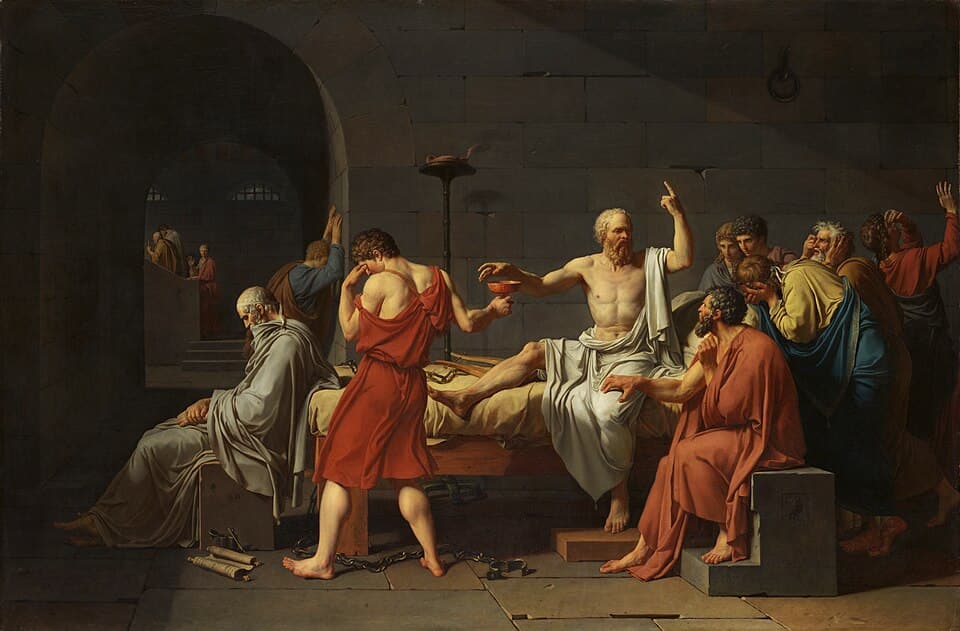
It is in the shade of a plane tree, near the Agora of Athens, that the young Plato meets his master Socrates one late afternoon in the year 402 BC. The dust of the streets still clings to the old philosopher's bare feet, and the hubbub of the merchants gradually fades. Plato has known Socrates for a few years already, having followed him from discussion to discussion, and he comes that day with the desire to understand the man as much as the method. He takes out his wax tablet, ready to record every word.
—Master, I have often heard you tell of the oracle of Delphi. What did your friend Chaerephon report that day?
You know the story, Plato, for you have made me repeat it more than once. Chaerephon, in his fervor, went to ask the Pythia if there was anyone wiser than me. She answered no. Imagine my trouble! I who am conscious of no knowledge, how could I be the wisest? So I went through the city, questioning those said to be wise — politicians, poets, artisans. And everywhere I found men who thought they knew without knowing. That is the meaning of the enigma: my only superiority is that I do not delude myself. Where others are ignorant and believe they know, I am ignorant and I know it. It is a very meager wisdom, but it is the only honest one.
Where others are ignorant and believe they know, I am ignorant and I know it.
—You say you know nothing, yet you search relentlessly. Is there not a contradiction there that troubles you?
No contradiction, my young friend, quite the contrary! Acknowledging one's ignorance is not giving up searching — it is the very condition of searching. He who believes he is already full seeks nothing more; he has closed the door. I, because I know I am empty, remain in quest. Wisdom is not a treasure one possesses once and for all; it is a path one never stops traveling. And besides, the god of Delphi teaches us through that inscription you know: one must first know oneself. As long as I have not answered that, how could I claim to know justice or virtue? My ignorance is my goad.
Acknowledging one's ignorance is not giving up searching — it is the very condition of searching.
—You who have so often questioned me until I was left without answer, tell me: what do you call this way of doing things?
I call it the art of maieutics, Plato — the art of delivering minds. My mother Phaenarete was a midwife; she helped bodies give birth. I do the same trade for souls. I teach nothing, you see: I have nothing to transmit. I ask questions, and from question to question, it is you who bring to light the truth you carried without knowing it. Remember, when I pressed you on the definition of courage: you thought you had it, then it slipped away, and you had to seek it deeper. That ordeal, that fruitful disturbance, that is my delivery. Knowledge that comes from outside is forgotten; what one has given birth to oneself remains.
I teach nothing: I ask questions, and it is you who bring to light the truth you carried.
—On the Agora, I have seen you feign ignorance before arrogant men. Why this detour, rather than refuting them outright?
Because you do not convince anyone by crushing them, my friend. If I arrive claiming to know everything, I become one of those sophists who sell their speeches and silence others. My irony is not mockery: it is a door I open. By making myself small, by humbly asking to be instructed, I lead my interlocutor to unroll his thought until it contradicts itself. Then he discovers his weakness alone, without my having humiliated him — at least that is how I intended it. It is painful, I know: many leave furious with me. But it is on the agora, among merchants and passersby, that philosophy must live. Truth is not sought in the secrecy of paid schools, but in broad daylight, among citizens.
My irony is not mockery: it is a door I open.
—Little is said about the soldier you were. What really happened at Potidaea, where they say you stood motionless a whole night?
Ah, you stir up an old memory! That was thirty years ago now. Yes, a thought had seized me from morning, and I could not shake it off: I remained standing, searching for it, without moving. My companions, intrigued, even brought out their blankets to watch me sleep standing — but I was not sleeping. At sunrise, having said my prayer, I resumed my walk. They have made it a oddity; I see it as the simple obstinacy of the mind that does not let go of its prey. And know that in battle, I did not retreat: I held my rank as any hoplite should. The courage of the body and that of the soul, you see, may be but one and the same steadfastness.
The courage of the body and that of the soul may be but one and the same steadfastness.
—We have seen Athens bend under war, then under the Thirty. How did you get through those years when the city was tearing itself apart?
By trying to remain just, Plato, which was not simple. The long war against Sparta exhausted our forces and soured hearts. Then came the Thirty Tyrants, who wanted to involve me in their crimes: they ordered me to go arrest a man to have him killed. I refused and went home — I would have paid for that refusal with my life if their reign had lasted. When democracy was restored, I did not bow to the crowd any more than to the tyrants. My duty is not to please the power of the day, whatever it may be, but to obey what my conscience holds to be just. In a sick city, the philosopher is often the one who disturbs all parties.
My duty is not to please the power of the day, but to obey what my conscience holds to be just.
—Whispers of impiety are already rising against you. You who speak of a divine sign, are you not afraid that this will be held against you?
I know these whispers, and I know where they come from. Many confuse me with the sophists, or remember the mockeries a comic poet hurled at me on stage. I am said to deny the city's gods. That is false: that daimon, that inner voice that has always turned me from evil, I consider it a gift from the divine, not impiety. But I disturb, it is true. When you question the powerful, when you show that those thought wise know nothing, you make enemies who do not forget. The city does not like being stung like a gadfly stings a too-heavy horse. Yet I will change nothing in my manner: one does not keep quiet for fear of displeasing.
The city does not like being stung like a gadfly stings a too-heavy horse.
—Master, if one day that court condemns you and your friends offer you a chance to flee Athens, would you accept to escape?
You ask a serious question, Plato, and I want to answer frankly. No, I would not flee. All my life I have lived under the laws of this city; I have accepted its benefits, education, protection. Would I have the right, the day they are unfavorable to me, to trample them like a runaway slave? That would deny everything I have taught on the agora. It is better to suffer injustice than to commit it: if I fled, I would give credence to those who say I corrupt the youth by despising the rules. A good man must not calculate his chances of living or dying, but only ask whether what he does is just or unjust. The rest belongs to the god.
It is better to suffer injustice than to commit it.
—And this death, by the cup of hemlock, does it not frighten you? How can you speak of it with such calm?
Why should I fear what I do not know? There again my ignorance serves me, you see. No one knows what death is; perhaps it is the greatest of goods, and men fear it as if they knew it were an evil. Or else the soul, freed from the body, goes to live otherwise — and then what joy to find the sages of old! Or else it is a dreamless sleep, and who complains of a peaceful night? In either case, I have nothing to dread. What holds me back is not dying, but living badly. The hemlock takes the body, it does not touch what makes a man just. You who record me, keep this: the philosopher practices his whole life not to tremble.
What holds me back is not dying, but living badly.
—You never write anything, master. Are you not afraid your thought will be lost, for lack of being fixed on papyrus?
That is precisely why I entrust nothing to writing, Plato. Living speech answers, defends itself, adjusts to the listener; writing, on the other hand, remains mute when questioned and always repeats the same thing. A thought fixed on papyrus no longer knows how to deliver minds — it gives the illusion of knowledge without the effort. My philosophy is not a doctrine to copy; it is an exercise, a dialogue that is worthwhile only as long as it is searching. If it is to survive, it will be in the souls I have stirred, in the questions I leave you, to you and the others. What will you do with all that you engrave on your tablet? That no longer depends on me, but on you.
Living speech answers and adjusts; writing remains mute when questioned.
Read further
This imaginary interview was generated by artificial intelligence from sources documented in Socrates's profile. It dramatises what the figure might have said based on what we know about them, but does not constitute attested historical testimony. For primary sources and factual documentation, refer to the full profile.