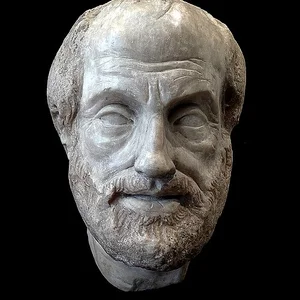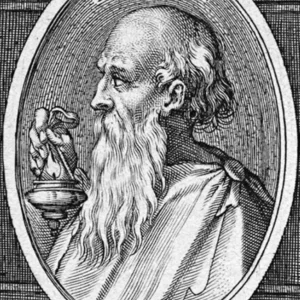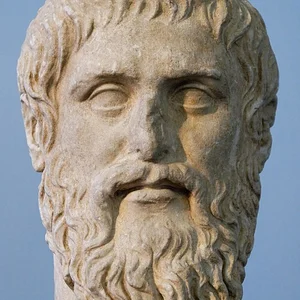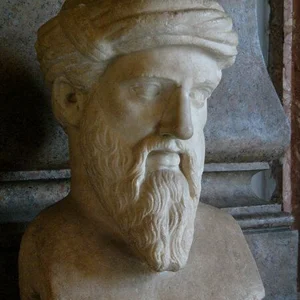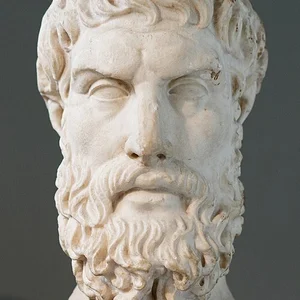

Greek philosopher (341–270 BC) and founder of Epicureanism, a philosophical school based in Athens. He championed a conception of happiness grounded in the absence of pain (aponia) and fear (ataraxia), achieved through the measured satisfaction of natural and necessary desires.
Epicurus(341 av. J.-C. — 269 av. J.-C.)
Epicurus
Athènes
7 min read
Frequently asked questions
Famous Quotes
« Pleasure is the beginning and the end of the blessed life.»
« When we say that pleasure is the goal, we do not mean the pleasures of the dissolute, but rather freedom from pain in the body and from trouble in the mind.»
« The wealth required by nature is limited and easily obtained; the wealth required by vain ideals extends to infinity.»
Key Facts
- 307 BC: founds his philosophical school in Athens, known as 'the Garden'
- Develops his philosophy of happiness based on ataraxia (freedom from mental disturbance) and aponia (freedom from physical pain)
- Distinguishes three categories of desires: natural and necessary, natural but unnecessary, and vain and unlimited
- His doctrine is often misinterpreted as encouraging debauchery, when in fact it advocates moderation
- 270 BC: dies in Athens; his school continues to influence ancient philosophy and endures for several centuries
Works & Achievements
Letter expounding Epicurean ethics: classification of desires, the fourfold remedy (tetrapharmakos), and the path to happiness. It is the most accessible of Epicurus's texts, often studied in philosophy classes.
Summary of Epicurean physics: atomist theory, the nature of the infinite universe, and a materialist explanation of phenomena. It serves as an abridgment of his major treatise On Nature.
Letter devoted to celestial and meteorological phenomena, aimed at freeing people from superstitious fear by offering rational natural explanations.
A collection of forty maxims summarizing the fundamental principles of Epicureanism. They served as a memory aid for disciples in the daily practice of philosophy.
A collection of 81 sayings discovered in a Vatican manuscript in the 19th century. They complement the Principal Doctrines and offer practical advice on friendship, pleasure, and wisdom.
Major work in 37 books laying out the entirety of Epicurean physics. Largely lost, fragments have been recovered from the carbonized papyri of Herculaneum.
Anecdotes
Epicurus founded his school, the Garden, around 306 BC in Athens, in a simple garden adjoining his house. Unlike other philosophical schools that taught in prestigious locations, this modest choice reflected his philosophy of simplicity. The Garden welcomed men and women alike, and even slaves, which was revolutionary for the time.
According to Diogenes Laërtius, Epicurus reportedly wrote around 300 scrolls over the course of his life, making him one of the most prolific authors of Antiquity. Unfortunately, the vast majority of his work has been lost, and only three letters and a few maxims transmitted by tradition survive.
On his deathbed, Epicurus is said to have written a final letter to his friend Idomeneus, in which he declared that despite excruciating pain caused by kidney stones, he remained happy thanks to the memory of their past philosophical conversations. This anecdote, reported by Diogenes Laërtius, illustrates the concrete application of his philosophy in the face of suffering.
Epicurus organized a modest monthly commemorative banquet with his disciples. Contrary to what the word 'epicurean' implies today, these meals were frugal: bread, water, and occasionally a little cheese. He even requested in his will that this tradition be perpetuated after his death.
Originally from Samos, Epicurus was the son of an Athenian settler. At 18, he traveled to Athens to complete his military service (ephebeia) and is said to have encountered the philosopher Xenocrates at the Academy. It was after being driven out of Samos by the Macedonians that he fully developed his philosophy and founded his school.
Primary Sources
When we say that pleasure is the end, we do not mean the pleasures of the dissolute nor those consisting in physical enjoyment, but rather the absence of pain in the body and of disturbance in the soul.
Nothing comes into being from what does not exist. For everything would come from everything, with no need of seeds whatsoever. And if what perishes were destroyed by passing into non-being, all things would have perished, lacking the existences into which they might have been resolved.
Death is nothing to us: for that which has been dissolved is without sensation, and that which lacks sensation is nothing to us.
Epicurus, son of Neocles and Chaerestrate, an Athenian of the deme of Gargettus. He began to study philosophy at the age of fourteen. He founded his school in a garden which he purchased for eighty minas.
When human life lay prostrate upon the earth, crushed beneath the weight of religion, a man of Greece was the first to dare raise his mortal eyes against it and the first to stand firm against it.
Key Places
Greek island in the Aegean Sea where Epicurus was born and raised. His father was an Athenian settler and schoolteacher there.
Garden located between the Academy and the Dipylon gate, where Epicurus founded his school around 306 BC. It is there that he taught for more than thirty years until his death.
City where Epicurus founded his first school around 311 BC, before being forced to leave due to the hostility of local Aristotelian philosophers.
City in Asia Minor where Epicurus taught before settling in Athens. There he recruited loyal disciples such as Metrodorus and Polyaenus.
City in Ionia where Epicurus's family took refuge after the expulsion of Athenian settlers from Samos. It is there that he began to deepen his philosophical thinking.
Typical Objects

Epicurus's main writing medium — he is said to have composed around 300 scrolls. His disciples copied and studied his texts within the Garden.

Common writing tool for daily notes and philosophical exercises. Students of the Garden used them to memorize the master's maxims.

Symbols of Epicurean frugality. Epicurus was content with a simple diet, claiming that a little cheese was enough to make a feast.

An everyday object that enabled philosophical discussions in the evening. Conversations in the Garden often continued after sunset.

Metrodorus of Lampsacus was Epicurus's closest disciple. Busts and portraits of Garden members adorned the school, underscoring the importance of friendship.

Epicurus had his maxims carved on the walls of the Garden so that everyone could meditate on them. This practice was imitated by Diogenes of Oenoanda centuries later.
School Curriculum
Vocabulary & Tags
Key Vocabulary
Tags
Daily Life
Morning
Epicurus rose at dawn and began his day with a meditative walk in his Garden. He had a frugal meal of barley bread and water, sometimes accompanied by a little cheese. He then devoted the morning to writing his treatises and corresponding with his distant disciples.
Afternoon
The afternoon was dedicated to teaching and philosophical discussions with his students under the trees of the Garden. Unlike the formal lectures of the Academy or the Lyceum, exchanges took place in a friendly and informal manner. Disciples memorized the master's maxims and practiced applying them in their daily lives.
Evening
In the evening, Epicurus shared a simple meal with his close disciples, an occasion for conversations on friendship and happiness. These modest dinners were a cherished moment of philosophical conviviality. Before retiring, he practiced self-examination, reviewing the day's events in light of his philosophy.
Food
Epicurus's diet was remarkably austere: barley bread, water, garden vegetables, olives, and figs made up the bulk of his meals. He would occasionally ask his friends to send him a little cheese to 'feast upon.' Wine was consumed in great moderation, diluted with water according to Greek custom.
Clothing
Epicurus wore a himation, the draped cloak characteristic of Greek philosophers, over a simple linen or wool chiton. His clothes were modest and unadorned, in keeping with his ideal of simplicity. He walked in leather sandals in his Garden and sometimes went barefoot in warm weather.
Housing
The Garden of Epicurus was a modest property located between the Dipylon and the Academy, on the outskirts of Athens. The house was simple, surrounded by a kitchen garden and fruit trees where teaching took place. The closest disciples lived on the property or in its immediate vicinity, forming a close-knit philosophical community.
Historical Timeline
Period Vocabulary
Visual Style
Un jardin méditerranéen baigné de lumière dorée, aux tons ocre et vert sauge, évoquant la simplicité et la sérénité de la vie philosophique hellénistique à travers un style inspiré des fresques pompéiennes.
Sound Ambience
L'ambiance sonore paisible du Jardin d'Épicure à Athènes : bruissement des oliviers, conversations philosophiques feutrées, chant des cigales et oiseaux méditerranéens, avec au loin les bruits étouffés de la cité.
Liens externes & ressources
Références
Œuvres
Lettre à Ménécée
fin du IVe siècle av. J.-C.
Lettre à Hérodote
fin du IVe siècle av. J.-C.
Lettre à Pythoclès
fin du IVe siècle av. J.-C.
Maximes capitales (Kyriai doxai)
fin du IVe siècle av. J.-C.
Sentences vaticanes
fin du IVe siècle av. J.-C.
De la nature (Peri physeôs)
fin du IVe siècle av. J.-C.