Imaginary interview with Socrates
by Charactorium · Socrates (469 av. J.-C. — 398 av. J.-C.) · Philosophy · 6 min read
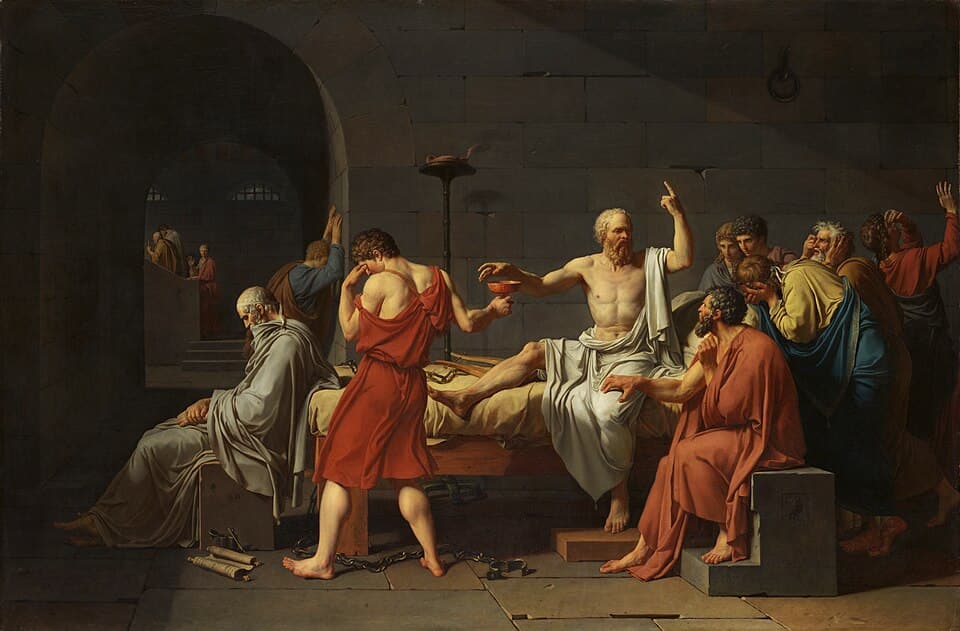
Athens, a morning in spring 399 BCE. The man receives us barefoot under the portico of the agora, where merchants and young men still linger. His trial has just begun; yet he speaks unhurriedly, as if he had all eternity before him.
—It is said that an oracle is at the origin of your entire quest. How did it begin?
It was my old friend Chaerephon who set everything in motion. He went to Delphi to question the Pythia, and she replied that no one was wiser than I. I first thought it was a joke of the gods, for I was conscious of no wisdom, great or small. So I set out to refute the oracle. I questioned the politicians, the poets, the artisans, all those who were considered wise. And everywhere I found the same thing: they thought they knew, and knew nothing. I, at least, did not claim to know what I did not know. That is my only superiority, if superiority there is. I know that I know nothing, and it is through this narrow crack that light enters.
I know that I know nothing, and it is through this narrow crack that light enters.
—Your days are spent here, on the agora, questioning passersby. Why this place rather than a school?
Because truth does not live in books or behind walls: it walks, it buys fish, it pleads its cases. I rise at dawn, a bit of bread, water mixed with a finger of wine, and here I am on the agora, dressed in my old himation, barefoot as always. There I stop a general, a cobbler, a son of a good family, and I ask them what courage is, what justice is. They answer confidently, then catch themselves in error. I teach them nothing — I have nothing to sell, unlike those sophists who peddle their knowledge. I merely hold up a mirror, and most often the man finds himself less handsome than he thought.
—You compare your art to that of a midwife. What do you mean by that?
My mother, Phaenarete, was a midwife, and I inherited her craft, but I deliver minds instead of bodies. This is what I call maieutics. I engender no thought: I am barren of wisdom. But I can recognize whether my interlocutor's soul carries a true child or a phantom, a fruitful idea or mere wind. My questions are the pains of childbirth; they hurt, I admit. Many resent me when I take away their illusion of having given birth to knowledge. But he who knows what a thing is uses it better than he who does not — it is for that birth that I work, for free, on this square.
I am barren of wisdom, but I can recognize whether the soul carries a true child or mere wind.
—Many accuse you of feigning ignorance to better trap your interlocutors. What do you reply?
They call this my irony, and it is not a lie but a courtesy to truth. When I approach a man convinced he knows everything, I cannot attack him head-on: he would recoil. So I make myself small, I beg him to instruct me, the poor ignorant one. And while he unfolds his knowledge, I ask one question, then another, and behold his fine certainties contradict themselves. I did not overthrow them: they stood only in his imagination. The sophists, on the other hand, teach one to be right against truth, to make the weaker argument triumph; I only seek to know what justice, goodness, courage are — and I have yet to find anyone, not even myself, who truly knows.
—Before the philosopher, there was the soldier. Do you remember the Potidaea campaign?
People take me for a old chatterbox of the agora, but I carried the spear and shield of a hoplite at Potidaea, over thirty years ago. The Thracian cold was terrible; the others bundled up, and I walked barefoot on the ice, as here on the paving stones. One morning, a question seized me — I no longer remember which — and I stood planted, motionless, searching for it. A whole day, then a whole night. My companions, intrigued, brought out their blankets to watch me sleep standing in my thought. At sunrise, I said my prayer and resumed my walk. Courage, you see, is not only facing the enemy: it is also not letting go of an idea until you have looked it in the eye.
Courage is not only facing the enemy: it is not letting go of an idea until you have looked it in the eye.
—You lived and thought while the city was collapsing. How to philosophize in the midst of such war?
I saw my youth under Pericles, when Athens believed itself eternal, then thirty years of war against Sparta, the plague, the fleet destroyed, and finally defeat. Many concluded that one must seize pleasure before the end, lie, betray, since everything was crumbling. I believe exactly the opposite. It is precisely when the city falters that one must ask: what is a just man? The stone of the walls falls, but the question stands. My fellow citizens resent me because I prevent them from sleeping in their misfortune. They would like a comforter; I am only a gadfly that stings the flank of a sluggish horse. A suffering city needs more examination, not less.
—The regime of the Thirty, then the return of democracy: you were seen refusing to obey the tyrants. Why this trial today?
When the Thirty took the city, they ordered me to arrest a man, Leon of Salamis, to have him executed and his property confiscated. I simply went home. I prefer to suffer injustice than to commit it. Democracy has since returned, and it is now the one that drags me before the judges. Do you find that contradictory? I do not. I never served a party, only the question. Those who judge me today dare not say the real reason: they are ashamed of their answers when I question them. One does not forgive a man for showing you that you do not know what you thought you knew. My impiety is to disturb the comfortable gods they have fabricated.
—You are accused of impiety and corrupting the youth. What would you say to your judges?
I heard Meletus recite his grievances, and I assure you his words almost made me forget who I am: to hear him, I would be a wonderful orator, whereas I am nothing of the sort. Corrupting the youth? I spent my life exhorting every young Athenian to care not for his money or reputation, but for his soul and truth. If that is corruption, show me a more honest teacher. As for impiety, it is a god who, through the voice of Delphi, set me to my task; to disobey him would be the true impiety. I will not flatter the court to save my skin. Better to die speaking truth than to live begging for pity.
—Your friends are preparing your escape. Why refuse to flee and accept the hemlock?
Crito came this morning, with a full purse, everything ready: a boat, a refuge in Thessaly. And I refuse. Consider: I have lived seventy years in the shadow of the laws of Athens, I have accepted from them my wife, my children, my education. Today, when they condemn me, even unjustly, should I break them like a runaway slave? That would give my accusers reason, who claim I despise the city's laws. One does not answer injustice with another. The cup of hemlock does not frighten me: dying is perhaps only that the soul, freed from the body, goes off at last alone. Why should a philosopher who has spent his life practicing to die tremble at the moment of success?
One does not answer injustice with another.
—You speak of death almost with serenity. Do you feel no fear?
To fear death is to think oneself wise when one is not, for no one knows whether it is not the greatest of goods, and yet one dreads it as the greatest of evils. One of two things: either it is a dreamless sleep, and what is sweeter than a night without dreams? or it is a journey of the soul to another place, and then I may meet the heroes of old and question them in turn — imagine the joy of finally questioning those I have known only through the poets! So I will say to those who condemned me that it is I who pity them, far more than I pity myself. They take away a few days; they reserve for themselves the remorse of injustice.
It is I who pity those who condemned me, far more than I pity myself.
Read further
This imaginary interview was generated by artificial intelligence from sources documented in Socrates's profile. It dramatises what the figure might have said based on what we know about them, but does not constitute attested historical testimony. For primary sources and factual documentation, refer to the full profile.