Kids interview Socrates
by Charactorium · Socrates (469 av. J.-C. — 398 av. J.-C.) · Philosophy · 5 min read
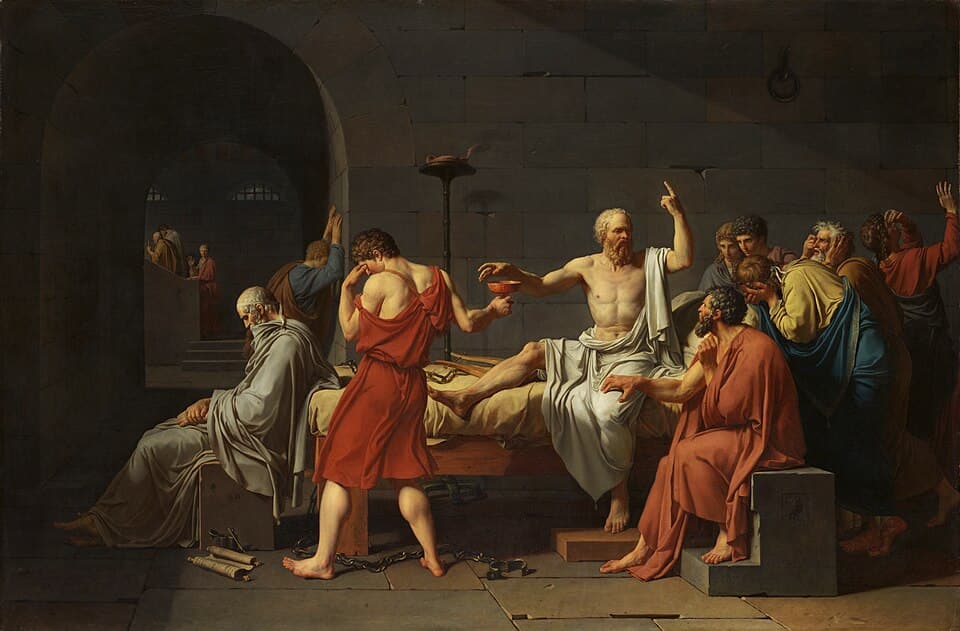
Two students from a discovery class arrive on the agora of Athens, under the sun. An old barefoot man awaits them, a smile on his lips. It is Socrates, and he has agreed to answer all their questions.
—We were told you always walk barefoot. Is that true?
You know, my child, it's true! I stroll around the agora, that great square where Athenians come to discuss and sell. Imagine a crowded square, smelling of warm bread and dust. And there I am, walking barefoot, in an old worn cloak. Why? Because I don't care about fancy sandals. What interests me are people. I stop, ask questions, listen. My body may be cold: it's my mind I want to keep awake. People often took me for a beggar, and that made me laugh.
My body may be cold: it's my mind I want to keep awake.
—Why did you always ask people questions in the street?
Ah, good question! Imagine a midwife: she helps mothers bring their baby into the world. I do the same, but with ideas. I call it maieutics — a somewhat learned word meaning 'to deliver minds.' I don't give you the ready-made answer. I ask you questions, over and over, until you find the truth yourself. That's much more solid, believe me, than a lesson recited without understanding. Sometimes my friends got annoyed. But in the end, their eyes shone: they had found it on their own.
I don't give you the answer: I help you bring it into the world.
—Is it true that you said you knew nothing at all?
Yes, and listen to why. One day, my friend Chaerephon went to consult the oracle at Delphi, a sacred place where people believed they heard the gods. The oracle replied that no one was wiser than Socrates. Me? Wise? I found that strange. So I looked for someone cleverer than me. I questioned those who thought they were knowledgeable. And I discovered they didn't really know what justice is, or courage. The difference? They thought they knew. I knew that I knew nothing. That was my only small advantage: I know my ignorance.
I am not wiser: I only know that I know nothing.
—And what was your favorite big question to ask people?
I was always looking for the same thing: what is a thing really? Not an example, no. The thing itself. Imagine I ask you: 'What is courage?' You answer 'It's a soldier who doesn't flee.' Good! But a courageous doctor, a courageous child — that's not the same. So I keep digging. My student Xenophon used to say that I thought a simple thing: whoever truly knows what a thing is knows much better how to use it. Seeking virtue, the excellence of the heart, was the work of my whole life.
As long as you don't know what a thing is, you don't truly know how to use it.
—You were a soldier? Were you afraid during battles?
Yes, I was a soldier, a hoplite as they called it — a foot soldier with a round shield and a spear. At the battle of Potidaea, around my thirty-seventh year, it was terribly cold. My comrades shivered, bundled up. And me? They say I stood still, motionless, for an entire day and night, lost in thought. Was I afraid? Of course, like everyone. But I had learned to stay master of myself. When your mind is calm, your body follows. It was the time of the great war between Athens and Sparta. Courage, you see, I didn't just seek it: I lived it.
When your mind is calm, your body follows.
—What was Athens like when you were old? Was everything going well?
No, my child, not really. My city had just lost a long war. After that, harsh men took power, called the Thirty Tyrants — they ruled by fear. Then democracy returned: a system where citizens vote and decide together. Imagine a tired, suspicious city, afraid of everything. And in that, me, the old nuisance who asks questions everywhere. Some found me dangerous. A poet, Aristophanes, even mocked me in his plays, before the whole city. Athens no longer quite knew what to think of me.
A city that is afraid always distrusts the one who asks questions.
—Why didn't people like the Sophists? And were you like them?
Ah, I was often confused with them, and it annoyed me! The Sophists were teachers who taught how to speak well, to win any debate. But careful: they charged a lot of money for that. And above all, they wanted to be right, not to find the truth. Me, it's the opposite. I never asked for a single coin. I taught for free, on the agora, to anyone who wanted to think with me. I wasn't trying to win: I was seeking the truth. Imagine two fishermen: one wants the biggest fish to show off, the other just wants to understand the sea. I was the second.
They wanted to be right; I wanted to find the truth.
—Why were you put on trial? What wrong did you do?
Nothing wrong, and yet I was accused of two things. First, of impiety — that is, disrespecting the city's gods. Then, of 'corrupting the youth,' as if my questions damaged young people. Imagine: I was blamed for teaching children to think too much! Before the court, I gave my defense, which is called the Apology. I didn't beg, I didn't cry. I said what I thought, simply. Deep down, my real fault was disturbing people. Powerful people don't like being shown that they don't know everything.
My only fault was disturbing those who thought they knew everything.
—Your friends wanted to help you escape. Why did you refuse?
It's true, my friends had everything planned. The prison was not well guarded, and with a little money, I could have fled far from Athens. But I said no. Listen to why, it's important. All my life, I had respected the laws of my city. If I ran away at the end, I would betray them all at once. What example would I have set? Imagine a captain who abandons his ship as soon as it gets rough. I preferred to stay faithful, even at the cost of my life. So I drank the hemlock, that poison, calmly, surrounded by my students. Dying standing up was better than fleeing bent over.
Dying faithful was better than living having betrayed.
—You never wrote a book? How do we know your ideas then?
You're right, I never wrote anything! Not a line. I thought writing was dead: a text cannot answer you when you question it. I wanted living dialogue, voices, glances. So how do you know me today? Thanks to my students. The most famous, Plato, wrote down our conversations long after my death. Another, Xenophon, wrote his memories of me. Imagine two friends telling the same grandfather: it's through them that I still speak to you. I lived by speech, and it's through the speech of others that I have come to you.
I wrote nothing, and yet here I am still talking to you.
—What was your house like in the morning? What did you eat?
Oh, it was very simple! I lived in a small house, without riches, and that suited me. In the morning, I woke at dawn, when the sky turns rosy. My meal? Barley bread, sometimes a bit of cheese, olives, water or wine mixed with water. Nothing luxurious. Imagine a bare room, without carpets, without precious objects. Why live like this? Because the fewer needs I had, the freer I was. A man who always wants more is a slave to his desires. Me, with my bread and my questions, I was the richest man on the agora.
The fewer needs I had, the freer I was.
Read further
This imaginary interview was generated by artificial intelligence from sources documented in Socrates's profile. It dramatises what the figure might have said based on what we know about them, but does not constitute attested historical testimony. For primary sources and factual documentation, refer to the full profile.